




 157 / 310

ENGINE
111
2.1.5.2 COMPONENTS
A. RADIATOR
The radiator used in ARIA is of cross flow type. The
radiator is a heat exchanger used to dissipate the
coolant heat. A radiator fan is used to create forced
air circulation.
Radiator consists of radiator core, inlet tank and an
outlet tank.
Cores are usually made of aluminum. The core has
two sets of passages, a set of tubes and a set of fins
attached to the tubes. The tubes run from inlet tank
to outlet tank. Coolant flows through the tubes and
air flows between the fins. The atmospheric air pass-
ing between the fins carries away the heat, which
lowers the temperature of the coolant.
B. THERMOSTAT
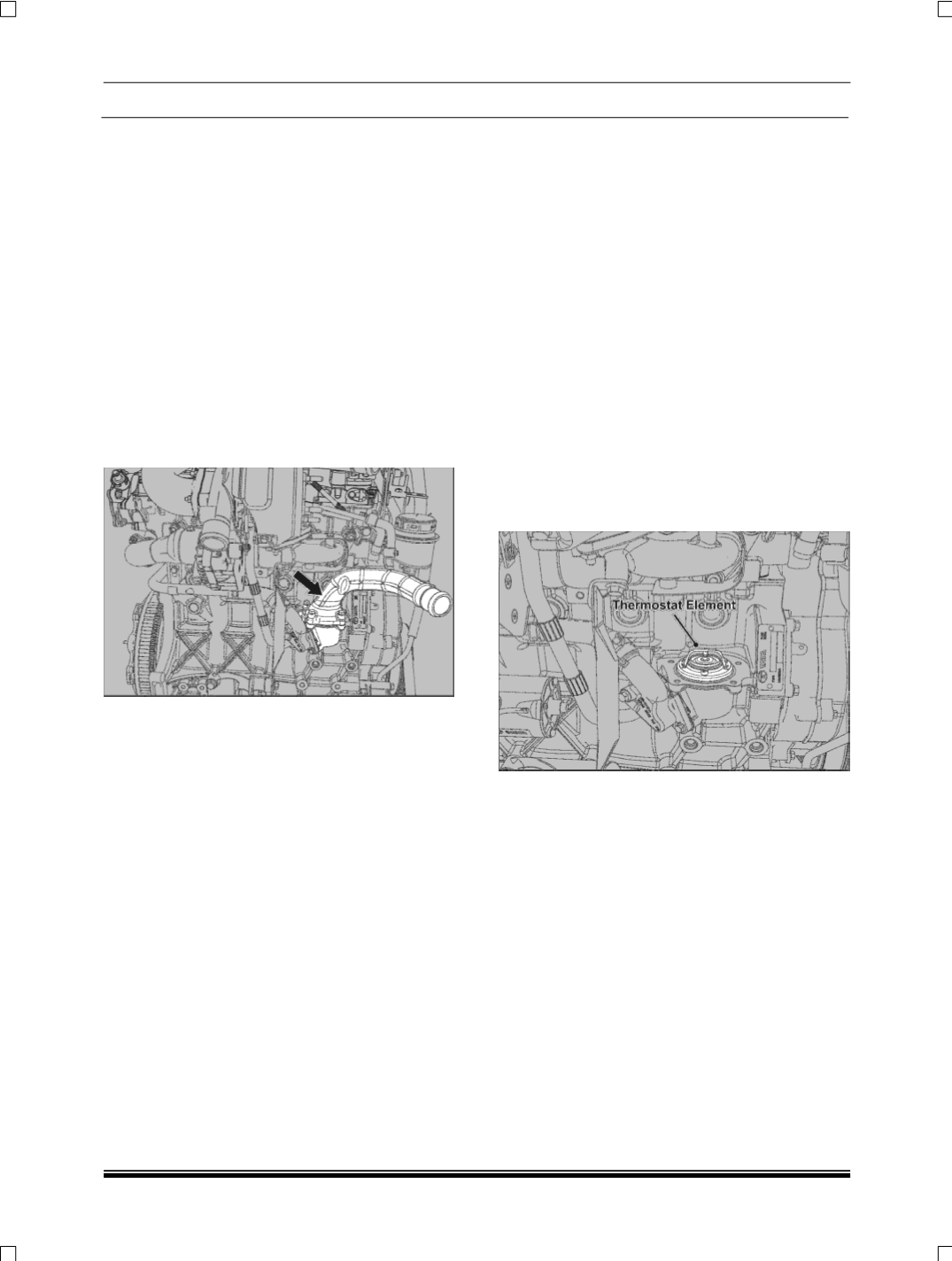
It is located in a housing provided for it in the Engine
block
The thermostat controls the flow of coolant as fol-
lows.
1. During a cold start, thermostat does not allow
coolant to flow to radiator since it is closed; in-
stead the coolant flows through thermostat
bypass outlet back to the engine .Thus short cir-
cuiting of radiator which helps in attaining engine
working temperature in a very short period.
2. As soon as the coolant temperature reaches the
opening temperature of the thermostat, the ther-
mostat valve starts opening gradually and coolant
starts flowing to the radiator. At the same time the
thermostat by-pass starts closing gradually.
3. As the engine working temperature reaches
thermostat full open temperature, the thermostat
valve opens fully and thermostat by-pass valve
closes completely. In this condition maximum
quantity of engine coolant flows from radiator to
water pump.
SPECIFICATIONS
•
Thermostat start open temperature is 87º±2ºC at
0.1mm travel.
•
Full open temperature is 98º±2º C at 8.0 mm
(Min.) travel.
•
Leakage through main valve (including jiggle
pin) at room temperature and 1 kg/cm
2
is
150cc/min.
•
Main flow rate of 165 LPM at 1.4 bar back pres-
sure.
Satisfactory operation of thermostat is very
much essential for:
•
Efficient engine operation
•
Longer engine life.
Checking procedure of thermostat:
1. Remove thermostat element from the housing.
2. Mount thermostat element in a suitable fixture
and place the fixture in a vessel filled with water.
3. Fix dial gauge with its spindle on valve surface
with a pretension of 0.5mm
4. Heat the vessel and measure the water tempera-
ture with proper thermometer.
5. Note down the temperature when dial gauge
needles starts moving indicating valve opening.
6. Note down the water temperature for needle
movement
(for valve fully open position).
7. The opening temperature and fully open temper-
ature as measured should be as per the
mentioned specifications.