




 191 / 310

ENGINE
145
2.1.8.1.4 MAINTENANCE
2.1.8.1.4.1 PRECAUTIONS
!! WARNING
To avoid the danger of being burned, do not touch
exhaust system when the system is hot. Any service
on the exhaust system should be performed when
the system is cool.
At every interval of periodic maintenance service and
when vehicle is raised for other service, check ex-
haust system as follows:
•
Check rubber mountings for damage, deteriora-
tion or out of position.
•
Keep sufficient clearance between exhaust sys-
tem component and underbody.
•
Check exhaust system for leakage, loose connec-
tion, dent & damage. If bolts or nuts are
loosened, tighten them to the specified torque.
•
Check nearby body areas for damage, missing or
mispositioned part, open seam, hole, loose con-
nection or any other defect which could permit
exhaust fumes to seep into vehicle.
PRECAUTIONS FOR CATALYTIC CONVERTER
In the event of following symptoms, drive the ve-
hicle at slow speed without rapid acceleration.
•
Engine misfires or runs irregularly, following a
cold start.
•
A significant loss of power is noticed.
•
In case MIL lamp remains ON even after engine
has been started.
•
If the vehicle continuously runs with misfiring, it
may cause overheating of shell, carpet etc. result-
ing into fire.
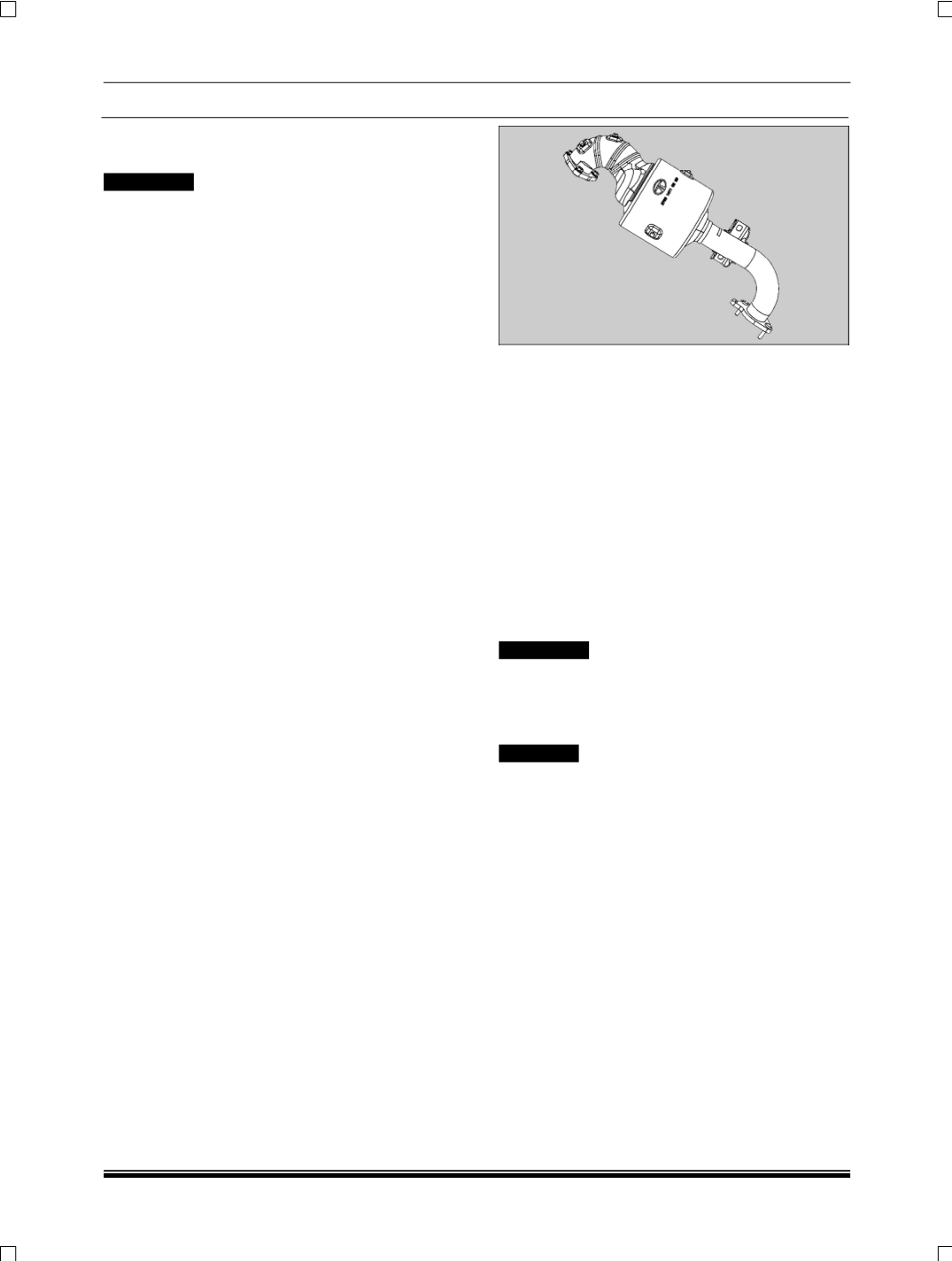
MAINTENANCE OF CLOSED COUPLED CATA-
LYTIC CONVERTER
Closed Coupled Catalytic Converter should be
flushed by giving full throttle
(4 to 5 times)
in stand-
ing condition of vehicle on daily basis. In addition to
this it is recommended to run the vehicle at high
speeds
(80 to 100 kmph)
for few km as this will help
to flush the carbon soot deposits from exhaust sys-
tem and closed coupled catalytic converter. High
speed running of the vehicle may be done periodical-
ly to avoid chocking of Closed Coupled Catalytic
Converter.
Alternative method for flushing operation for cleaning
the catalytic converter is by directing dry compressed
air draft (3 to 4 bar) in the direction of catalytic con-
verter inlet, after removing it from the vehicle.
AVOID
•
Push start or tow-starting the vehicle.
(Use jump
leads).
•
Long
(not more than 10 seconds)
repeat
(not
more than 3 times)
starting of the vehicle. Investi-
gate the cause for difficulty in starting and rectify
the same.
•
Long idling
(to warm-up)
if the engine is running
rough, after a cold start.
•
Switching “OFF” the ignition when driving down
the hill.
•
Fuel almost empty.
•
Pre-Coating / Painting of Close Coupled Catalytic
Converter.
!! WARNING
PARKING WARNING
Avoid parking of vehicle over inflammable materials,
such as dry leaves; grass etc. as exhaust system is
hot enough to initiate fire
.
! CAUTION
•
Ensure exhaust system and diesel particulate
filter is not blocked and is free from obstruction.
•
Blockages in the exhaust can create back pres-
sure, poor pick up, black smoke, carbon build up,
high fuel consumption etc.
•
Check if there is Excessive carbon build-up /
sticky valve.
•
Check and ensure EGR Valve & control system is
clean and functioning properly.
•
Excessive carbon build-up / sticky valve.
•
Damaged vacuum lines.
•
The Catalytic converter should not be dropped
from a height. If dropped, it should not be used.
All these can keep the ‘EGR’ open when not desired
and vice versa. Either way these can seriously affect
power output of the engine and also the emission
levels.