



 493 / 1526

18
BRAKES
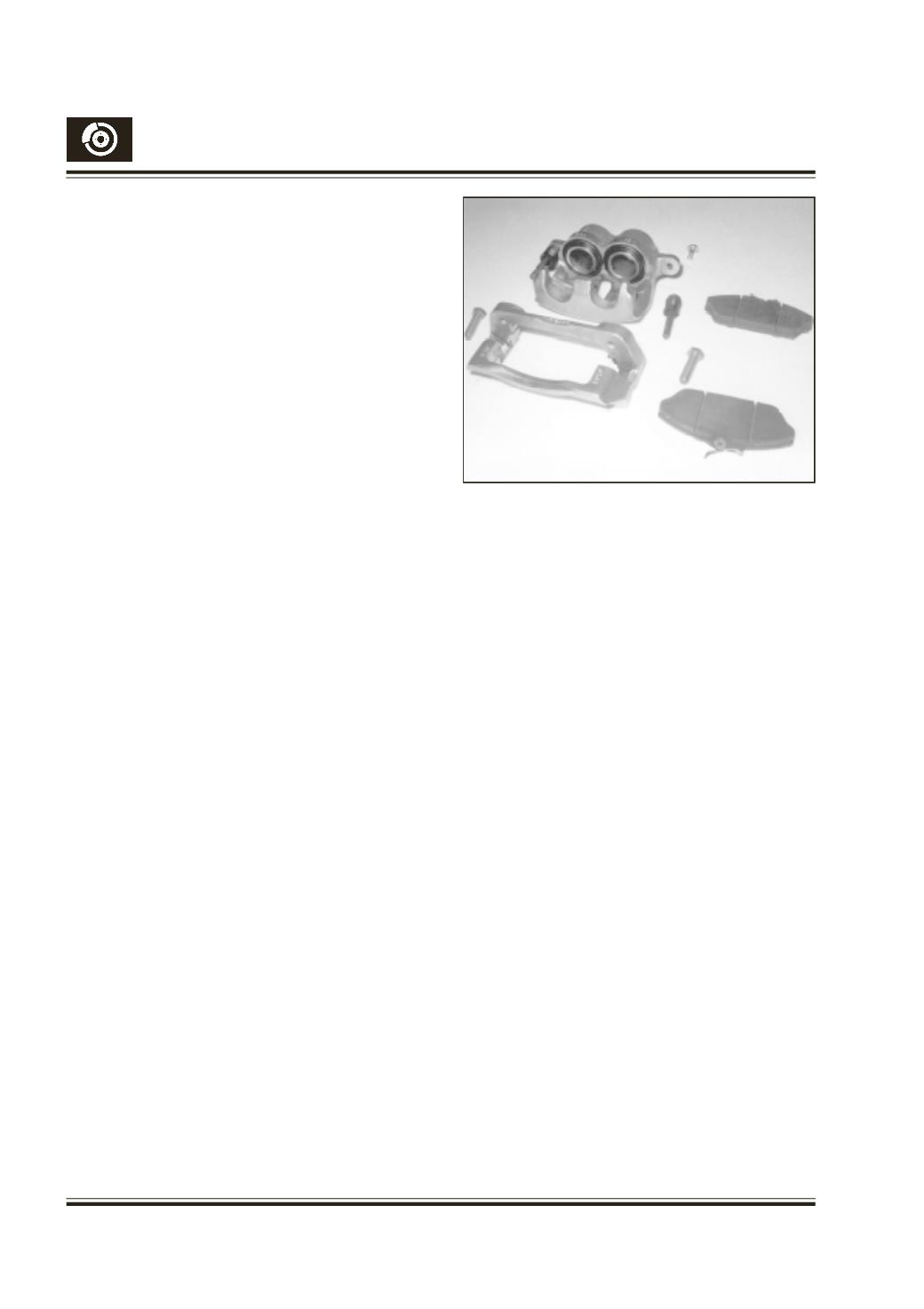
INSPECTION
Fig. 12
Clean all parts thoroughly with fresh brake fluid.Never
use mineral oil like kerosene, petrol, diesel etc. After
thoroughly cleaning, examine all parts for damages
and corrosion.
PISTON
Outer surface should be free from nicks, score or rust
and should be smooth to touch. Caliper housing bore
should be free from score, pitting, corrosion and should
be smooth to touch.The seal groove in the bore should
be thoroughly cleaned and no nicks should be there
at the edges. If the above conditions are quite
satisfactory then replacement with appropriate kit will
give satisfactory performance. If not the caliper
assembly should be replaced. Do not use emery paper
on piston surface.
SLIDING PINS
Should be free from rust and bends and guide pin
dust covers should be soft and free from cracks or
puncture. If in doubt, replace them.
PISTON SEALING RING
Piston sealing ring is used to seal piston and cylinder
and it is used to adjust the clearance between pad
and disc. Replace the piston sealing ring with a new
one at every overhaul. Fit piston sealing ring into
groove in the cylinder taking care that it should not be
twisted.
CALIPER ASSEMBLY
Smear fresh brake fluid on to the sealing ring and fit it
on to the groove in the cylinder bore. Smear fresh
brake fluid to the bore and on piston surface. Assemble
dust cover on to the piston by reversing the dust cover.
Now push the piston gradually into the bore until it
reaches the bottom. Fit the other end of the dust cover
on to the caliper body. Smear sliding pins with special
red rubber grease. Insert the loose guide pin into the
top hole of the bracket and fit the dust cover on to the
carrier. Now fit the caliper assembly to the carrier in
the reverse order of removal.
DISC INSPECTION
Before assembling the caliper back to the carrier, the
disc should be inspected.
The disc should be free from score marks. If scores
are found, this should be ground and refitted. But at
no time more than 0.25 mm (0.010") material should
be ground per side. If the total thickness of the disc
after grinding is found to be less than 19.00 mm, the
disc should be changed. After fitment, the face run
out of the disc should be less than 0.10 mm otherwise
pedal pulsation will be felt during brake applicable.
The disc thickness variation to be checked by
measuring the thickness of disc at 4 or more points
around the circumference of disc. All measurements
must be made at the same distance from edge of the
rotor. During the measurement confirm that the dial
gauge probe to be approx. 10 mm from the outer edge
of the brake rotor, perpendicular to the disc and under
slight pre load. Check front wheel bearing for looseness
before face run out measurement. The control of the
braking surface finish is necessary to avoid pulls and
erratic performance. It will also help in extending pad
life.
Fig. 12