




 1262 / 1526

ENGINE
94
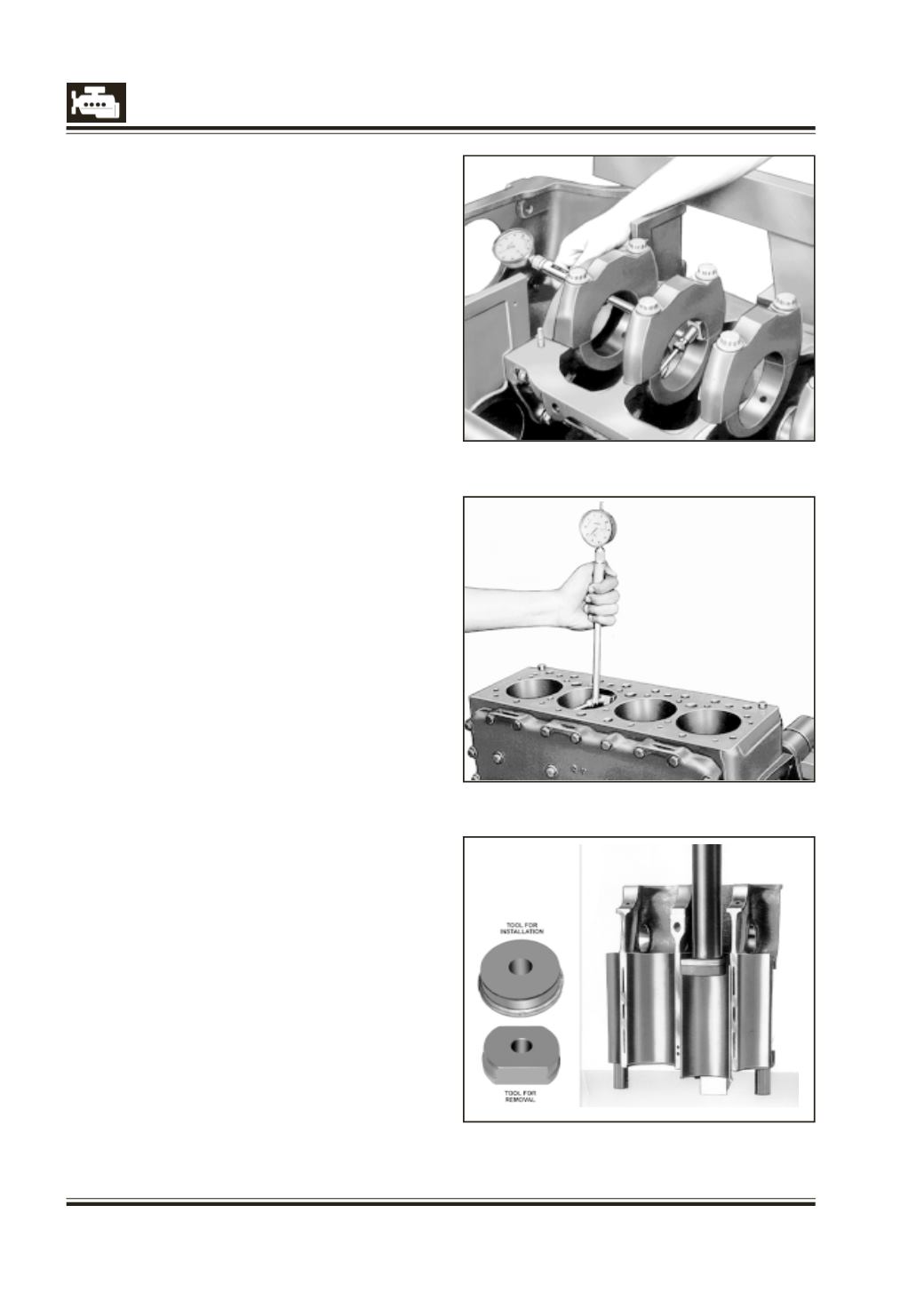
Fig. 4
Fig. 5
Fig. 6
Note:
Since a slight clearance exist between main
bearing cap dowel pins and the corresponding dowel
holes in the block, it is possible for the cap once
removed to be replaced off centre If measurements
'B' and 'C' are equal, the bearing cap is properly
centralised. If a difference in these two measurements
is noticed, the bearing cap can be centralised by
lightly tapping the cap with mallet in required
direction after loosening the bolts.
5 In case of very little wear only in main bearing
caps, it is possible to reclaim the crankcase by
facing the cap mating surface after removing the
dowels. The parent bore should then be re-
machined to original dimensions after refitting
new dowels on a suitable line boring machine or
with special reamers. This is an extremely
precision job and should be carried out only if
proper facilities are available. Otherwise, the
cylinder block should be replaced.
6 Unscrew main bearing cap bolts and remove
bearing caps.
iii. CYLINDER BORING AND HONING
1 Clean cylinder bores thoroughly.
2 Measure bores using internal measuring gauge fig. 5
and record readings on engine inspection sheet 1.
3 If taper and ovality of used cylinder bores is found
within 0.04 mm and 0.015 mm respectively,
cylinder bores can be finished by mere honing.
Replace liners if cylinder bore wear exceeds these
limits.
REMOVAL AND INSTALLATION OF LINERS
REMOVAL
1 Keep cylinder block upside down on hydraulic
press such that bore from which liner is to be
removed lies clear in machine table slot.
2 Ensure that the block is resting squarely on
machine bed.
3 Press out liners individually using drift, 2651 5890
02 01 and a suitable distance piece between press
ram and the drift. Fig 6. Make sure that the
distance piece is also seating squarely between
the drift and the ram.
INSTALLATION
1 Clean parent bores in the block thoroughly especially
for carbon in the counter bore for liner collar.
2 Place cylinder block on the hydraulic press
ensuring that it is resting squarely on the press
bed, and with head parting surface at the top.