




 125 / 745

KRYOTEC ENGINE
117
P. EXHAUST SYSTEM
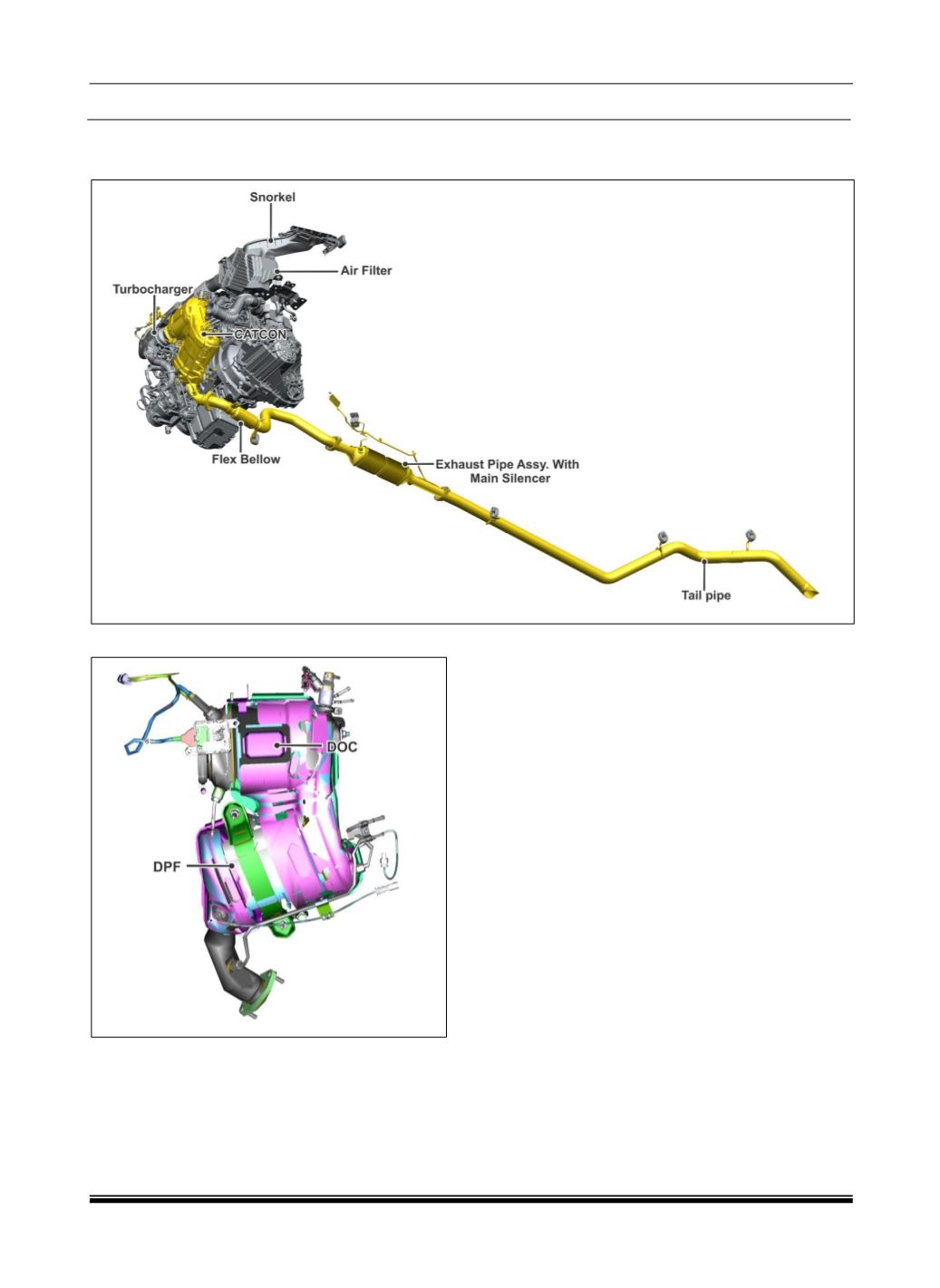
LAYOUT
COMPONENTS
Exhaust after treatment consists of mainly: Diesel
Oxidation Catalyst (DOC), Diesel Particulate Filter
(DPF), Selective Catalyst Reduction (SCR) and
various sensors and actuators.
The exhaust gas coming from the engine first
passes through the DOC.
It then flows through DPF. DPF is a filter which
filters carbon soot in the exhaust gas. DOC and
DPF contains precious metals which converts
hydrocarbons, carbon monoxide etc. in the exhaust
gas to harmless constituents. Additionally DPF also
removes most of the carbon soot particles in the
exhaust gas. The collected carbon soot in the DPF
is regenerated to clean the filter.
In order to reduce the NOx levels even further, SCR
system is used. In SCR system, Diesel Exhaust
Fluid (DEF) is injected in the exhaust stream. With
the help of injected ammonia in the Diesel Exhaust
Fluid (DEF), NOX is also converted into harmless
constituents.
DIESEL OXIDATION CATALYST (DOC)
The exhaust coming from the engine first passes
through the DOC. It is flow through filter that
contains precious metals to start the oxidation of
hydrocarbons, carbon monoxide and unburned fuel
and oil. It is mainly used for oxidizing nitrogen oxide
(NO) to nitrogen dioxide (NO2), substances that
together create NOx.
When exhaust gases passed over an oxidation
catalyst, carbon monoxide (CO), hydrocarbons
(HC), the organic fraction of diesel particulates
(OF), as well as non-regulated emissions such as
aldehydes or PAHs can be oxidized to harmless
products.
DIESEL PARTICULATE FILTER (DPF)