




 1333 / 1906

ELECTRICAL
31
3.8 Pulley and pulley Protective cap
Assembly:
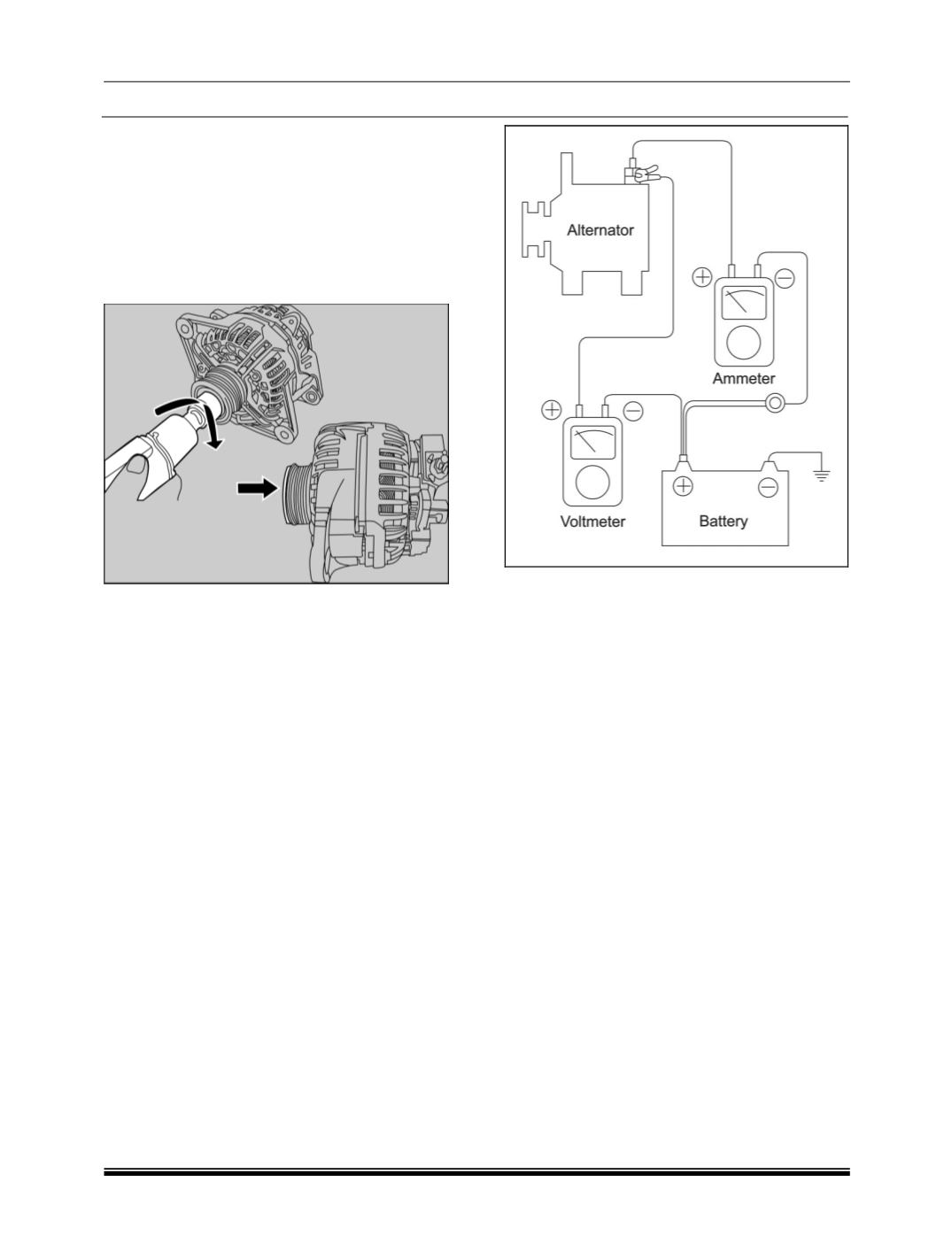
Insert the solid pulley in to the rotor shaft, use the
assembly tool as described in point 1.1. Hold the
alternator pulley by hand or with a pulley holder,
using the serration tool overrunning alternator
pulley can be screwed into the alternator shaft.
Protective cap can be assembled by hand
pressing on to the pulley.
NOTE
It is not permitted to operate the over running
alternator pulley without protective cap.
REFITTMENT:
1.Locate the alternator on its mounting bracket
and fit the three mounting bolts with specified
tightening torque.
2.Fit the Alternator belt.
3.Connect the electrical connection.
ALTERNATOR TESTING PROCEDURES
VOLTAGE DROP TEST OF ALTERNATOR
OUTPUT WIRE
This test determines whether or not the wiring
between the alternator "B" terminal and the
battery (+) terminal is good by the voltage drop
method.
1. Turn the ignition switch to "OFF".
2. Disconnect the output wire from the alternator
"B" terminal. Connect the (+) lead wire of
ammeter to the "B" terminal of alternator and
the (-) lead wire of am- meter to the output
wire. Connect the (+) lead wire of voltmeter to
the "B" terminal of alternator and the (-) lead
wire of voltmeter to the (+) terminal of battery.
TEST
1. Start the engine.
2. Turn on the headlamps and blower motor, and
set the engine speed until the ammeter indicates
20A. And then, read the voltmeter at this time.
RESULT
1. The voltmeter may indicate the standard value.
Standard value: 0.2V max.
2. If the value of the voltmeter is higher than
expected (above 0.2V max.), poor wiring is
suspected. In this case check the wiring from the
alternator "B" terminal to the battery (+) terminal.
Check for loose connections, color change due to
an over-heated harness, etc. Correct them before
testing again.
3. Upon completion of the test, set the engine
speed at idle. Turn off the headlamps, blower
motor and the ignition switch.
OUTPUT CURRENT TEST
This test determines whether or not the alternator
gives an output current that is equivalent to the
normal output.
PREPARATION
1. Prior to the test, check the following items and
correct as necessary. Check the battery
installed in the vehicle to ensure that it is good
condition. The battery checking method is