




 1335 / 1906

ELECTRICAL
33
vehicle is fully charged. The battery checking
method is described in the section "Battery".
• Check the alternator drive belt tension. The
belt tension check method is described in the
section "Inspect drive belt".
2. Turn ignition switch to "OFF".
3. Disconnect the battery ground cable.
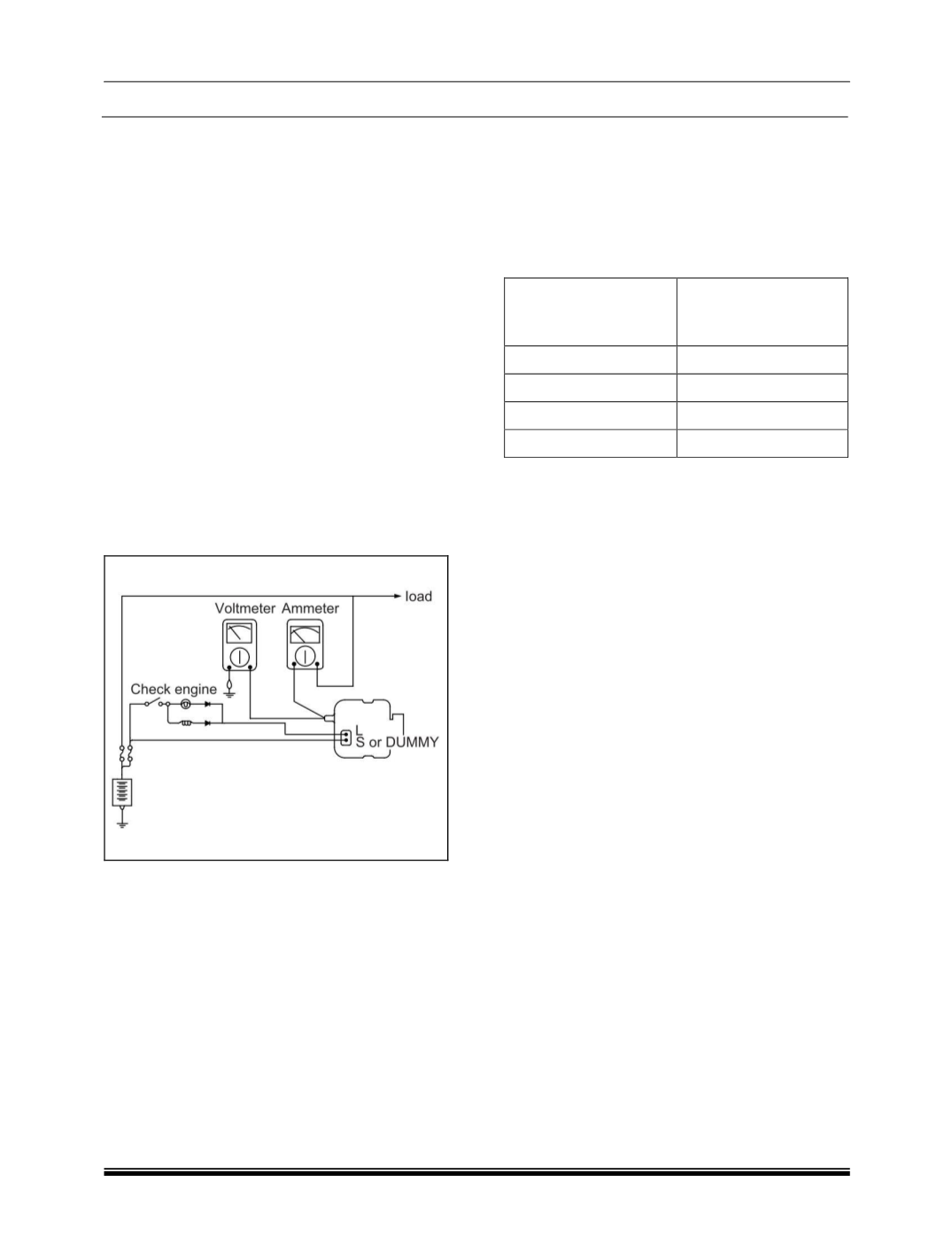
4. Connect a digital voltmeter between the "B"
terminal of the alternator and ground. Connect
the (+) lead of the voltmeter to the "B" terminal
of the alternator. Connect the (-) lead to good
ground or the battery (-) terminal.
5. Disconnect the alternator output wire from the
alternator "B" terminal.
6. Connect a DC ammeter (0 to 150A) in series
between the "B" terminal and the disconnected
output wire. Connect the (-) lead wire of the
ammeter to the dis- connected output wire.
7. Attach the engine tachometer and connect the
battery ground cable.
TEST
1. Turn on the ignition switch and check to see
that the voltmeter indicates the following value
Voltage: Battery voltage
If it reads 0V, there is an open circuit in the
wire between the alternator "B" terminal and
the battery and the battery (-) terminal.
2. Start the engine. Keep all lights and
accessories off.
3. Run the engine at a speed of about 2,500 rpm
and read the voltmeter when the alternator
output current drops to 10A or less.
RESULT
1. If the voltmeter reading agrees with the value
listed in the regulating voltage table below, the
voltage regulator is functioning correctly. If the
reading is other than the standard value, the
voltage regulator or the alternator is faulty.
REGULATING VOLTAGE TABLE
Voltage regulator
ambient temperature
°C (°F)
Regulating voltage
(V)
-20 (-4)
14.2 ~ 15.4
20 (68)
14.0 ~ 15.0
60 (140)
13.7 ~ 14.9
80 (176)
13.5 ~ 14.7
2. Upon completion of the test, reduce the engine
speed to idle, and turn off the ignition switch.
3. Disconnect the battery ground cable.
4. Remove the voltmeter and ammeter and the
engine tachometer.
5. Connect the alternator output wire to the
alternator "B" terminal.
6. Connect the battery ground cable.