




 1214 / 1906

Anti-lock Braking System(ABS)
24
4. TROUBLE SHOOTING AND DIAGNOSIS :
While the key is in IGN position, the ABS ECU
monitors the system for faults. Diagnostic
information and system function monitoring can
be accessed by connecting diagnostic tool to the
vehicle diagnostic connector.
After detecting a fault, the ABS ECU will select a
suitable default strategy which will retain, if
possible, some operational ABS capability. If ABS
is not active, conventional braking will remain
available.
A. ROAD TEST :
WARNING :
It is essential that brake pedal travel is not
obstructed by items such as extra floor mats.
(a) While driving the vehicle with ABS :
Observe the warning lights, check parking
brake/fluid warning light extinguishes after initial
bulb check and when the parking brake is
released, indicating that power assistance is
available.
(b) Normal ABS brake operation :
In road conditions where surface friction is
sufficient to slow or stop the vehicle without wheel
lock, ABS does not operate.
In an emergency braking situation, if one or more
wheels begin to slow rapidly in relation to vehicle
speed, ABS will detect wheel locking tendency
and will regulate brake pressure to maintain wheel
rotation.
(c) Brake application with partial failure :
WARNING :
If a fault develops in the brake system it is
essential that it is investigated immediately.
i. TMC failure :
If during braking, a drastically reduced resistance
is detected at the pedal and braking effectiveness
is very much reduced, failure of the non-powered
(master cylinder) portion of system is indicated. If
this occurs, do not pump the brake pedal. Push
the pedal through free movement to obtain
braking effort from the power circuit.
ii. Brake Booster failure :
When power assistance is not available, braking
effort is only available from the master cylinder In
this case the pedal travel will be or feel shorter as
there is no assistance and greater effort will be
required to stop the vehicle.
WARNING :
Foot pressure on the pedal, using master
cylinder only, will not achieve the same degree of
braking as is available from power assistance.
ii. Insufficient fluid in TMC
If there is insufficient fluid in master cylinder to
create pressure, braking to all four wheels is
retained and ABS remains operative. The red
warning light
(fluid level indicator lamp)
will be
illuminated if the level in fluid reservoir is low
(due
to leakage of fluid)
enough to actuate fluid level
switch.
WARNING :
Longer pedal travel is required, but power
assisted braking is available at reduced efficiency.
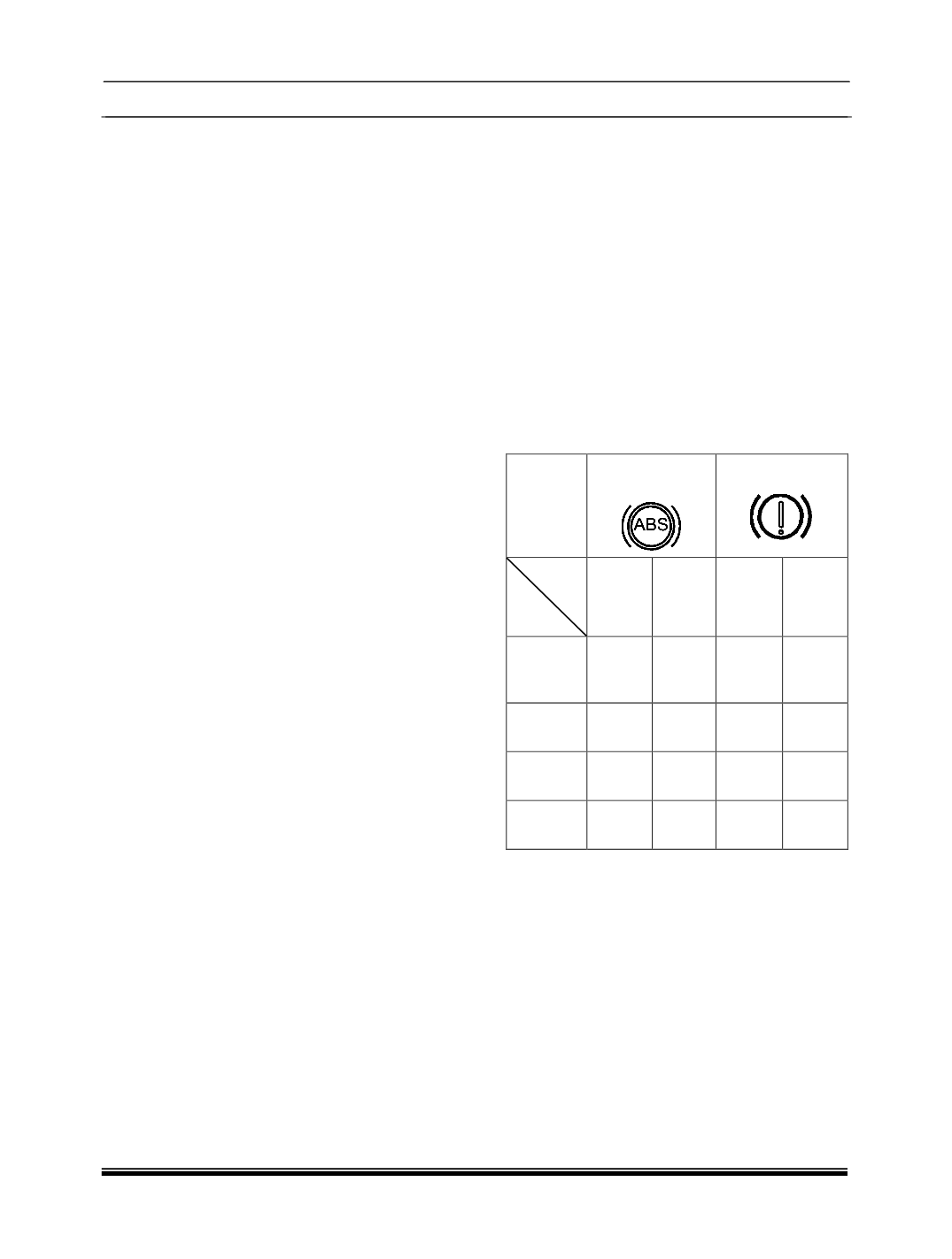
B. TABLE OF ABS 9.1 - FALL-BACK LEVEL
ABS
FALLBAC
K LEVEL
ABS Warning
Lamp
Brake Lamp
Status
System
System
active
Lamp
System
active
Lamp
System
active with
limitation
YES
OFF
NO
ON
System
active
YES
OFF
YES
OFF
Emergency
- EBD
NO
ON
YES
OFF
System
passive
NO
ON
NO
ON
NOTE :
For brake bleeding procedure conventional/ using
diagnostic tool refer Brakes group.