




 674 / 1575

BRAKES
20
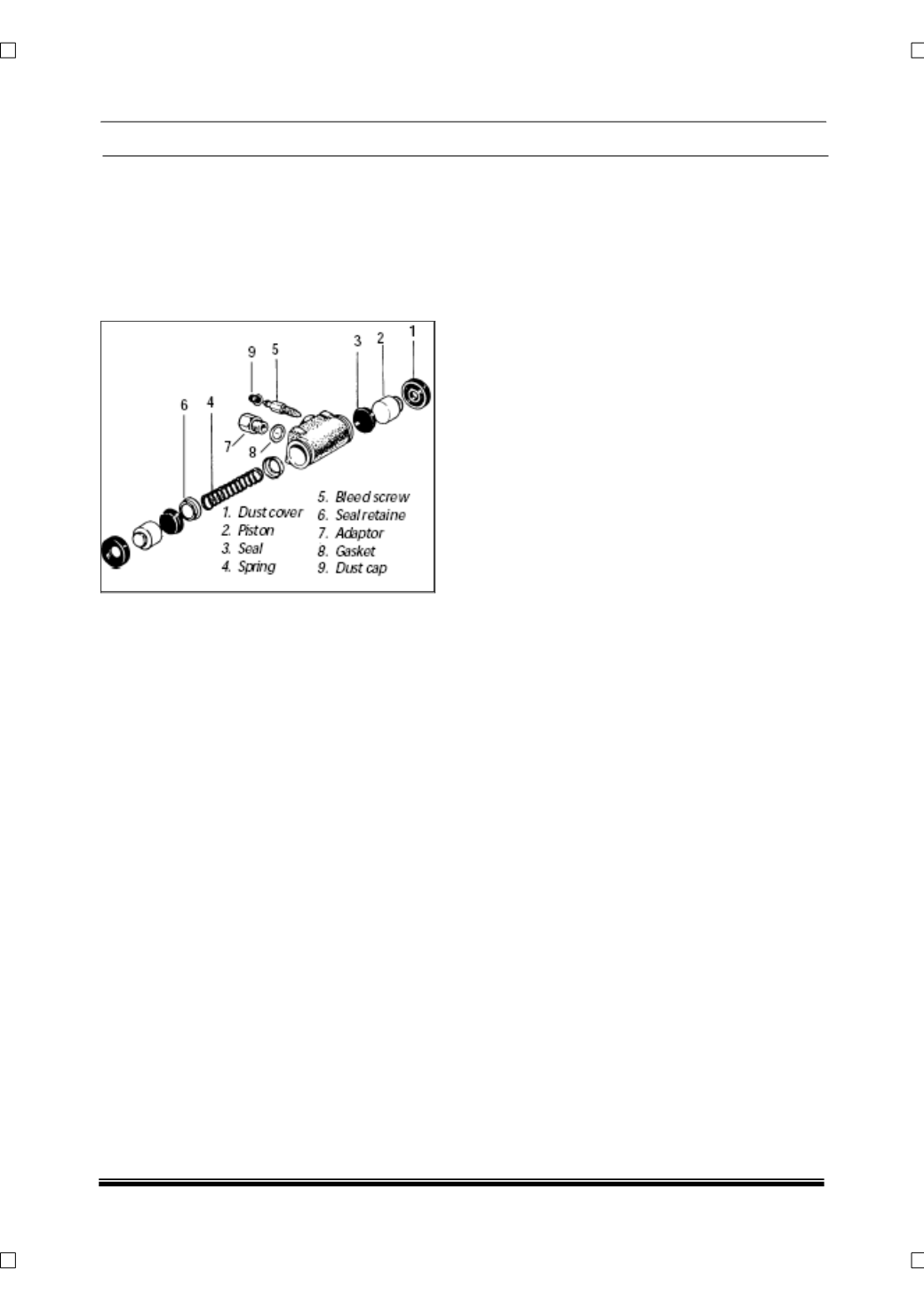
DISMANTLING OF WHEEL CYLINDER
Clean the wheel cylinder externally. Remove the
dustcovers fitted on the wheel cylinder assembly
and the bleed screw. Push out the pistons, and
springs. Remove the seals from the pistons and
clean all the parts thoroughly in fresh brake fluid
or alcohol and place them on a clean sheet of
paper.
NEVER CLEAN THE WHEEL CYLINDERS OR
INTERNAL PARTSWITH KEROSENE OR
PETROL,
AS
IT
WILL
LEAD
TOCONTAMINATION AND DAMAGING OF
RUBBER PARTS.
EXAMINATION OF WHEEL CYLINDER
Examine the cylinder bore and pistons. If they are
not scored, corroded or ridged and are smooth to
touch, new seals can be fitted. If there is any
doubt about the condition of the bore, a new
wheel cylinder assembly must be installed.
Inspect the wheel cylinder dust cover for cuts,
cracks, hardening or other sign of deterioration. If
damaged the dust cover needs replacement.
If the system has been contaminated with mineral
fluid of any type, the system should be flushed out
with fresh Brake Fluid or Alcohol and all rubber
parts including hoses should be replaced.
For example a contaminated seal may be
identified by comparing it with a new seal (but do
not let them touch).If the old one is appreciably
larger, seal contamination is indicated. Whenever
wheel cylinders are serviced, replacement of
seals and dust covers from an appropriate wheel
cylinder repair kit is strongly recommended.
ASSEMBLING OF WHEEL CYLINDER
When properly inspected, assemble as follows:
Lubricate the wheel cylinder bore liberally with
fresh brake fluid. Dip new gland seals and pistons
in fresh brake fluid.
Assemble gland seals on to the pistons in such a
way that it fits squarely on the piston stem (seal lip
should be towards the thin collar of the piston).
Assemble the spring on to the one of the piston
stems.
Assemble the piston assembly into the cylinder
bore with the spring leading into the bore carefully
easing the seal lip.
Insert the other piston with the seal from the other
end.
Fit the dust covers to the wheel cylinder mouth
and piston.
Fit the bleed screw and tighten to 0.55 - 0.8 mkg
torque.
Fit a rubber band around the pistons to retain the
min the bore.
ABSOLUTE CLEANLINESS HAS TO BE
MAINTAINED AND A CLEAN BRAKE FLUID
MUST BE USED. NEVER USE BRAKE FLUID
BLED FROM THE SYSTEM.
REFITTING OF WHEEL CYLINDER
Install the wheel cylinder assembly on to the back-
plate and secure with the bolts and washers.
Tighten the wheel cylinder mounting bolts and
washers. Tighten the wheel cylinder mounting
bolts to a torque of 0.54 to 0.68 mkg. Fit the
adaptor with a new gasket on to the feed port and
tighten to a torque of 2.5 to 2.8 mkg. Remove the
rubber band from the wheel cylinder. Refit the
brake shoes as described under “Fitting Shoes”.
Connect the bundy pipe to the adapter port.
Refit drum and wheel.
Bleed the system.