



 1453 / 1863

ELECTRICAL
151
8.10 IN VEHICLE NETWORKING (
IVN
)
NETWORKING
Networking means connecting different ECU’s in vehicle
Systems are connected with unshielded twisted pair (standard specialized wire)
That will share vehicle runtime data to realize features
One System controls its partner systems (
E.g. ESP Controls Transfer Case Controller
)
TYPICAL CAN (
Controller Area Network
) NETWORK:
This vehicle is equipped with a CAN (
Controller
Area Network
). It involves a software and
hardware solution which is designed to efficiently
manage the resources on the vehicle allowing:
The sharing of information between the various
ECU’s.
The integration of several ECU’s through one
network.
A high network information exchange speed
(
500 Kbps
).
Advantages in economic terms because there
is a considerable reduction in the
wiring/connectors inside the vehicle.
Higher standards in terms of quality and
reliability.
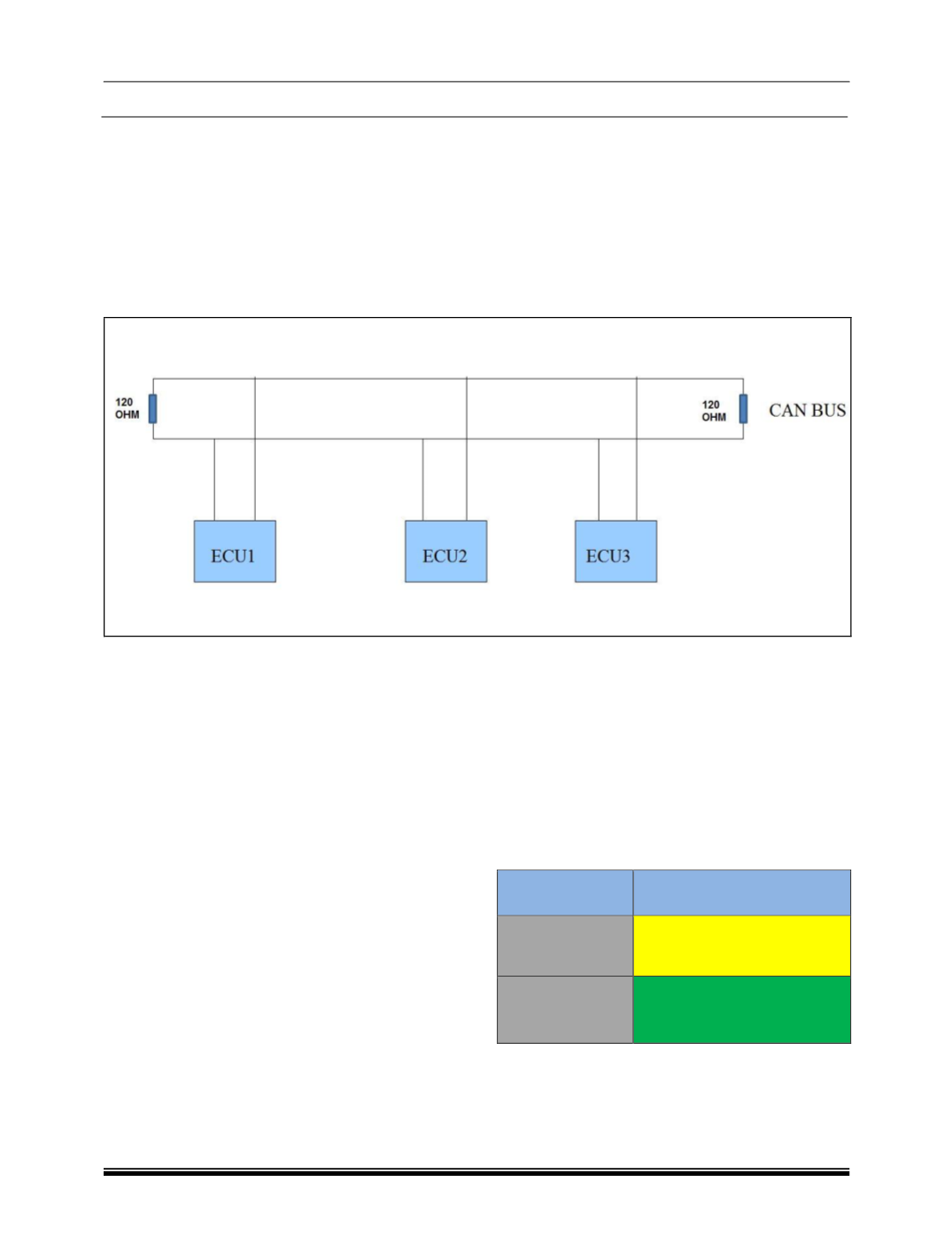
The CAN bus consists of two lines, CAN_L and
CAN_H (
CAN Low and CAN high, respectively)
, as
well as two terminating resistors (
110-130 ohm
).A
twisted-pair cable, highly resistant to noise, is used
for the communications line.
The advantage of using a CAN system is that
communication takes place between numerous
ECU’s and consequently the number of signals to
be managed is very high.
The different ECU’s which make up the system,
known as network nodes, are connected to the
CAN by means of communication interfaces known
as Transceivers. The exchange of information at
CAN type serial lines are only possible using a
CAN 2.0B transmission protocol.
Colors of CAN wires:
CAN LINE
Wire Colour
CAN H
Yellow
CAN L
Green