




 1326 / 1428

STEERING
20
1.3.3.5 DO’S & DON’TS
DON’TS
1. Never lift steering gear by holding bellows.
2. Never store steering gear resting on its bellows.
3. Never store / transport steering gear with bellows
fouling with other objects.
4. Never remove port plug before connecting with
mating parts.
5. Never use cotton waste which will cause contam-
ination.
6. Do not adjust ball joint nuts except during wheel
alignment
7. Never lift steering gear by holding IBJ’s.
8. Do not remove the protective cap from the input
shaft during transit or before assy.
9. Do not remove the protective cap from the OBJ
during transit or before assy.
NOTE
Bellow is a seal. Do not use sharp tools near bellows
if it can damage bellows.
! CAUTION
Damaged bellow or absence of clip can cause water
ingress and subsequent failure of Power steering.
DO’S
1. Lift steering gear by holding mountings / body /
cylinder only.
2. Store / transport steering gear resting on body /
cylinder only.
3. Use steering gears on ‘first in first out’ basis.
4. If any steering gear is dropped, inspect for dam-
age before using.
5. If any bellow is found damaged, replace it imme-
diately with a good part & with proper position of
clips
6. If any bellow clip is found missing, do not use the
defective steering gear. Instead use another new
steering gear
7. If the steering gear is off the vehicle, all ports
should be covered with protective plugs to avoid
contamination.
1.3.3.6 WHEEL ALIGNMENT
Wheel alignment is a procedure of aligning wheels
according to the specifications.
The purpose of these adjustments is to give maxi-
mum tire life and vehicle-travel that is straight and
true when driving along a straight and level road. A
correct wheel alignment is necessary because it af-
fects directional stability, tire tread wear and
vehicle’s safety.
Warning signs of improper wheel alignment include
steering wheel shimmy, a constant steering pull to
one side, tire squeal noises when making turns, ex-
cessive vibration as speed accelerates, and changes
in direction after a car has hit a bump on the road. If
any of the above symptoms are noticed, wheel
alignment becomes necessary.
Wheel alignment should be done at the time of fitting
new tires and thereafter at regular intervals. Wheels
which may be only a fraction out of alignment can
scrub or drag along the road instead of rolling along
it.
Normally overall wheel alignment refers to the pro-
cedures used to check and adjust the steering
system, including the camber, caster, and toe.
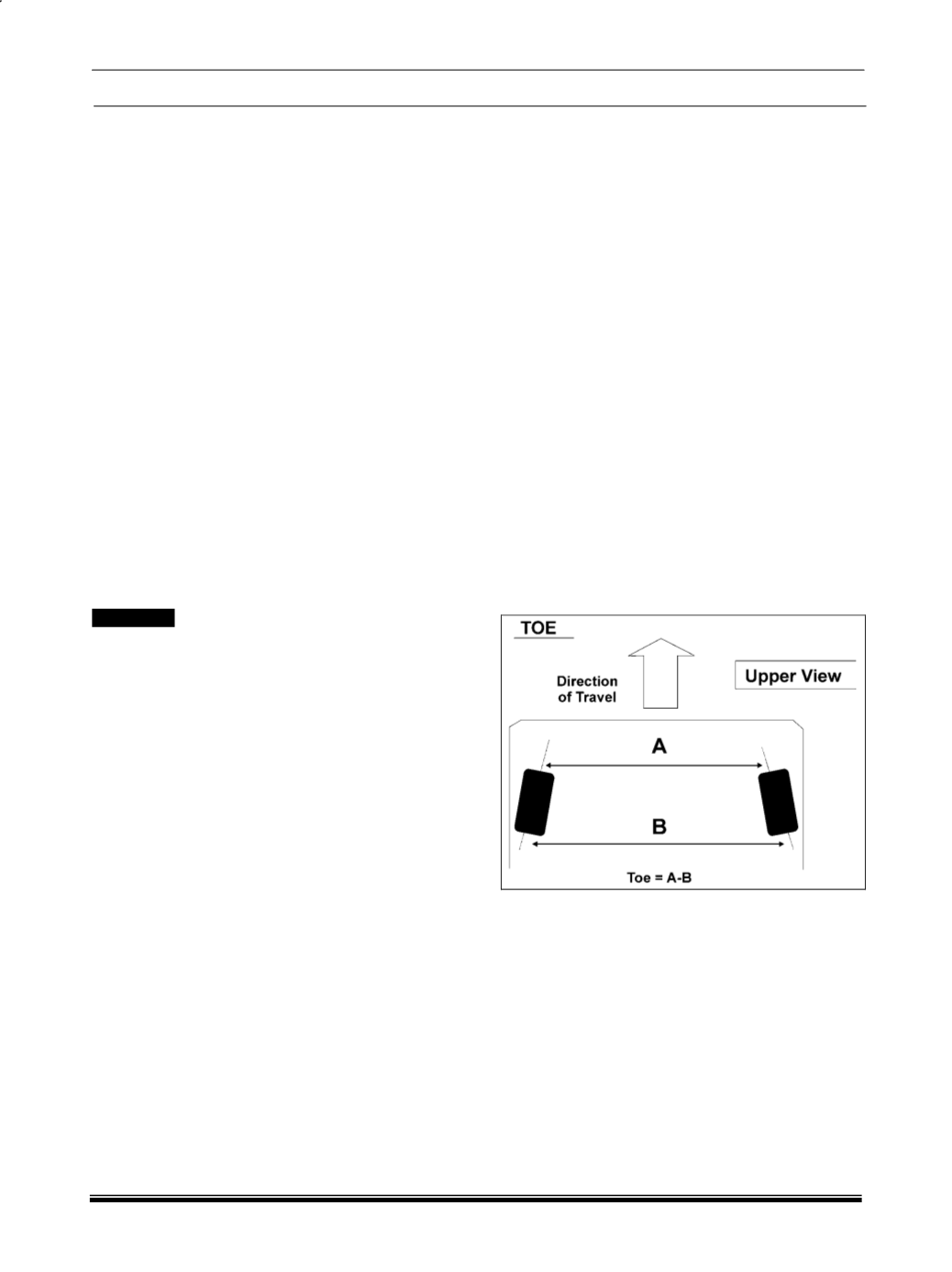
Basically toe is a measurement of how much the
front and/or rear wheels are turned in or out from a
straight ahead position. When the wheels are turned
in, toe is positive (+). When the wheels are turned
out, toe is negative (-).
The purpose of toe is to ensure that the wheels roll
parallel. Toe also serves to offset the small deflec-
tions of the wheel support system that occur when
the vehicle is rolling forward. In other words, with the
vehicle standing still and the wheels set with toe-in,
the wheels tend to roll parallel on the road when the
vehicle is moving.