




 652 / 745

ELECTRICAL
10
• When the ignition switch is in the “ON” position,
this gauge gives an approximate indication of the
amount of fuel in the fuel tank and it takes few
seconds to stabilize after the ignition is turned ON.
WARNING:
1) Running the fuel tank too low or empty can
cause engine to stall and could endanger User
and passengers. User must stop and obtain
additional fuel as soon as possible after low fuel
warning telltale
turns ON.
2) Do not continue adding fuel after the automatic
shut off function is operated if it is equipped on the
fuel pump. The sensor in the fuel tank may
misjudge the amount of fuel remaining.
3) Low fuel warning symbol
shall blink if there
is any fault in the system. Take car to the nearest
TATA MOTORS authorized service station if the
symbol starts blinking.
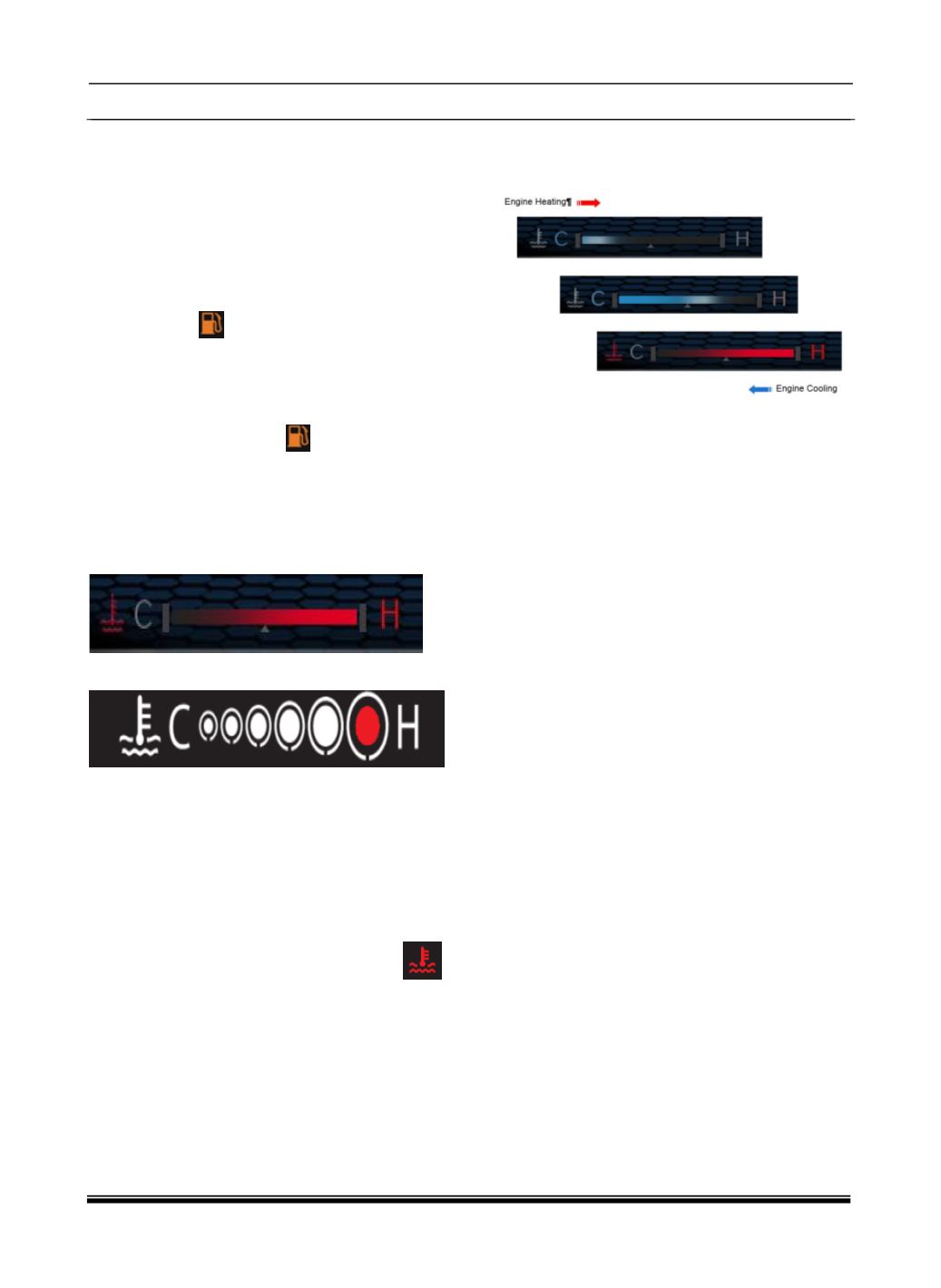
C. Temperature Gauge
Q5 7" Instrument Cluster
Q5 4" Instrument Cluster
When the ignition switch is in the “ON” position, this
gauge indicates the engine coolant temperature.
The indicator should be within normal, acceptable
temperature range i.e., between “H” and “C”. If the
indicator approaches “H”, overheating is indicated
by red LED bar in case of 4” and red progress bar in
case of 7”.
If the coolant temperature reading is very high, The
Engine coolant temperature telltale flashes
with an audible buzzer.
In this case, stop the vehicle, switch ‘OFF’ the
engine and cool it down for some time. Contact a
nearest TATA MOTORS Authorized Service Centre
immediately for rectification.
For Q5 7" Instrument Cluster
Temperature gauge graphics color changes
depends on the engine coolant temperature as per
below in the direction high temperature zone.
CAUTION
The RED bar and High Coolant temp warning
Telltale indicates overheating that may damage the
engine. Continuing to drive the vehicle when engine
overheating is indicated can result in severe engine
damage or fire.
NOTE
At every key in and Ignition ON, Temperature
Gauge Bars move to H and returns to C position for
Q5 4”. This is welcome strategy and self-check
feature.
WARNING
Never remove the radiator pressure cap from the
radiator when the engine is hot. Do not restart the
engine until the problem has been duly attended.