




 89 / 745

KRYOTEC ENGINE
81
G. MEASURING BEARING CLEARANCE
USING PLASTIGAGE
Engine crankshaft and connecting rod bearing
clearances can be determined by the use of
Plastigage or equivalent. The following is the
recommended procedure for the use of Plastigage:
1. Remove the oil film from surface to be checked.
Plastigage is soluble in oil.
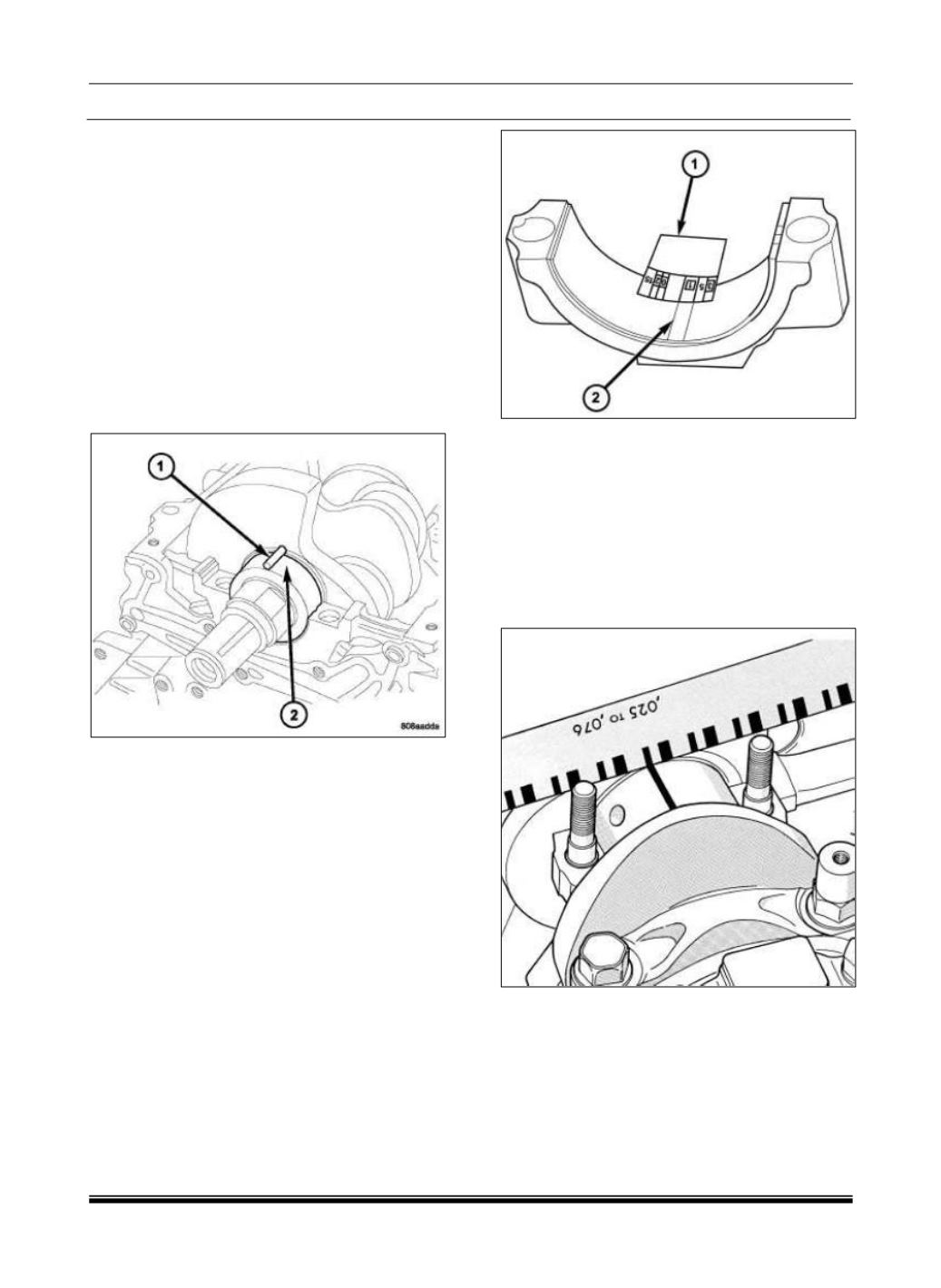
2. Place a piece of Plastigage (1) across the entire
width of the journal (In addition, suspected areas
can be checked by placing the Plastigage in the
suspected area). Plastigage must not crumble in
use. If brittle, obtain fresh stock.
NOTE
Typical crankshaft journal shown.
NOTE
DO NOT rotate the crankshaft. Plastigage will
smear, causing inaccurate results.
3. Torque the bearing cap bolts of the bearing
being checked to the proper (Torque
Specifications).
NOTE
Typical connecting rod cap shown.
4. Remove the bearing cap and compare the width
of the flattened Plastigage (2) with the scale
provided on the package (1). Locate the band
closest to the same width. This band shows the
amount of clearance. Differences in readings
between the ends indicate the amount of taper
present or the possibility of foreign material trapped
under the bearing insert.
5. Record all readings taken. Compare clearance
measurements to (Refer to 09 - Engine/
Specifications).
NOTE
Typical connecting rod journal shown.
Plastigage is available in a variety of clearance
ranges. Use the most appropriate range for the
specifications you are checking. Plastigage
generally is accompanied by two scales. One scale
is in inches, the other is a metric scale.
6. Install the proper bearings to achieve the
specified bearing clearances.
7. Repeat the Plastigage measurement to verify
the bearing selection prior to final assembly.