




 827 / 1906

TRANSMISSION
12
The transmission electrical connector is an
important part of the transmission operating
system. Any interference with the electrical
connection can cause the transmission to set
diagnostic trouble codes or affect proper
operation.
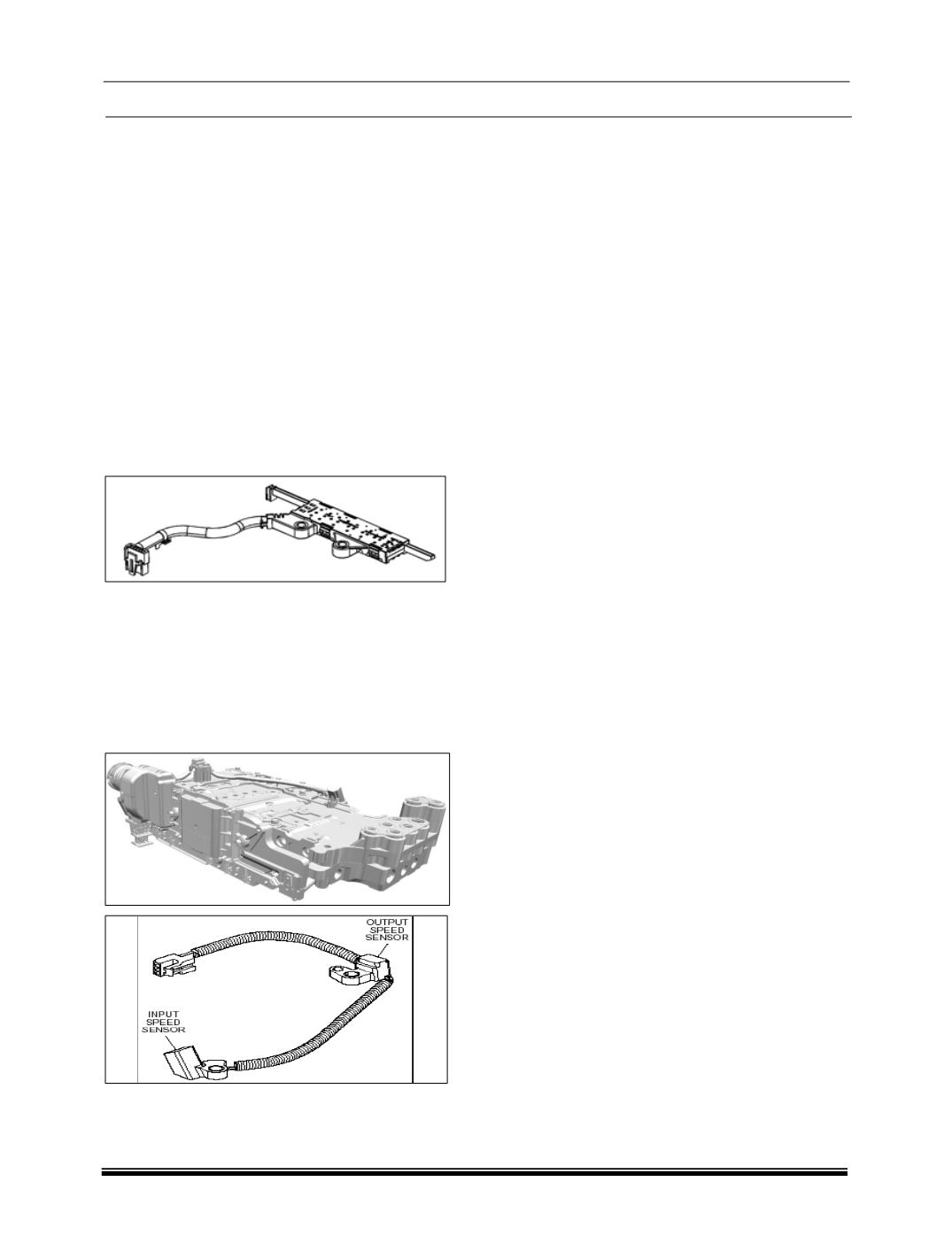
Internal Mode Switch (IMS):
The transmission manual shift shaft position,
given by the Internal Mode Switch (IMS), is a
sliding contact switch that connects to the manual
valve located inside the mechatronic. The four
inputs to the TCM from the position switch
assembly indicate which transmission gear range
(PRND) is selected.
Note:
This is for information only. Disassembly of this
component is not allowed.
Input & Output Speed Sensors:
The Input and Output Speed Sensor (ISS & OSS)
are hall-effect type sensors. They both connect to
the TEHCM through a wire harness and
connector. These signals are used to determine
line pressure, transmission shift patterns, torque
converter clutch (TCC) slip speed and gear ration
addition to the CAN bus data
Note:
This is for information only. Disassembly of this
component is not allowed.
Transmission Fluid Temperature (TFT) Sensor:
The Transmission Fluid Temperature (TFT)
sensor is located in TEHCM.
The TFT is a thermistor, which changes value
based on transmission oil temperature.
Shift Scheduling
The Controller Area Network (CAN) was created
in order to increase communication reliability,
rapidity, capacity and flexibility between the
electronic systems of the vehicle and to create a
database to avoid information transmission
failures.
Clutch-to-Clutch
transmission
technology
performs gear shifts by simultaneously applying
one clutch while releasing another. A precise
timing is required to ensure optimal shift quality.
Direct Pressure Control of Clutch to Clutch:
Two pressure commands are required to make a
shift, one to control the oncoming clutch, one to
control the off going clutch. A Variable Bleed
Solenoid (VBS) is used to directly generate each
pressure command which acts on a control valve
to regulate the pressure delivered to the clutch.
Shift valves can be used to multiplex the clutches
on which the regulator valves act and to give
failure mode protection.
Terminology:
Oncoming clutch:
The clutch being applied
during a shift. If two are to be applied, one is
selected as the Primary and one as the
Secondary.
Off going clutch:
The clutch being released
during the shift.
Common or Holding clutch:
This is the clutch
that remains applied during a shift.
Under lap:
When the Off going clutch is released
before the oncoming clutch has capacity. In power
on conditions this often known as Flare.
Overlap:
When the oncoming and Off going both
have capacity at the same time, also known as
Tie-Up.
Towing recommendation:
Vehicle recovery towing requirement, Vehicle to