




 1042 / 1863

FRONT AXLE (4X4)
44
ASSEMBLY
1. Clean CV joint components and boot area on
shafts using approved solvents.
NOTE
Do not use gasoline
2. Apply tape to shaft splines to protect boot
during installation.
3. Slide new boot from shaft having one Circlip
groove i(of DOJ Side) in reverse orientation.
Slide new small clamps i(two nos.) and
Rzeppa side boot in correct orientation.
NOTE
Lightly coat inner and outer race with approved
Lithium grease.
4. Pack CV joint only with specified grease. If
there is any remaining grease, place it inside
the boot.
5. Align CV joint splines with shaft splines. Gently
rock CV joint while pushing onto shaft, until
click is heard. Now Install the Circlip
6. Pull firmly on CV joint to make sure circlip is
seated.
NOTE
If necessary, tap CV joint shaft with brass or soft
face mallet.
7.
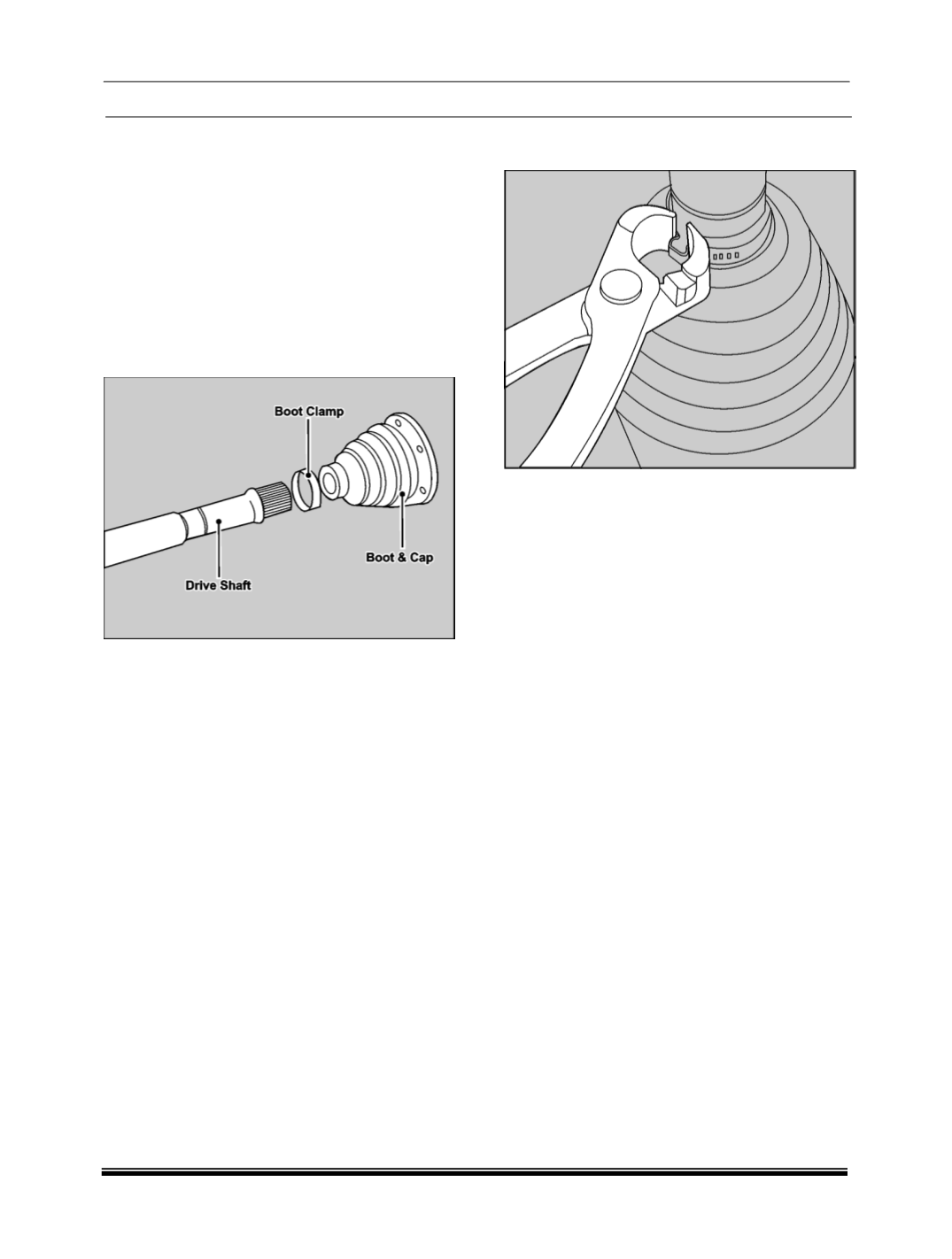
Position the boot and clamp over CV joint
(large end)
and secure with appropriate clamp.
Use Clamp climper
(Part No. 270458903332)
8. Align boot marks on shaft. Install and tighten
small clamp.
CV JOINT TESTING PROCEDURE
GENERAL GUIDELINES FOR TESTING DRIVE
SHAFT NOISE:
1. Ensure that the DRIVER is alone in the vehicle
while conducting the test.
2. All the windows of the vehicle should be fully
rolled up to reduce the disturbances caused by
external noises.
3. Drive on a smooth stretch of road and pay
particular attention to various noises
emanating from the front portion of the vehicle.
Observe the changes in noise levels through
speeds between 10 and 60 kmph.
4. It should be noted here that the driver may
encounter difficulty in distinguishing between
similar sounding noises resulting from either
the drive shaft or the under-body
(for example
noise from suspension, steering etc.).
5. Therefore, it is advised that the vehicle be
driven on uneven and bumpy surfaces as well,
to observe the noises which may then be
attributable to the under-body.
6. Focus should be on the side of the vehicle
which is being considered for the drive shaft
complaint.
7. Tests for CV
(wheel side/ Outer side)
and
Inboard
(FA/ Inner side)
joints are different and
need to be conducted separately.