



 967 / 1526

111
ENGINE2.2LDICOR
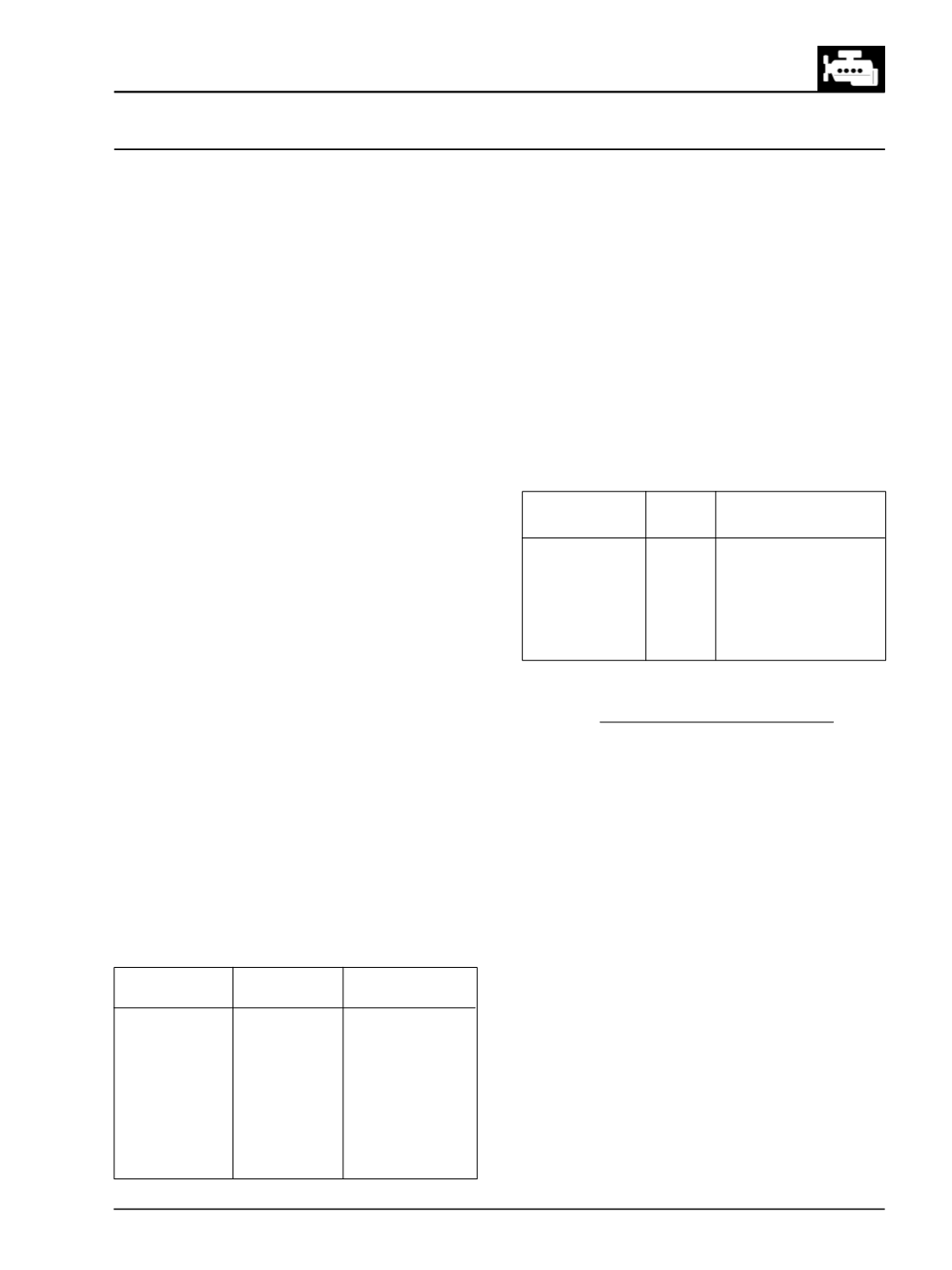
Engine Speed
Time
Torque
(rpm)
(minutes)
(mkg)
800
0.0
5
1500
7.1
5
2000
8.8
5
2500
10.6
5
2750
12.3
5
3000
14.1
5
3500
15.9
5
3750
17.7
5
4000
19.4
5
1500
28.5
28.6
2000
30.5
21.4
2500
30.5
17.1
3000
28.9
15.4
3500
25.6
13.6
4000
22.5
12.5
The Formula to be used is,
SpeedXLoadXC.F
Power =
716.2
Record corresponding load and check fuel
consumption
Record room temperature and atmospheric pressure.
Work out power torque and fuel consumption value
sand check whether they are as per specifications.
Check fly-up speed of the engine pulling accelerator
to position. The fly - up should be 4800 ± 50
Check engine idling speed. It should be 800 ± 50 rpm.
Check alternator for proper functioning.
If engine performance and other parameters are
satisfactory, then disconnect dynamometer and take
the engine for fitment on vehicle.
EngineTesting
After assembly of the engine, mount engine on test
bed, prepare engine for starting and testing in the
following manner :
l
Connect oil pressure gauge and temperature
gauge
l
Connect water hose to and from radiator. Fill
coolant (water and anti-corrosive agent) in the
cooling system. Fit radiator cap. Properly bleed
the system.
l
Fill required quantity of recommended oil in the
oil sump.
l
Mount air cleaner assembly on test bed suitably.
Connect air cleaner outlet to compressor using
suitable hoses and air mass flow sencer.
l
Make suitable linkage of controlling accelerator
lever.
l
Connect exhaust pipe to turbocharger outlet.
Connect battery cables to starter motor. Ensure
that -ve terminal is earthed. Connect all the EMS
sencers and actuator (except vehicle speed
sencer, clutch and brake switch) and the ECU (with
test bed software only).Ensure that no fault are
present.
Now, start the engine testing as per the procedure
mentioned below.
l
Crank engine with accelerator lever in idling
position .Allow oil to be circulated through the
system. Check and ensure that oil pressure
indicated by gauge is satisfactory.
l
Slightly raise the engine speed and check for any
oil ,fuel, water and air leakages. Rectify if any. Check
colour of the exhaust gas. Check for any unusual
noise from the engine.
l
Connect engine to dynamometer and run for
runnigin test as per schedule.
Engine running-in test schedule
After running-in test of the engine, reduce
dynamometer load to zero and allow engine to run at
idling speed for about 5 minutes and then stop it.
Engine Performance test
After running-in test, engine performance test is to
be conducted as follows
Pull the pedal sencer to lever fully pressed position
and lock it in the same position throughout the test.
Run the engine at full speed and allow coolant
temperature to reach 850C.
Gradually change the load of the dynamometer until
the engine runs at rpm given in the following
table.Engine rpm should be checked with an accurate
tachometer and should be corrected within 5 rpm.
Engine speed Load Fuel consumption
(rpm)
(m-kg)
(in seconds for