



 428 / 745

BRAKES
25
FITTING SHOES ASSEMBLING
Lightly smear the following parts with special
grease as given. Keep the grease away from the
shoe linings and all hydraulic parts.
1. Tips of new shoes - High melting point grease.
2. Hand brake strut slots - Graphite grease.
3. Adjuster Pushrod Threads - Mineral oil base
grease.
Note:
When new shoe is fitted, ensure to fit new
shoe return springs also. Always fit new shoes in
pairs to both the sides of the vehicle. (RLH and
RRH sides)
Do not polish lining with sand paper or emery
paper. If lining is polished with sand paper or
emery paper, hard particles of sand paper will be
deposited in the lining resulting in damage of
drum surface.
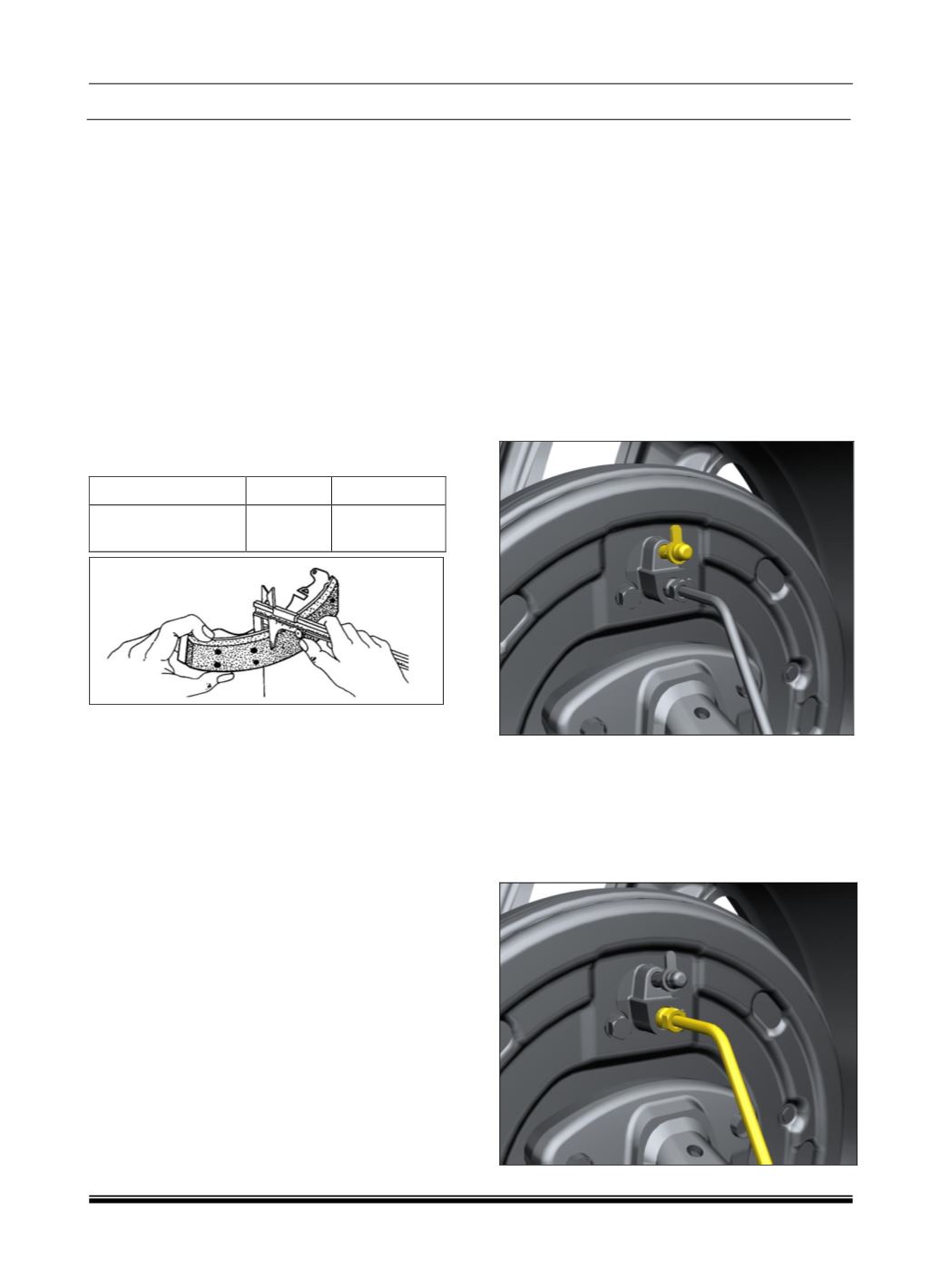
Brake Lining
Standard Service Limit
Lining Thickness
above the rim
5.5 mm
1.0 mm
Note:
The cable should just be tight without
pulling the hand brake lever from the 'fully off'
position.
Ensure that the shoe linings (
3 & 4
) are free from
oil and grease.
During servicing of shoes/replacement, the brake
dia. overshoes should be set to 253.2 to 253.6
mm by adjusting the ratchet.
This is to have minimum clearance between
shoes and drum.
Clean the wheel mounting face on the drum with a
wire brush and wipe the inside with a clean rag.
Note:
If the drum looks poor in condition, or is
scored inside where the brake shoes contact, fit a
new drum.
Offer the drum to the brake and adjust the length
of the adjuster until it is only just possible to fit the
drum over the brake shoes. Check the pawl is in
contact with the adjuster nut on the adjuster and
fit the drum. Repeat procedure with the opposite
rear brake and operate the foot brake through its
full stroke 10 to 20 times. Check the movement of
the hand brake and road test the vehicle.
WHEEL CYLINDER SERVICING
OVERHAULING THE WHEEL CYLINDER
Wheel cylinder should be overhauled as per
recommended service schedule.
REMOVAL OF WHEEL CYLINDER (REAR)
When removing or servicing wheel cylinders, it is
necessary to drain the brake fluid from the system
and remove the brake shoes.
Attach a transparent (Vinyl) bleed tube to the
bleed screw, having first removed its rubber dust
cover. Unscrew the bleed screw 1/2 to 3/4 turn
and pump out the fluid into a suitable container by
operating the brake pedal. Remove the bleed
tube.
Remove the brake shoes as explained under
“Removal of Shoes”.
Remove the coupling nut from the feed port.
Remove the wheel cylinder from the wheel
cylinder mounting bolts and take out the wheel
cylinder from the back plate.