




 1064 / 1119

FATC
41
d) PRESSURE TEST
USING
MANIFOLD
GAUGES
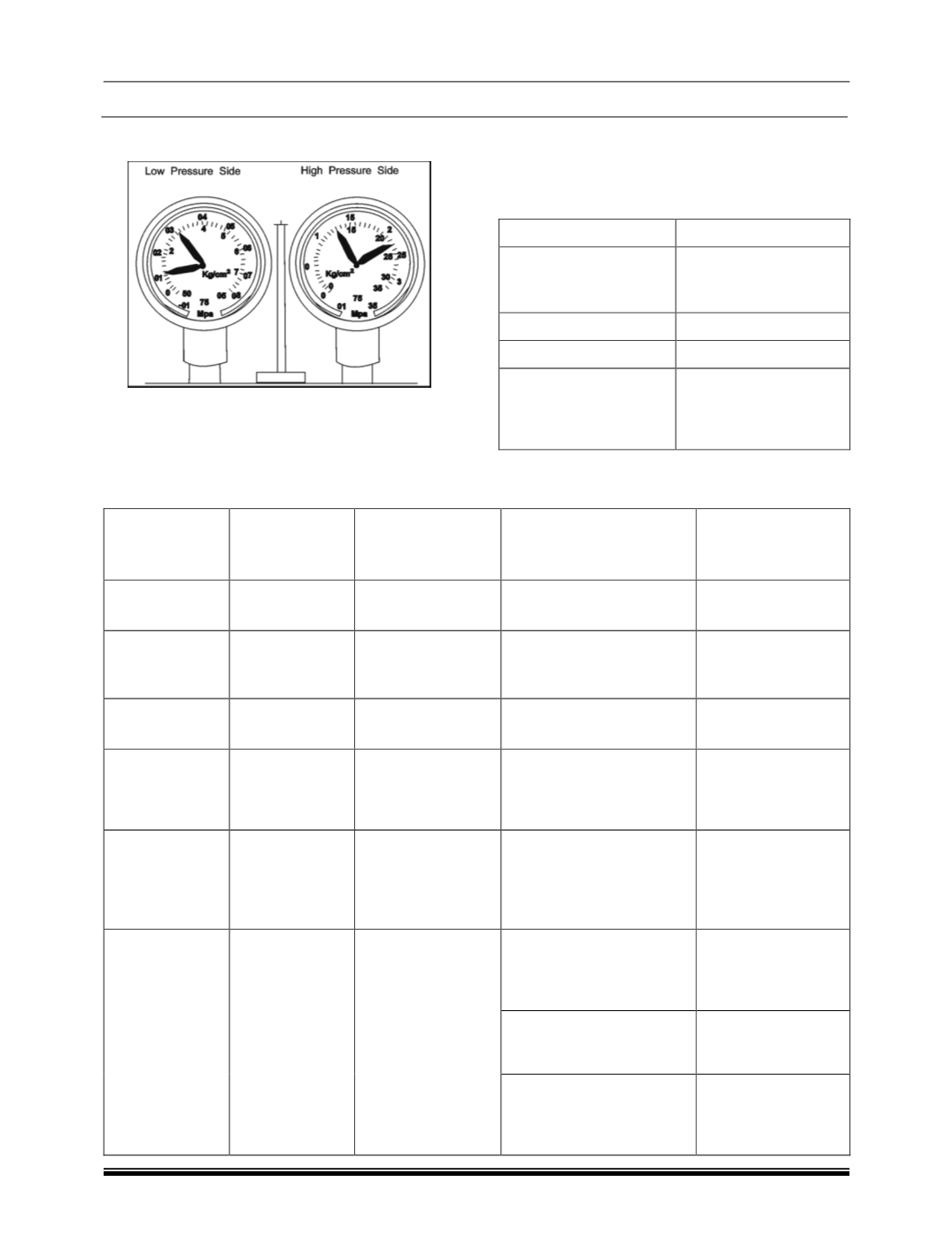
This is a method where trouble is detected and re-
paired by using manifold gauge. The manifold gauge
indicates the refrigeration cycle high and low pres-
sure side pressures on the respective gauge.
NOTE
Make sure following conditions are fulfilled before
getting the correct gauge readings (after engine has
warmed –up
)
Engine speed
1500rpm
A/C inlet temperature
(Ambient Temperature)
30° - 35° C (86° - 95°
F)
Blower speed
High
Temperature Control
Full cold
Reference value be-
fore AC operation at
both high and low
pressure sides
5-8 kg/ cm
2
(0.5 - 0.8
MPa)
Based on the values the following conclusions can be inferred and further troubleshooting can be done.
Low Pressure
side in kg/cm
2
( M Pa)
High Pressure
side in kg/cm
2
( M Pa)
Remarks
Symptoms
Possible reasons
1.5-2.5
(0.15-0.25)
14-16
(1.37-1.57)
System pressure
is normal
Normal cooling
AC system working
normal
0.5-1.0
(0.05-0.1)
7-10
(0.69-0.98)
Pressure low
Insufficient cooling
1. Refrigerant quan-
tity too small.
2. Gas leakage.
Vacuum
5-6
(0.5-0.6)
Refrigerant fails to
circulate
No cooling experienced
Clogging of AC cy-
cle.
Initially 1.5-2.5
(0.15 -0.25)
and later vacu-
um
Initially 14-16
(
1.37-1.57)and
later
7-10
(0.69-0.98)
Moisture present
in system.
Initially works normally
but later no cooing expe-
rienced
Freezing of expan-
sion valve due to
presence of mois-
ture.
4-6
(0.4-0.6)
7-10
(0.69-
0.98)
Pressure on low
pressure side is
high and pressure
on high pressure
side is low.
No cooling.
Compressor Defec-
tive.
2.5- 3.5
( 0.25 –
0.35)
20-25
( 1.95-
2.45)
System pressure
is high.
Only Insufficient cooling.
Excessive refriger-
ant in the system
causing insufficient
condenser cooling.
Insufficient cooling with
low pressure piping will
be hot.
Air has entered the
system.
In sufficient cooling with
frost or large amount of
dew on low pressure pip-
ing
TXV valve faulty.