




 1062 / 1119

FATC
39
(II) EVACUATION AND RECHARGING
1. Add refrigerant oil as per the table given in “Re-
plenishing Compressor Oil” procedure in the
same section.
2. Evacuate the system according to the manufac-
turer’s instructions.
NOTE
If the vacuum reading is below 700mmHg after 15
minutes, suspect a leak in the system. Partially re-
charge the system and check for leaks by using leak
detector. Check suction lines first, then run the com-
pressor for 5 minutes and then check the high
pressure lines.
CAUTION
The system must be evacuated immediately before
recharging commences. Delay between Evacuation
and Recharging is not permitted
.
3. Recharge the refrigerant as per instructions.
Refrigerant quantity to be charged in the system
is
520 ± 20 gms.
NOTE
When charging refrigerant only without replacing any
component, replenish the same amount of measured
oil when recovering refrigerant (if not measured, re-
plenish 30cc oil).
4. If the full charge has not been accepted by the
system, start the engine and run it at 1500 rpm
for a minimum of 2 minutes. Switch ON the air
conditioning system, open the vehicle windows,
set the temperature control to full cold and run the
blower at maximum speed.
5. Consult Refrigerant Station Manual for correct
procedure to complete the charge.
6. Carry out the air conditioning system perfor-
mance test.
c) FLUSHING OF AC SYSTEM
Whenever there is an AC compressor failure the AC
system should be flushed. This is done in order to
remove the debris of the AC compressor that might
have circulated through the system.
The compressor used in Q501 is a variable dis-
placement type which does not have any parts
rubbing against each other as compared to a recip-
rocating compressor. However it being the only
moving component in the system, when it fails inter-
nal part might get circulated throughout the system.
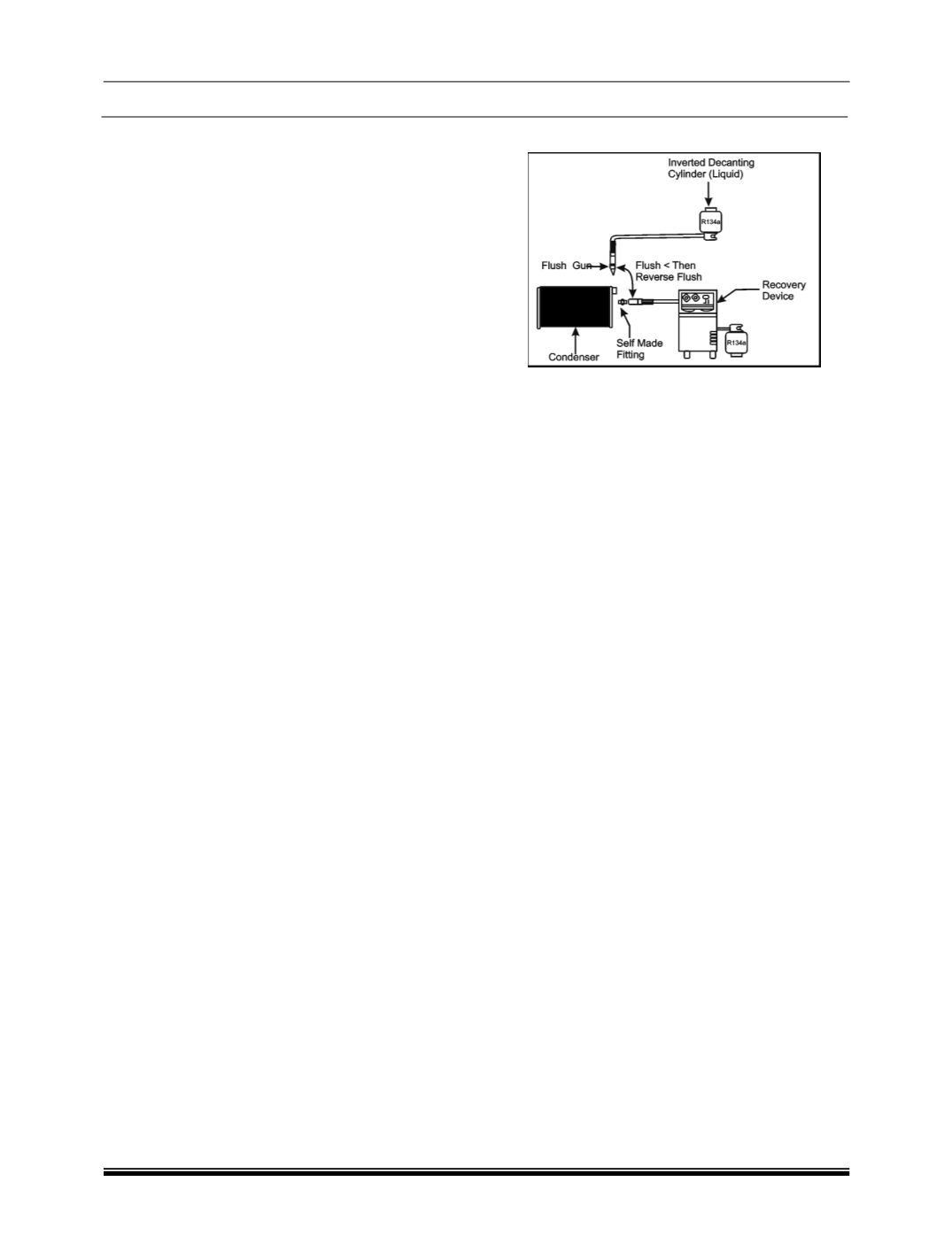
Flushing can be either done using an inverted de-
canting R134a cylinder filled with refrigerant. In some
recovering devices a flushing port is provided.
NOTE
If a compressor is replaced without flushing,
de-
bris would circulate throughout the system.
Hence all the components should be flushed
Flushing also removes excess oil from the sys-
tem. If you suspect the system contains too much
oil, flushing is a way to start fresh so you can es-
tablish the correct quantity of refrigerant oil in the
system.
Following points should be noted while per-
forming a flushing process
1. Flush individual components.
2. Self made flushing fitments will be required asAC
system component fittings all differ in size, shape
and thread size.
3. When replacing air conditioning parts with new
ones, it is necessary to replenish oil by approxi-
mately the same amount which was left in each
part.
4. Reverse flush the components.
5. Do not flush through a compressor otherwise
possible internal damage could occur.
6. Recycle the refrigerant recovered during flushing;
the recovery device will remove contaminants
through a filtration system.
CAUTION
Be sure to use specified compressor oil only
.