




 250 / 948

STEERING
17
iii. HYDRAULIC SYSTEM AIR BLEEDING :
NOTE:
Before proceeding to bleed the system:
All pipes and hoses are securely fitted and
fastened.
Always use recommended oil from closed
containers. Any dirty oil poured in the system
will result in damage to pump / gear.
CAUTION:
It is recommended to use the strainer present in
the reservoir while pouring the steering oil in the
steering reservoir to avoid entry of dirt and
contaminants into the hydraulic circuit.
Fill the reservoir nearly full. Crank the engine
for 10 seconds, if possible, without allowing it
to start. If the engine does start, shut off
immediately. Check and refill the reservoir.
Repeat at least three times each time
checking and refilling the reservoir.
CAUTION:
Ensure that the oil does not drop down to the
lower level of reservoir or run out of the reservoir;
to avoid air induction into the system.
Start the engine and check for any leakage in
the system and if noticed take corrective
action.
Start the engine and steer the vehicle from full
left to full right turn 3-4 times. Add fluid, if
necessary, to maintain the level up to the
‘MAX’ mark on the reservoir
CAUTION:
Do not force the wheel against lock position.
With the engine at steady speed, check for
bubble / foaming in the oil. If present, it
indicates that air is getting sucked into the
system. Check the suction line fittings and
correct if necessary.
Once the system is bled properly there should
not be any change in oil level in the reservoir
if the engine is started & stopped repeatedly.
Now the system is ready for driving - top up or
remove excess oil so that final oil level is at
‘MAX’ mark on the reservoir.
CAUTION:
Do not start the engine without oil in the power
steering system. This will result in serious damage
to the pump.
If the oil level fluctuates when turning the steering
wheel and oil overflows after engine is stopped, it
indicates that the bleeding was not performed
perfectly. It can cause noise and early damage to
the pump in this case one should again repeat the
bleeding procedure.
Do not load the system until it is bled properly.
Severe damages could occur otherwise.
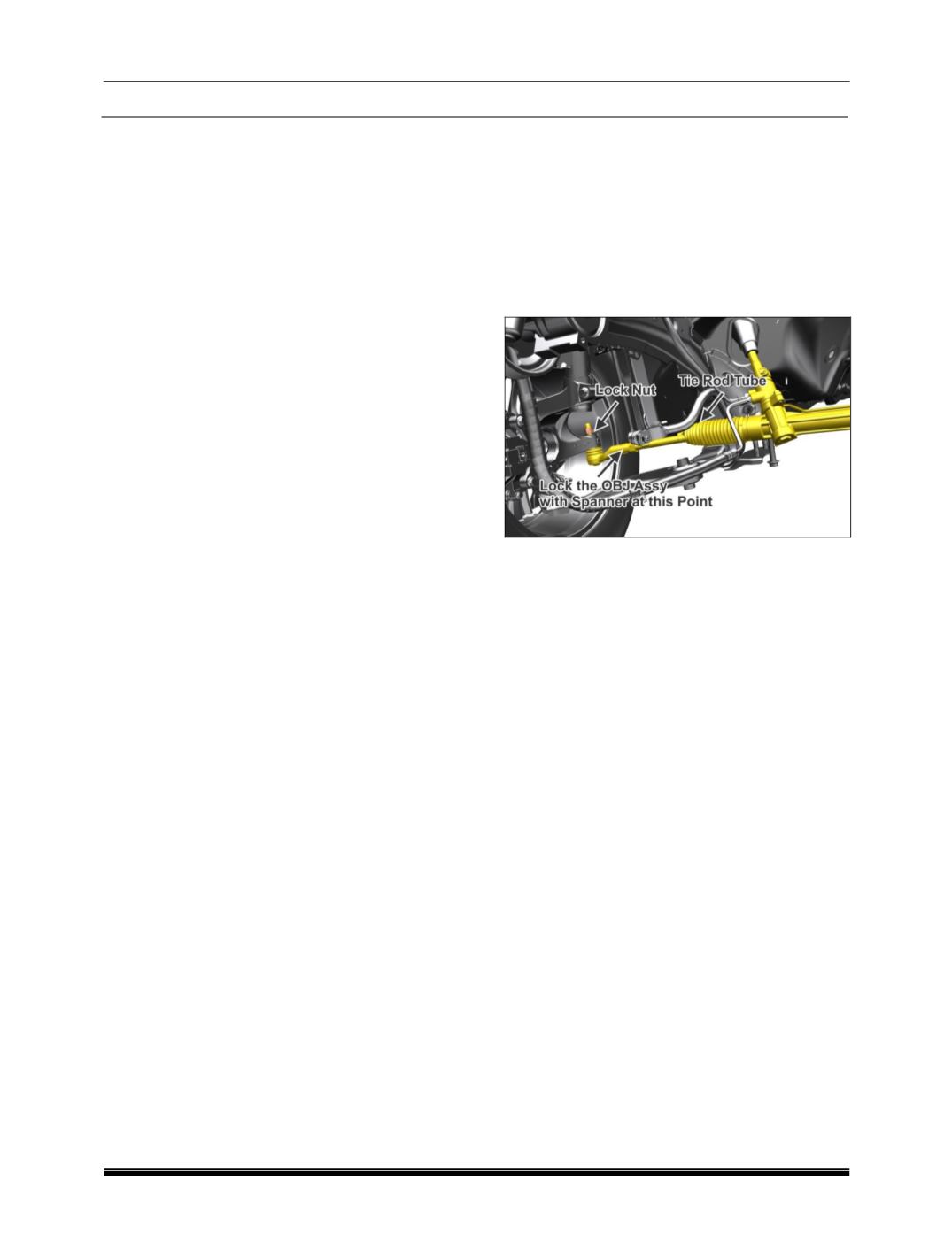
iv. TOE IN ADJSUTMENT :
1. To adjust the “TOE” loosen the lock nut and
hold the OBJ assembly with spanner to avoid
the rotation.
2. Loosen or tighten the tie rod tube as needed.
3. While adjusting the “TOE IN”, adjust the
length of both tie rods by rotating in same
direction such that their lengths remain equal
at all times.
4. The Toe in value should be in the range 2-
5mm.
NOTE:
Ensure that number of threads of exposed out
of the lock nut is same on LH and RH side.
For vehicles with ESP, Steering Angle Sensor
(SAS) calibration has to be done after wheel
alignment.