




 1291 / 1526

ENGINE
123
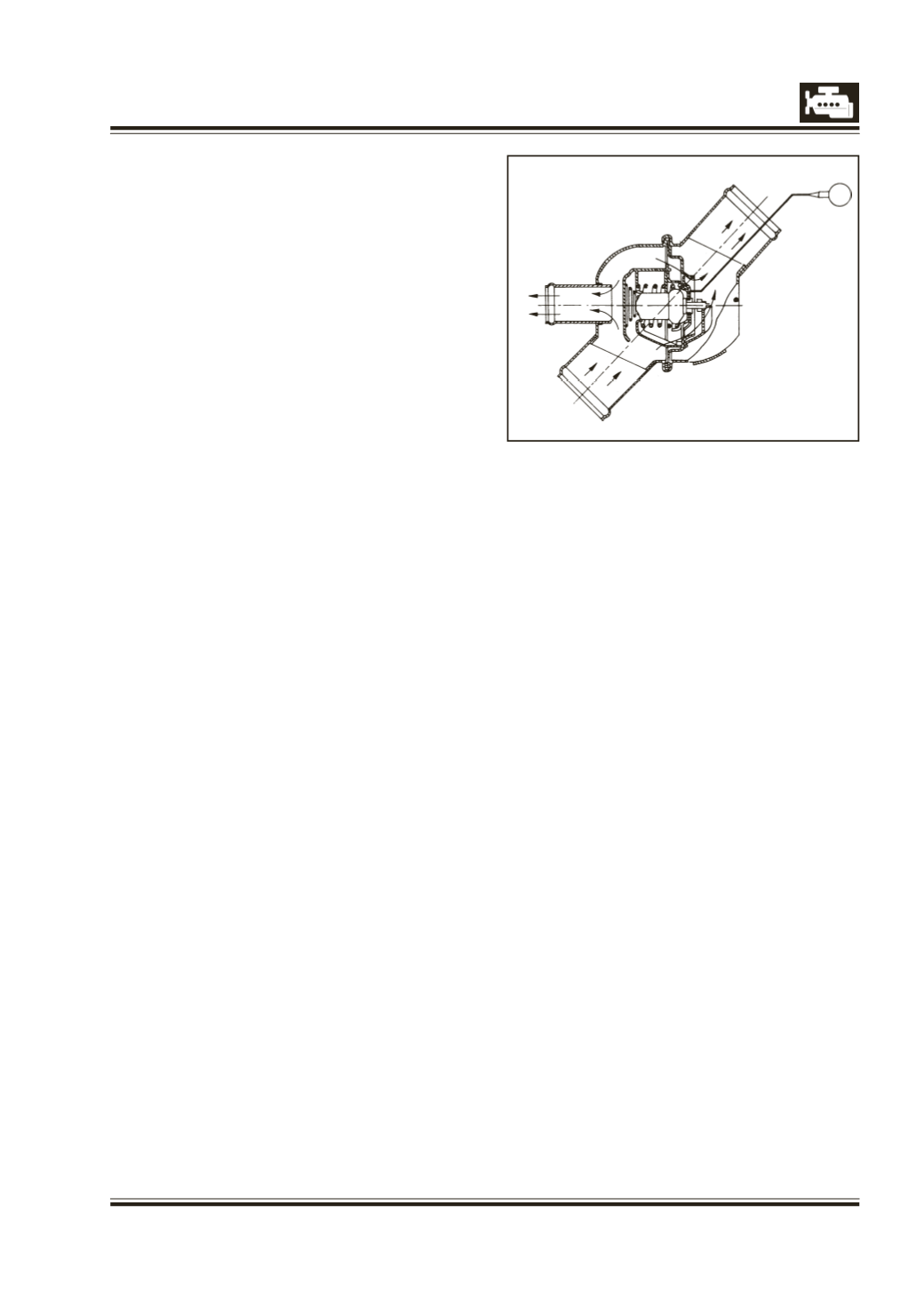
Fig. 1
ENGINE COOLING SYSTEM
THERMOSTAT
Fig. 1.
Thermostat installed in cooling system between upper
cooling water line and radiator upper tank ensures
minimum operating temperature of engine which is
extremely important for efficient engine operation and
longer engine life.
So long as engine is cool (immediately after starting)
thermostat does not allow water to go to radiator thus
disconnecting it from cooling system. Water flows
towards water pump through by-pass out-let of
thermostat and is circulated back to engine, short
circuiting radiator. Thus, working temperature of
engine is achieved rapidly.
As soon as working temperature of engine is attained,
thermostat valve starts gradually lifting, allowing
cooling water from-engine to circulate through
radiator. At the same time by-pass out-let to water
pump gradually closes’ thereby allowing only metered
quantity of cooling water to flow through it.
Thermostat is self-controlled to adjust water flow
quantities through radiator and bypass outlet in
accordance with engine working temperature.
Failed thermostat keeps valve in open position and is
as good as an engine operating without thermostat.
This will result in over-cooling of engine, particularly if
vehicle is used for short distance runs, or operates in
city.
Although adverse effects of over-cooling on engine
operating without or with failed thermostat may not
be visible immediately, engine life and its operating
efficiency are decisively affected. Therefore, do not
operate engine without or with a failed thermostat.
CHECKING OF THERMOSTAT
1 Fix thermostat on test stand.
2 Fit a dial gauge connecting its spindle to
thermostat valve diaphragm through pointer.
3 Adjust pre-load on dial to about 0.5 mm and set
dial gauge needle at zero.
4 Place test stand with thermostat in a vessel filled
with water over a burner.
5 Place suitable thermometer (preferably calibrated
telethermometer) into water.
6 Note down temperature when dial gauge needle
starts moving indicating opening of valve
(opening temperature).
7 Simultaneously note down temperature when
valve is opened to 7.5 to 8.5 mm (fully open).
(Max. lift of value 8 + 0.5 mm for DICOR Engine.)
8 For DICOR engine thermostat opening
temperature 83 + 2
0
C fully open at 94
0
C
(If thermostat starts opening between 85
0
C and
89
0
C and is fully open between 90
0
C and 100
0
C, it
should be considered to be in a satisfactory
condition.)
9 With thermostat still mounted on test stand
connect water hose at outlet of thermostat
(towards arrow head).
10 Connect inlet of thermostat to a hand operated
water pump (water at room temperature).
11 Check flow of water at outlet under 1 bar pressure.
It should be within specified limits.
NOTE
a. This flow is caused by a hole in valve head or
corrugation on valve seat intentionally provided
to ensure that cooling system can be completely
filled with water when engine is cold. If this flow
rate is too high, check visually for dirt particles
which have settled down on the valve seat.
b. If hole in valve head is clogged, it should be
reopened by a sharp pointer.