



 120 / 1525

81
4 DLT ENGINE
LUCAS DPC FIP - FEATURES
1. EXCESS FUEL SYSTEM
To assist engine starting, the excess fuel system
provides at very low pump speeds the fuel delivery
that is greater than the full load delivery.
The system is incorporated in the delivery control
mechanism, which by the action of a return spring
allows the distance between the pumping plungers to
be increased to a level that is more than the normal
operating levels. This increased outward travel of the
plungers allows an extra quantity of fuel to flow in
during the filling cycle. The same is pumped out during
the pumping stroke.
As the Engine speed increases, the increase in transfer
pressure automatically cuts-off the excess fuel. The
transfer pressure pushes the delivery control system
against the opposing return spring to retain it in the
normal operating position.
2. TWO SPEED GOVERNOR
(MINI-MAXI)
l
The function of the two speed governor is to
control the idling. Fast idling and the maximum
no-load speed of the engine.
l
The Governor interferes only during idling and
maximum no-load conditions, to determine the
position of the metering valve and thus control
the fuel delivery.
- During the intermediate phase, the metering
valve is directly linked to the throttle lever
(accelerator pedal), providing a direct control.
ADVANTAGES :
l
Smooth response to alterations in throttle
position.
l
Improved driveability.
3. PROGRESSIVE LOW LOAD ADVANCE (PLLA)
The Low Load Advance System overrides the normal
speed advance system. Under low load conditions,
due to reduced fuel supply, there is a tendency for the
timing to retard. The low load advance system
compensates for this characteristic by slightly
advancing the injection at reduced fuel levels.
The type of low load advance system used on Tata
Safari is called the progressive low load advance
(PLLA) system.
The advantage of the PLLA system is, that it
progressively changes the advance to suit the engine
load conditions. Thus helps in achieving better
emissions and also reduces transient noise.
4. SUPPORTED TOOTHED BELT TYPE DRIVE
l
The assembly consists of drive shaft assembly
supported by two bearings and in the pump
housing the shaft is connected to the pump
hydraulic head by an intermediate shaft.
l
The bearing opposes the loading created by the
drive belt, thus maintaining the alignment of the
drive shaft and the hydraulic head.
ADVANTAGES :
l
Smoother Running
l
Pumping drive draws lesser power from the
engine
l
Noise reduction
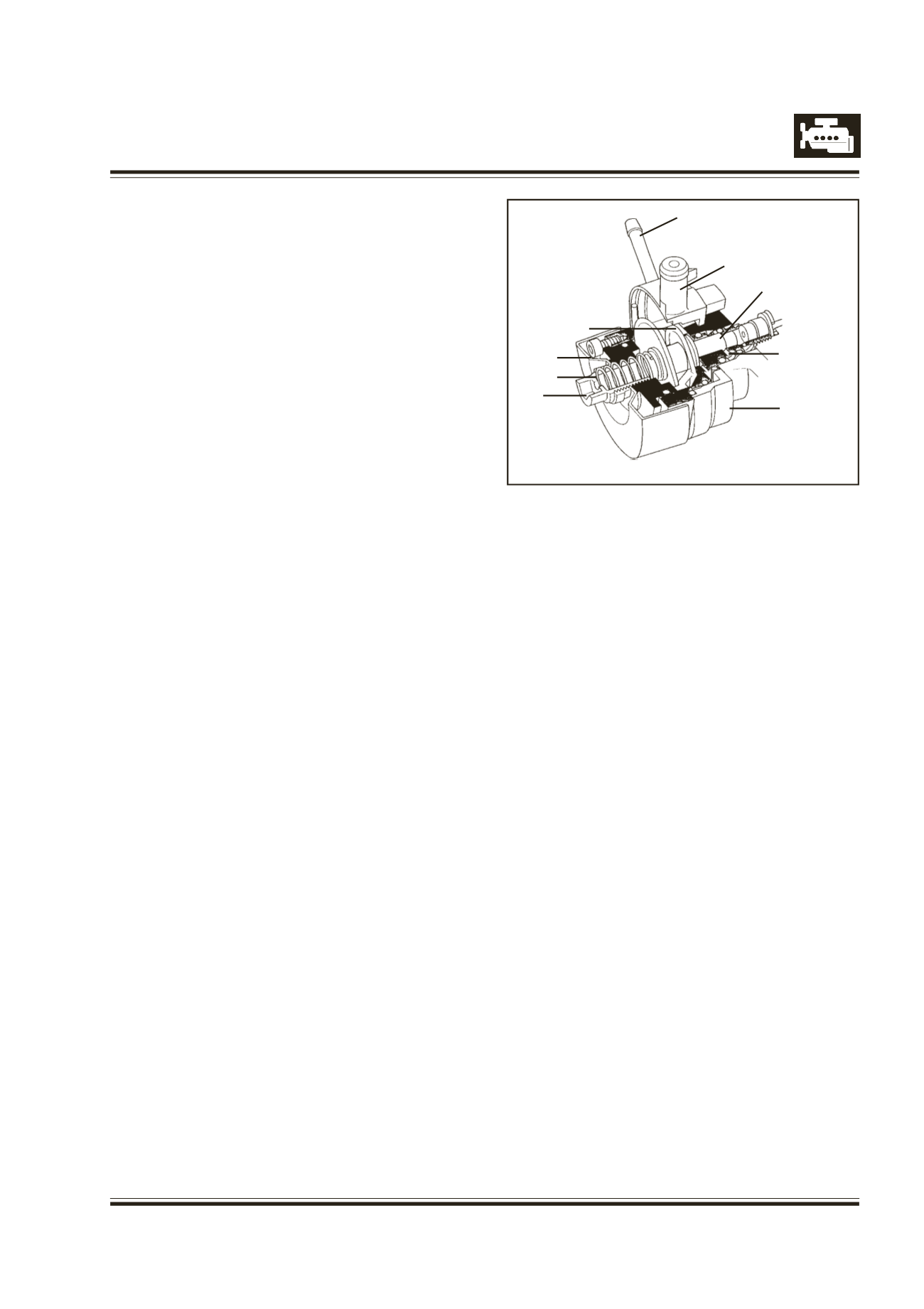
5. BOOST CONTROLLER
(Fig 165)
The Boost Controller is necessary on the FIP fitted to
turbo charged applications, in order to adjust the
maximum fuel delivery in accordance with the
variations in the boost pressure from the turbo charger.
The fuel adjustment plate and the roller shoes on these
pump are provided with ramps to allow for the
progressive change in fuel delivery as the assembly
move axially on the rotor by the action of the actuating
piston moving against a carriage return spring.
The boost controller consists of a piston valve moving
within a valve body. The valve is linked to a pair of
Fig. 165
Backleak return
Boost pressure inlet
Piston
Discharge
to transfer
pump inlet
Valve body
Fuel
adjusting
screw
Spring
Spacer
Diaphragms