




 698 / 1235

ANTI LOCK BRAKING SYSTEM (ABS)
6
6.2.1.5 WORKING OF ANTI-LOCK BRAKING
SYSTEM
(ABS)
!! WARNING
1.
ABS is an aid to retain steering control and
stability while braking.
2.
ABS will not prevent accidents resulting from
excessive cornering speeds, following
another vehicle too closely or aquaplaning,
i.e. where a layer of water prevents adequate
contact between tyre and road surface.
3.
ABS will not improve braking performance or
stopping distance beyond that which is
physically possible in relation to road
conditions and the vehicles tyres or brakes.
4.
The additional control provided by ABS must
never be exploited in a dangerous or
reckless manner which could jeopardise the
safety of driver or other road users.
The ABS ECU takes wheel speed information from
sensors, located within the hub carrier, and monitors
the relative deceleration/acceleration of each wheel
at all times. These signals are used to calculate the
rotational deceleration
(Negative acceleration
) rates
for each wheel during braking operation. In the event
of a wheel slip condition
(i.e. rotational deceleration
being outside of allowable limits
) the hydraulic
system will control the brake line pressure by
operating the appropriate solenoid valves within the
hydraulic modulator and thus releasing the brake
pressure from that particular wheel.
Once the wheel deceleration has recovered to within
allowable limits the modulator then allows pressure
to be re-applied to the particular brake caliper or
wheel cylinder from which the brake pressure was
released.
When ABS intervention is necessary the warning
lamp will not illuminate but the driver will feel the
brake pedal pulsating and may experience audible
feedback from the modulator indicating that ABS
control is taking place.
The ABS and EBD warning lamps will illuminate for a
system check when the ignition is switched ON. Both
lamps will then extinguish to indicate the system is
healthy.
(As the EBD lamp is shared with the Parking
brake lamp this will not extinguish until the parking
brake is released.)
If a fault occurs with the system
or any of its constituent components the relevant
warning lamp in the instrument cluster will illuminate
to inform the driver for the respective fault.
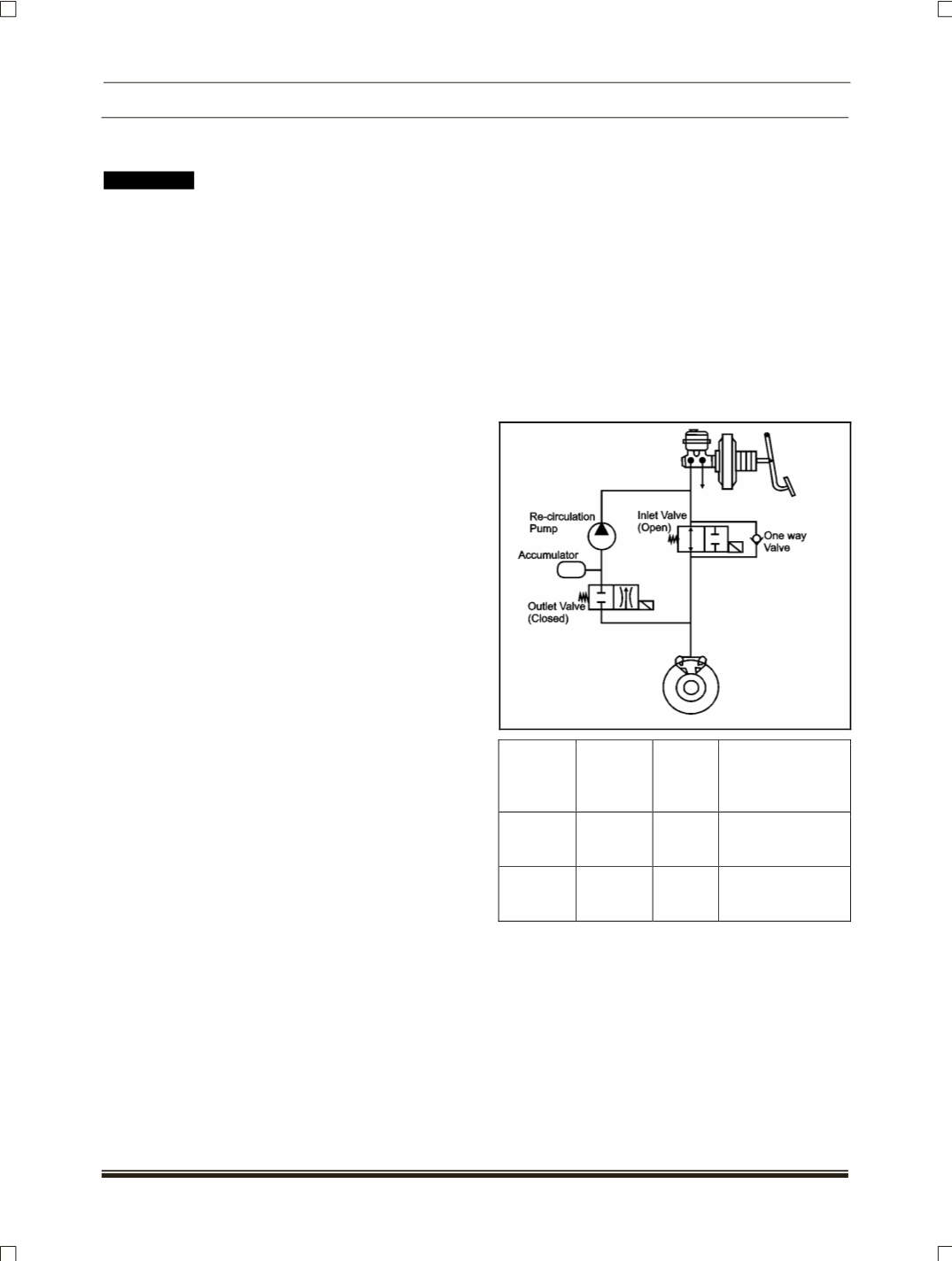
A. BRAKING WITHOUT ABS IN OPERATION
In case of normal braking operation when no wheel
speed differences are detected and neither ABS nor
EBD are active, when the driver presses the brake
pedal, brake pressure developed in tandem master
cylinder
(TMC)
reaches to each wheel through
hydraulic control unit
(HCU)
. During this phase, both
inlet and outlet solenoid valves are switched OFF
(or
not excited)
by the ECU. Hence the inlet valve is
open and outlet valve remains closed allowing the
brake fluid to flow freely through the inlet valve and
to the relevant wheel.
When the driver releases brake pedal, the brake fluid
flows back from the wheel, through the respective
one way valve towards TMC.
Solenoid
valve
Electricity
status
Valve
open-
close
Open-close
channel
INLET
OFF
OPEN
Master cylinder
-Wheel cylinder
OUTLET OFF
CLOSE Wheel cylinder -
reservoir