



 283 / 1428

ENGINE 273 MPFI
277
ENGINE
3.11.4 DTC (DIAGNOSTIC TROUBLE CODE)
Diagnostic Trouble Code (DTC) is a standard code can be defined as per SAE J 2012v003 as an alphanumeric
identifier for a fault condition identified by the ‘On Board Diagnostic System’.
Diagnostic trouble codes are stored in the ECUmemory and can be read through Laptop Based Diagnostic Tester
discussed above. The codes are stored in response to a problem/fault found in the vehicle. Each code identifies a
particular problem area and is intended to provide the information to the technician to quickly locate/identify where
the fault might be occurring in the vehicle.
Terms and Definitions:
Circuit/Open:
Fixed value or no response from the system where specific high or low detection is not feasible or
can be used in conjunction with circuit low and high codes where all three circuit conditions can be detected.
Range/Performance:
Circuit is in the normal operating range, but not correct for current operating conditions, it
may be used to indicate stuck or skewed values indicating poor performance of a circuit, component, or system.
Low Input:
Circuit voltage, frequency, or other characteristic measured at the control module input terminal or pin
that is below the normal operating range.
High Input:
Circuit voltage, frequency, or other characteristic measured at the control module input terminal or pin
that is above the normal operating range.
Intermittent/Erratic:
The signal is temporarily discontinuous, the duration of the fault is not sufficient to be
considered an open or short, or the rate of change is excessive.
Structure of DTC:
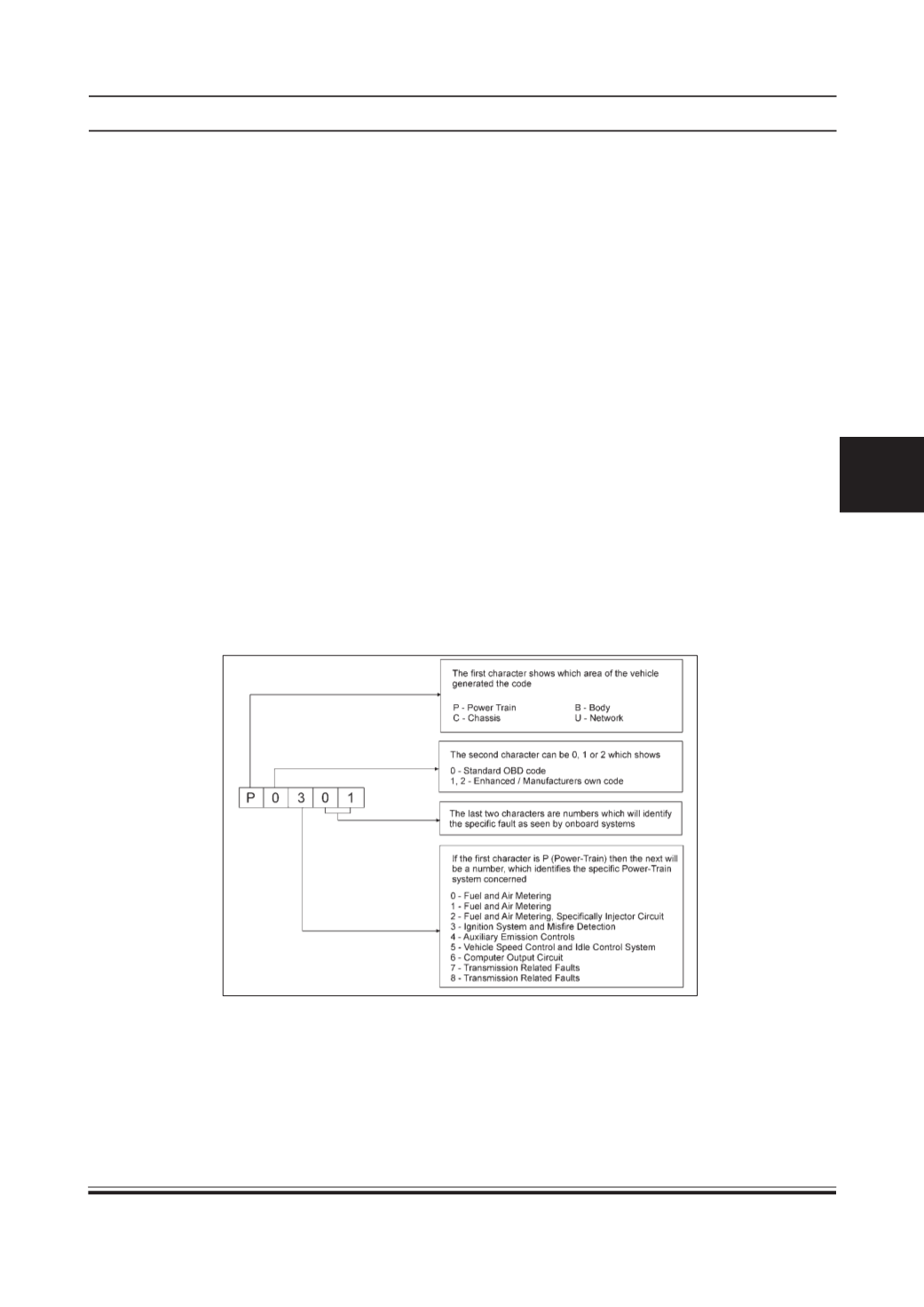
DTC is a five character alphanumeric number. The first character being alphabet represents the area of the generated
the code. For example power-train, body chassis etc. Definitions of next four numeric characters are represented
in the following way:
The recommended DTCs consist of a three-digit numeric code preceded by an alphanumeric designator. The
alphanumeric designators are “B0”, “B1”, “B2”, “B3”, “C0”, “C1”, “C2”, “C3”, “P0”, “P1”, “P2”, “P3”, “U0”, “U1”, “U2”,
“U3”, corresponding to four sets of body, four sets of chassis, four sets of power train and four sets of network
trouble codes. Most circuit, component, or system diagnostic trouble codes that do not support a sub-fault
strategy are specified by four basic categories:
Circuit/open,
Range/performance,
Circuit low,
Circuit high.