




 1259 / 1428

FUEL SYSTEM
28
4. CNG LEAK DETECTION TESTING:
Leakage test need to be performed after any repair
on CNG components / vehicle.
All the joints of high pressure & low pressure lines
can be checked for leakage with the help of “Leak
Detector” available in market or with the help of
“Snoop Solution”.
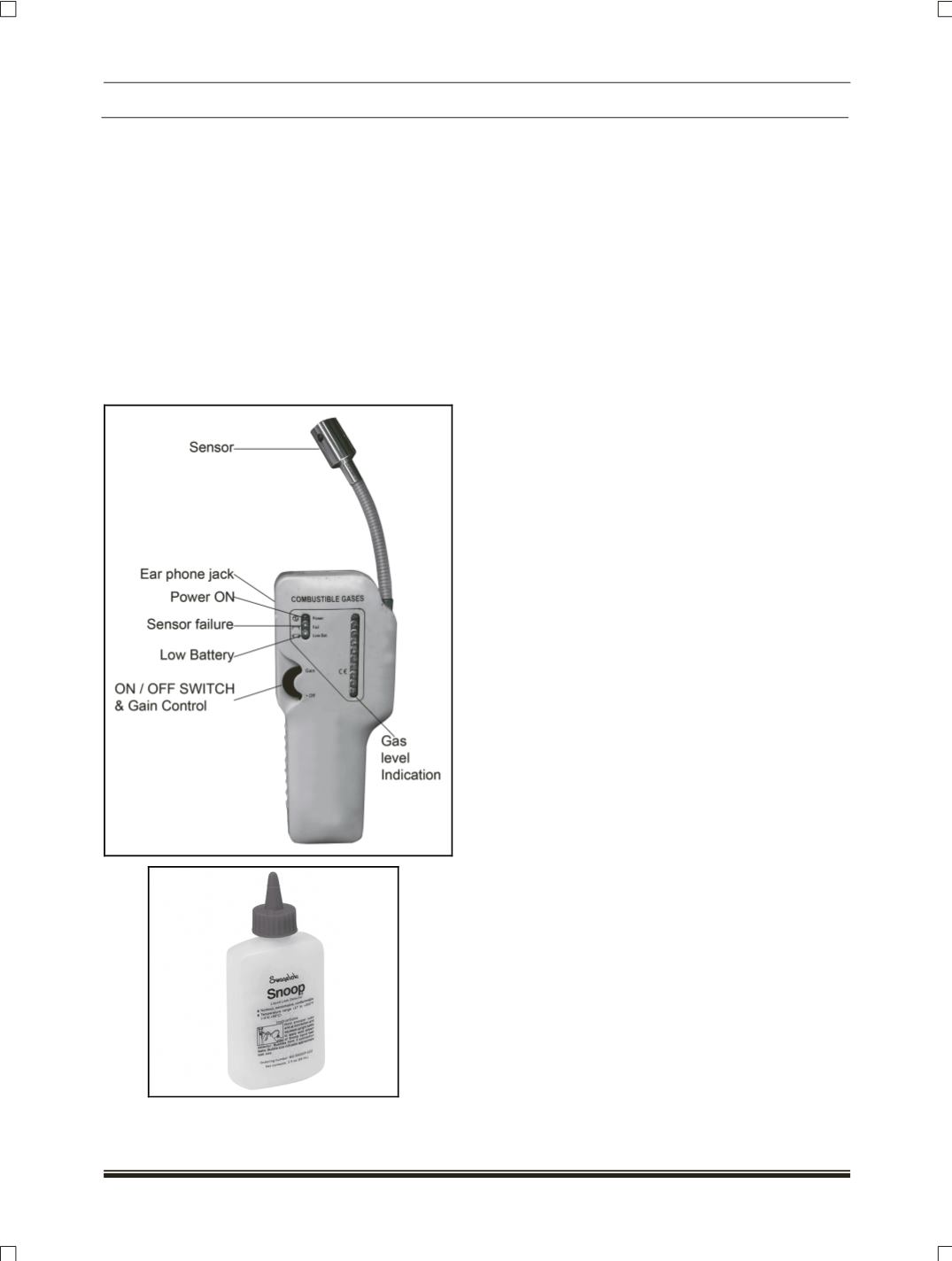
The Gas “leak detector” gives indication in terms of
Buzzer & LED glowing, whereas “Snoop solution”
applied on joints will show bubbles (at joints) in
case of leakage.
The picture of “leak detector” & Snoop solution are
as shown below.
LEAK SUSCEPTIBLE AREAS:
A) High Pressure lines:
1) Filler valve pipe connections.
2) Pressure gauge pipe connection.
3) Cylinder valve inlet & outlet connections.
4) High pressure line joints:
a) Below floor LH long member.
5) Inlet Connection on Pressure regulator.
B) Low pressure lines:
1) Pressure regulator outlet connection.
2) Pressure regulator to LP filter connection.
3) LP filter to gas rail connection.
4) CNG rail PT sensor.
5) Injector ‘O’ ring.
Leakator:
Following method is used to perform leakage test
using Leakator:
1. Turn the instrument ON and allow it to warm up
(approximately 60 seconds).
2. The instrument is ready to check for gas leaks
after the audible alarm begins to beep.
NOTE:
The instrument always starts in its high-
sensitivity mode.
3. Now check for the presence of gas by positioning
the tip of the flexible probe near the area to be
tested / at pipe joints / connectors.
4. An increase in the relative concentration of gas is
indicated by fast LED blinking & alarm beep rate.
5. Once the presence of the gas has been.
confirmed, the instrument’s sensitivity can be
lowered by double pressing the ON / OFF button
(a decreasing frequency tone should be heard),
allowing the location of the leak to be easily pin
pointed.