




 282 / 1003

1.5L REVOTORQ BS VI ENGINE
78
Low engine noise.
Lower emission.
System flow
For system flow schematic refer exhaust system
schematic layout.
The exhaust gases are made to pass through the
turbocharger turbine which will rotate the compres-
sor mounted on the same shaft on the air inlet side.
The air from the air filter is sucked by VGT com-
pressor. The compressed air then flows through an
intercooler and then to the intake manifold. For
more information refer Air intake system.
PRECAUTIONS
Avoid Lifting the turbocharger by holding the ac-
tuator.
Avoid Lifting turbocharger holding the rod end.
Avoid Lifting turbocharger holding the compres-
sor side.
Hold the turbo-charger at the turbine housing
/center housing.
No foreign particles (dust/dirt) should enter the
vacuum line.
Ensure the conditions of handling and installa-
tion of turbocharger/manifold are such that there
is no risk of shocks, dropping the turbocharger
or damage to the sealing surfaces (turbine hous-
ing inlet and outlet surfaces, compressor inlet
and outlet, oil circuit), or damage to the actuator
or flow adjusting rod and screw which might lead
to the misalignment.
If the turbocharger is dropped, then it should be
inspected. If it is damaged, it should not be
used.
Put few drops of oil during assembly and rotate
the wheel with finger. Look for free movement of
wheel with no wheel rubbing.
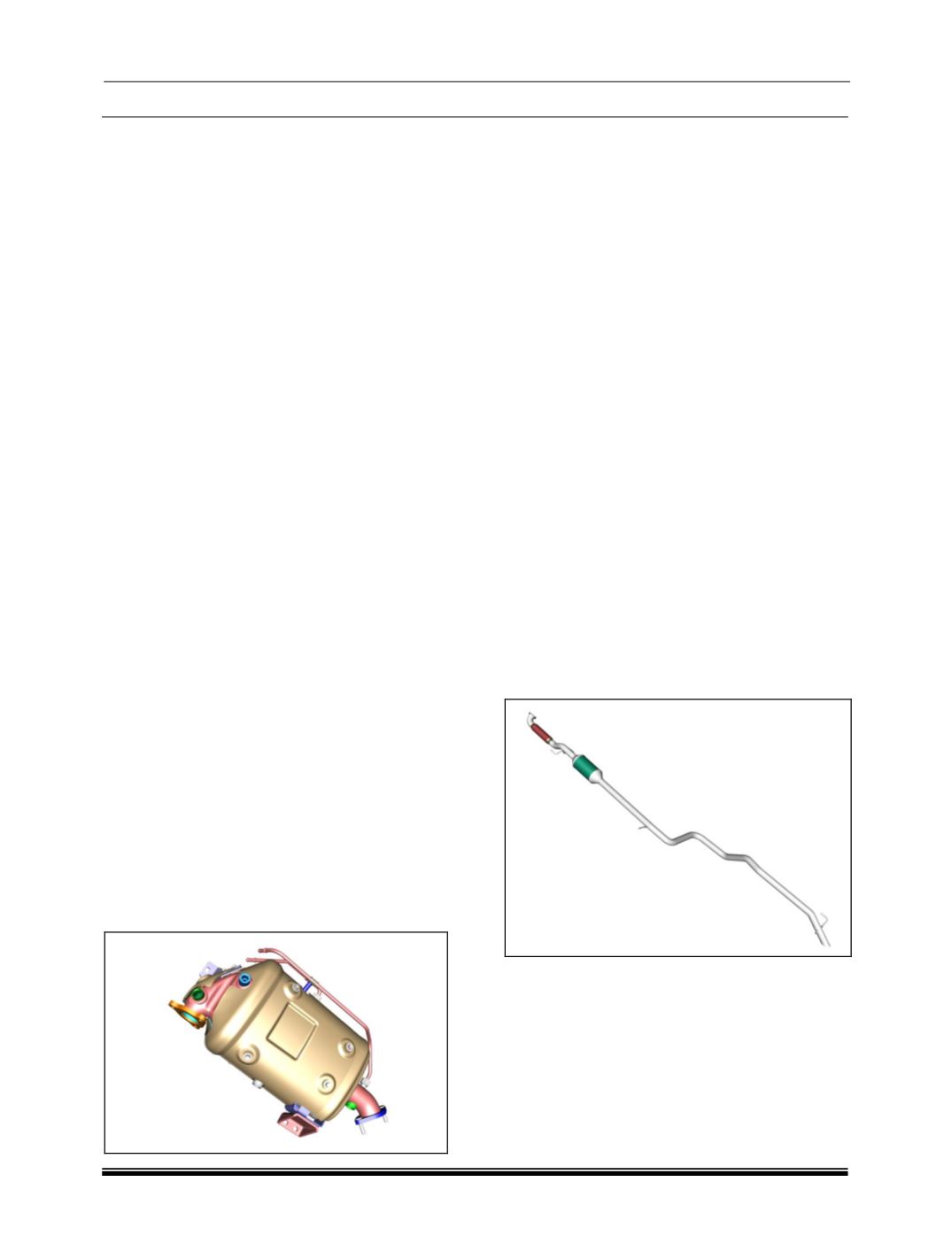
C. LNT + DPF
The Close Coupled Catalytic Converter is a critical
element of the system used to reduce vehicle
exhaust emissions. The catalytically active element
within the converter lowers the activation energy
needed to selectively transform harmful combustion
products into less harmful gases. The catalyst
becomes active when it reaches a threshold
temperature.
Close coupled Catalytic Converter is physically
positioned very close to the engine exhaust ports to
enable quicker light-off. It also enables flushing out
of the carbon particles present in the Catalytic
Converter.
Benefits
• Positioned close to the engine exhaust ports for
fast light-off and reduced cold start emissions.
• Robust construction offers excellent durability.
• Internally insulated construction design enables
improved durability, reduced heat rejection and
lower noise.
D. Silencer
The main function of the silencer is to reduce the
amount of noise emitted by the engine exhaust
gases that flow out. It typically makes use of the
change in the cross sectional area which can be
made as a chamber to filter or reduce the sound
waves which the engine produces.
Exhaust Pipe Assy. with Pre-silencer