




 959 / 1034

HVAC
46
10.Rectify any leaks and recheck for leaks during
evacuation prior to charging.
(c) Using Soap Solution/ Leak detector spray:
A
leak detector spray or soap solution can be used to
detect the leak by spraying it at the joints. If there is
a leak bubbles are formed.
10.2.2 REGULAR MAINTENANCE
A. REFRIGERANT RECOVERY, RECYCLING
AND RECHARGING
!! WARNING
Air conditioning system is charged with a high
pressure, potentially toxic refrigerant. Repairs or
servicing must only be carried out by an operator
familiar with both the vehicle system and the
charging and testing equipment.
All operations must be carried out in a well- venti-
lated area away from open flame and heat
sources.
Always wear safety goggles and gloves when
opening refrigerant connections. Wear eye and
hand safety protection. Open connections slowly
and carefully when liquid or pressure is present,
allowing it to bleed off slowly.
! CAUTION
Overcharging air conditioning system will cause ex-
cessive head pressure.
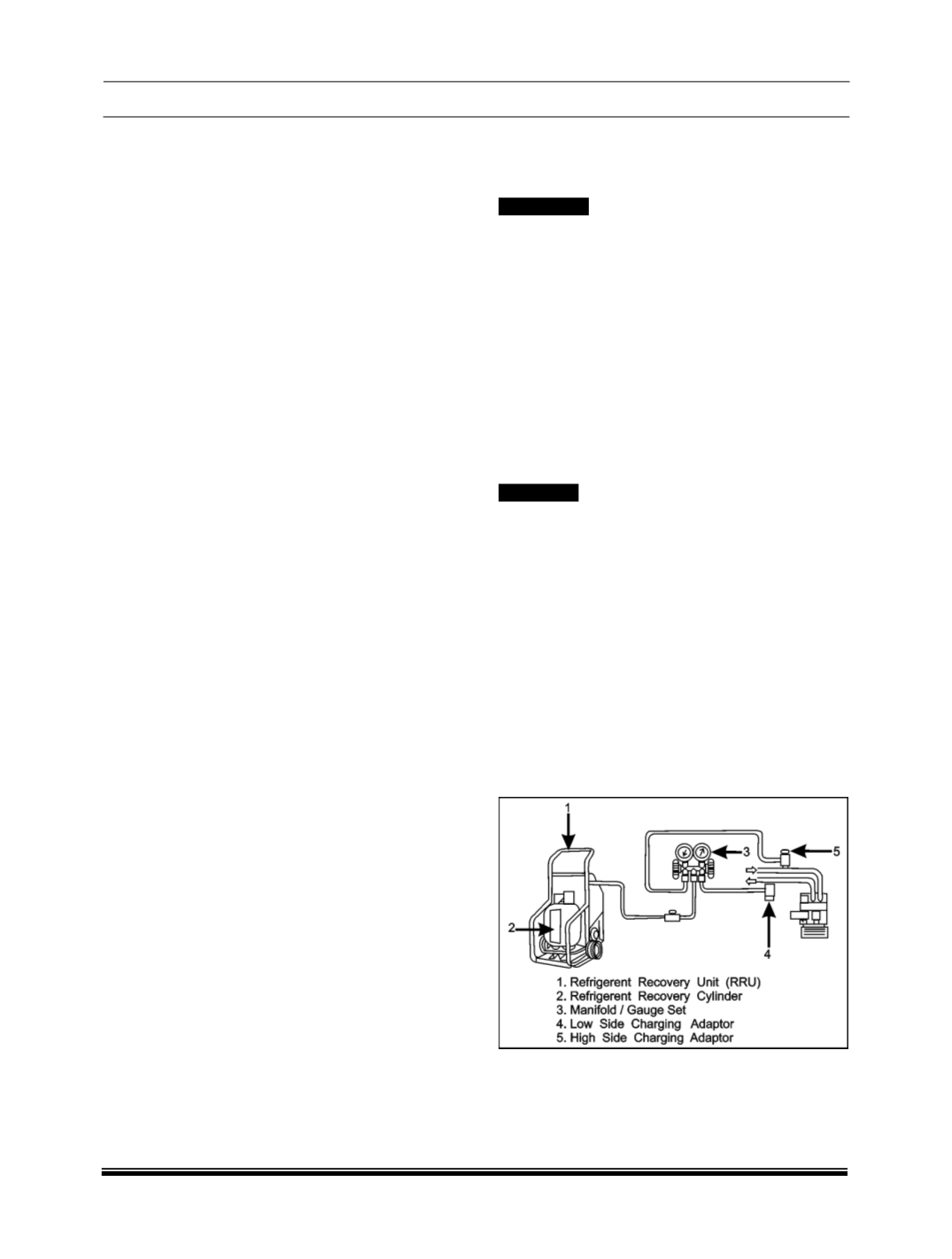
An air conditioning portable Refrigerant Recovery
Recycling Recharging Station or Refrigerant Recov-
ery Unit (RRU) for use with R134a refrigerant
incorporates all the features necessary to recover
refrigerant R134a from the air conditioning system,
to filter and remove moisture, to evacuate and re-
charge with the reclaimed refrigerant. The unit can
also be used for performance testing and air condi-
tioning system analysis.
The operator must adhere to the equipment manu-
facturers’ instructions.
The RRU set up is as shown in following figure:
(I) RECOVERY AND RECYCLING
The following procedure is usual for the use of Re-
frigerant Recovery, Recycling and Recharging
station or Refrigerant Recovery Unit (RRU) when