



 539 / 1526

11
ANTI-LOCK BRAKES
ABS
4. ANTI LOCK BRAKE SYSTEM - THEORY
Anti lock Brake system (ABS) is a closed loop
system, which modulates the brake pressure in
response to the brake slip rate of the wheel so as to
prevent the controlled wheel or wheels from
becoming fully locked above a preset minimum
speed.
During emergency braking situations at high speeds,
panic braking will be applied under conditions like -
Un-anticipated obstacle and mistakes committed by
other drivers and pedestrians or braking under more
critical driving conditions such as driving on wet
and slippery road surfaces like ice etc the wheels
tends to lock which in turn will skid. This will lead to
loss of steerability and stability of the vehicle as it
loses traction.
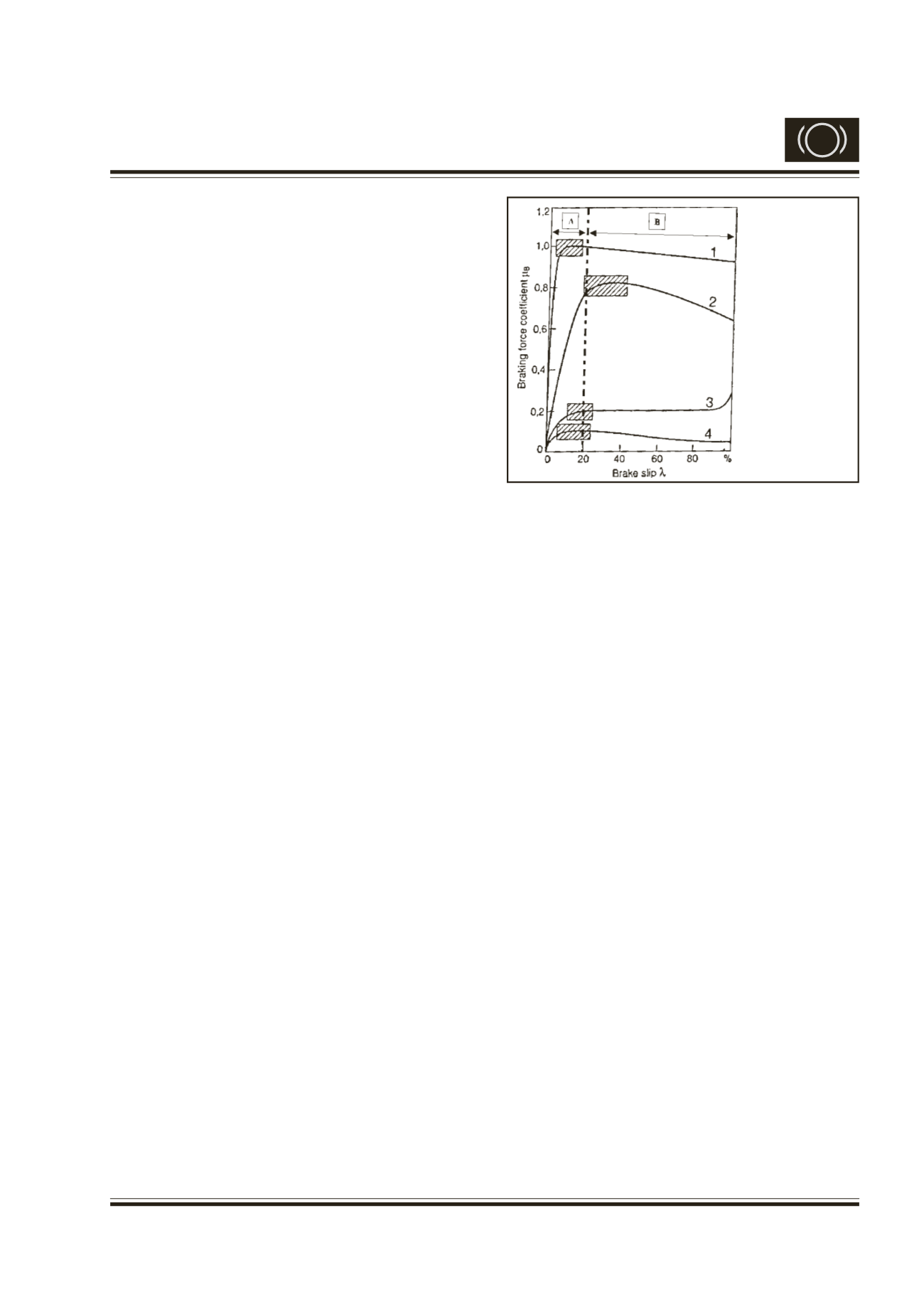
Wheel slip :
The vehicle can stop in relation to how well the tyre
contact surface grips the road. At 0% slip, the tyre
rotates freely and at 100% slip, the tyre and wheel
are locked and the weight of the vehicle pushes the
locked tyres along the road surface. In this situation,
vehicle stability and steerability will be lost.
During gradual braking, the %slip will be in between
10 to 20% and at this condition vehicle stopping
distance and steering control will be at their best.
This optimum slip (10 to 20 %) is required for
achieving maximum braking performance & for
stopping the wheel.
The theory behind ABS is simple. Whenever a driver
brakes, the wheels of the vehicle have to transfer
this braking force to the ground surface for achieving
braking. As long as driver brakes gradually, the
braking force is transferred through the tyres to the
ground surface & optimum braking is achieved. But
when driver applies panic braking, the tyres will stop
rotating instantaneously (locking condition). The
vehicle drags all the 4 wheels in the same direction
(at the point of braking) & also driver cannot steer
the vehicle so as to avoid any accident.
To avoid the wheels from getting locked & skidding
while panic braking, Antilock brakes system is
provided. The main benefits of ABS are in the area
of vehicle stability and steerability. i.e. This system
prevents the wheel locking during emergency braking
situations and thereby helps the driver to maintain
A
: Stable Range
B
: Unstable range
1 : Dry Asphalt
2: Wet Concrete
3. Snow
4. Polished Ice
stability of the vehicle & also in bringing the vehicle
to a complete stop with a minimum possible stopping
distance in the safest possible way.
The purpose of ABS 5.3, 4-sensor 4-wheel, vertical
split system is to provide
1.
Enhanced steering control by enabling the
vehicle to move in a driver’s intended direction,
even during panic braking.
2.
Enhanced braking stability by making the most
of available traction on all surfaces.
3.
It’s operational throughout the vehicles entire
speed range, effective down to the speed of
2.75 km/ h.
It is capable of rapid adaptation to changes in surface
traction. ( Dry road with patches of ice) and capable
of slowing down the yaw effect on the vehicle when
vehicle is driven on a µ split track, so that even an
average driver can initiate compensatory counter
steer.
ECU continually monitors the operating status of
ABS. Incase of ABS failure driver will be alerted
and conventional braking will still be operational
without ABS.
Fig. 3