




 551 / 1525

23
ANTI-LOCK BRAKES
ABS
7. ABS SYSTEM FAILURE WARNING LIGHT (Fail-safe function)
Cause of system failure
System
Warning lamp
ABS
EBD
ABS
EBD
None
operate
operate
OFF
OFF
1 Sensor failure
does not operate
operate
ON
OFF
Pump failure
does not operate
operate
ON
OFF
Low voltage of battery
does not operate Operate (at =6.5V)
ON
OFF
Failure of 2 or more sensors,
Valve failure
does not operate does not operate
ON
ON
ECU failure
Other failures (EBD)
Fig. 15
If any failure occurs in ABS system, then the fail-
safe circuit turns off the relay that supplies electricity
to solenoid valve, stopping the control signal output,
lighting the warning lamp at the same time to inform
ABS failure to driver.
Even in this condition, the basic hydraulic brake
function is always available to the driver, just like in
a vehicle without ABS system.
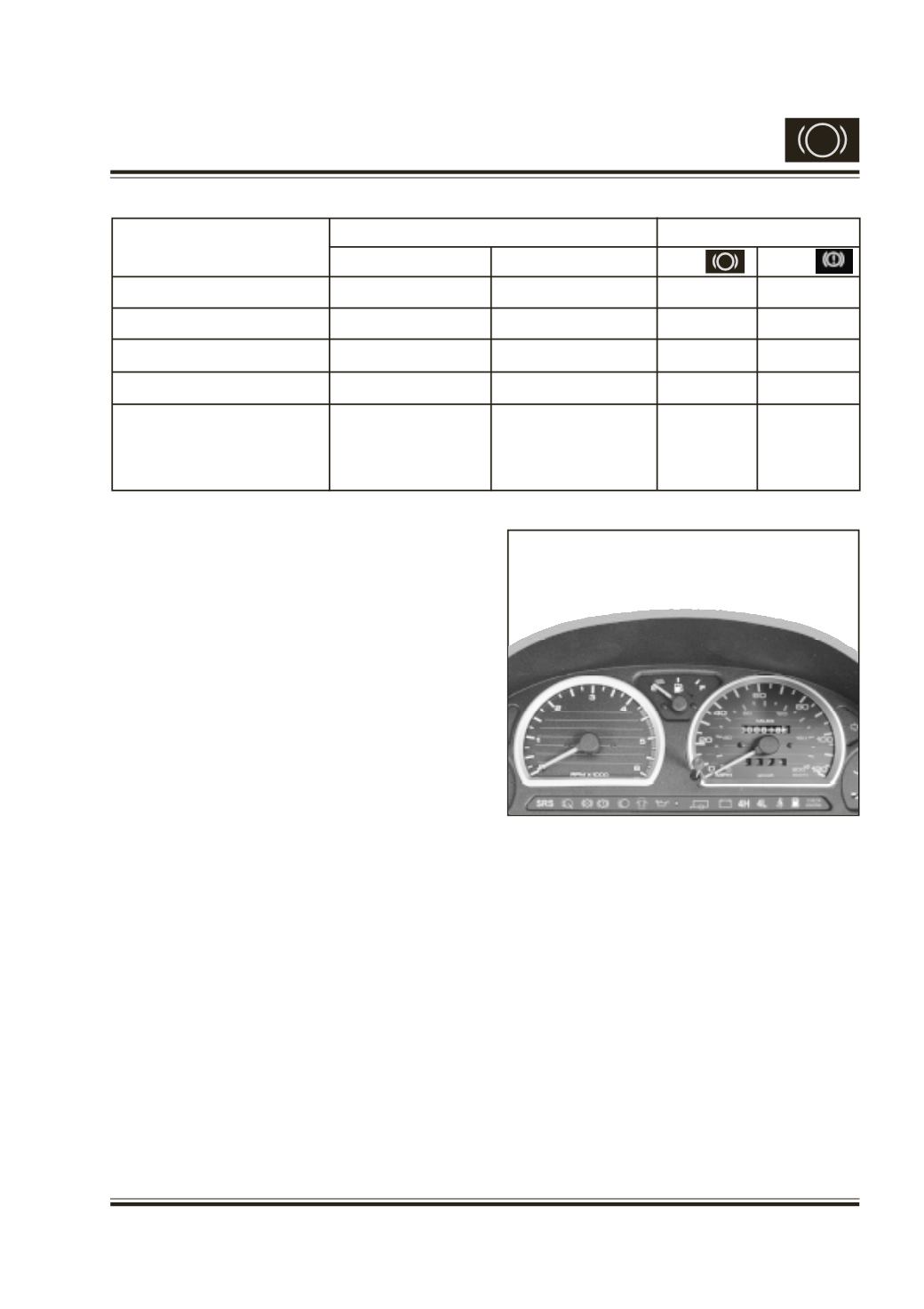
Under normal condition, with the ignition switch on,
the ABS warning light comes 'ON' and then goes
'OFF' after about 2 seconds. If it does not go 'OFF'
after this time, or light comes 'ON' when the engine is
running or light comes 'ON' at any other time, it means
that there is a fault in ABS system components.
If the warning light does not come on, the fault should
be sought in the electrical connections (for ignition
switch, ECU), fuse or warning lamp.
INSTRUCTIONSTOBE OBSERVEDONVEHICLES
FITTED WITH ABS
l
Before undertaking any electric arc welding
work, disconnect the ECU's connector.
l
During paintwork operations or major repair
work, which are likely subjected to higher
temperature (above 85
0
C). The HCU must be
removed.
l
Before removing the HCU, the battery's
negative cable must be disconnected.
l
If battery is removed, terminals must be fully
tightened.
l
Electrical wiring not to be repaired (should be
replaced).
l
Unit is not serviceable.
ABS