




 1271 / 1525

ENGINE
104
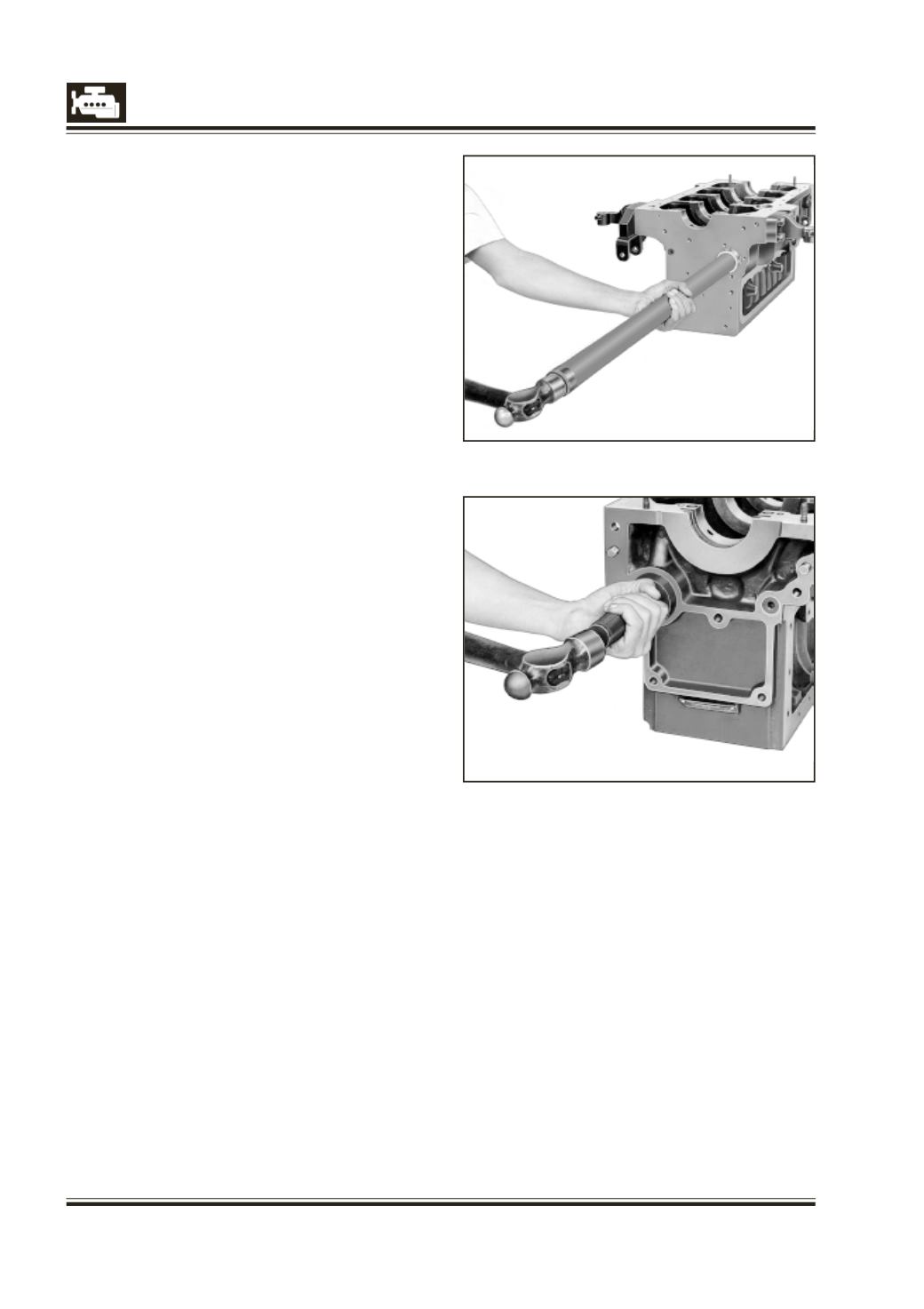
Fig. 20
Fig. 21
INSPECTION AND REPAIR OF CAMSHAFT AND
CAMSHAFT BUSHINGS
1 Carry out a visual inspection of camshaft for:
i.
Cracks, preferably check on a magnetic crack
detector.
ii. Overheating of journals, to be judged by
colour of journal bluish/brown colour
indicates overheating.
iii. Deep scoringmarks on journals and cams.
iv. Check hardness of journals and cam lobes with
skelerograph. It should be within specified
limits.
v.
Oil pump drive gear teeth for wear.
vi. Check condition of oil passage plug on rear face
of No. 3 camshaft journal. Replace plug, if
necessary.
2 Inspect dimensionally camshaft journals and their
runout.
3 If found beyond permissible limits grind camshaft
journals to next repair size.
4 Inspect dimensionally camshaft bushes in
crankcase.
5 If found worn beyond specified limits, remove
them from crankcase with drift, 312 589 07 39 and
sleeve, 312 589 07 39 and sleeve, 312 589 33 39
Fig. 20. Pry out expansion plug at 3rd bearing
before removal of this bush.
6 Fit new bushings with same tool.
7 Line bore camshaft bushings in accordance with
dimensions of camshaft bearing journals.
8 Fit expansion plug with special tool, Part No. 2523
5890 99 02 (Fig. 21) after coating its periphery with
sealing compound.
NOTE
a.
Camshaft bushes are serviced in semifinished
condition. After installation in crankcase it is
absolutely necessary to line bore them to
camshaft journals sizes.
b.
Do not grind camshaft journals beyond last repair
size.
c.
When fitting new camshaft bushings, following
care should be taken
i.
Bushing having axial slot in bore should be fitted
in parent bore for No. 1 journal, with slot to the
front (oil flowing from this groove lubricates
camshaft thrust washer and timing gears). Also
ensure that two oil holes in this bushing are in
line with drilled oil holes in crankcase.
ii.
No. 2, and 3 bearings are identical and are fitted
with one hole in line with that in crankcase.
iii. For manufacturing reasons, all camshaft bushings
are provided with 2 holes. However, only No. 1
bearing utilizes both holes functionally whereas
in others one hole is dummy.