




 835 / 1428

HVAC
865
HVAC
10.3 ON VEHICLE REPAIRS
Precautions while handling refrigerant lines:
WARNING:
Wear eye and hand protection when
disconnecting components containing refrigerant. Plug
all exposed connections immediately.
1. When disconnecting any hose or pipe
connection the systemmust be discharged of all
pressure. Proceed cautiously, regardless of gauge
readings. Open connections slowly, keeping
hands and face well away, so that no injury
occurs if there is liquid in the line. If pressure is
noticed, allow it to bleed off slowly.
2. Lines, flexible end connections and components
must be capped immediately they are opened to
prevent the entrance of moisture and dirt.
3. Any dirt or grease on fittings must be wiped off
with a clean alcohol dampened cloth. Do not use
chlorinated solvents such as trichloroethylene. If
dirt, grease or moisture cannot be removed from
inside the hoses, they must be replaced with new
hoses.
4. All replacement components and flexible end
connections must be sealed, and only opened
immediately prior to making the connection.
5. Ensure the components are at room temperature
before uncapping, to prevent condensation of
moisture from the air that enters.
6. Componentsmust not remain uncapped for longer
than 15 minutes. In the event of delay, the caps
must be fitted.
7. Receiver/driers must never be left uncapped as
they contain Silica Gel crystals which will
absorb moisture from the atmosphere.
8. The compressor shaft must not be rotated until
the system is entirely assembled and contains a
charge of refrigerant.
9. A new compressor contains an initial charge of
refrigerant oil. The compressor also contains a
holding charge of gas when receivedwhich should
be retained by leaving the seals in place until the
pipes are reconnected.
10. All precautions must be taken to prevent
damage to fittings and connections. Slight
damage could cause a leak with the high
pressures used in the system.
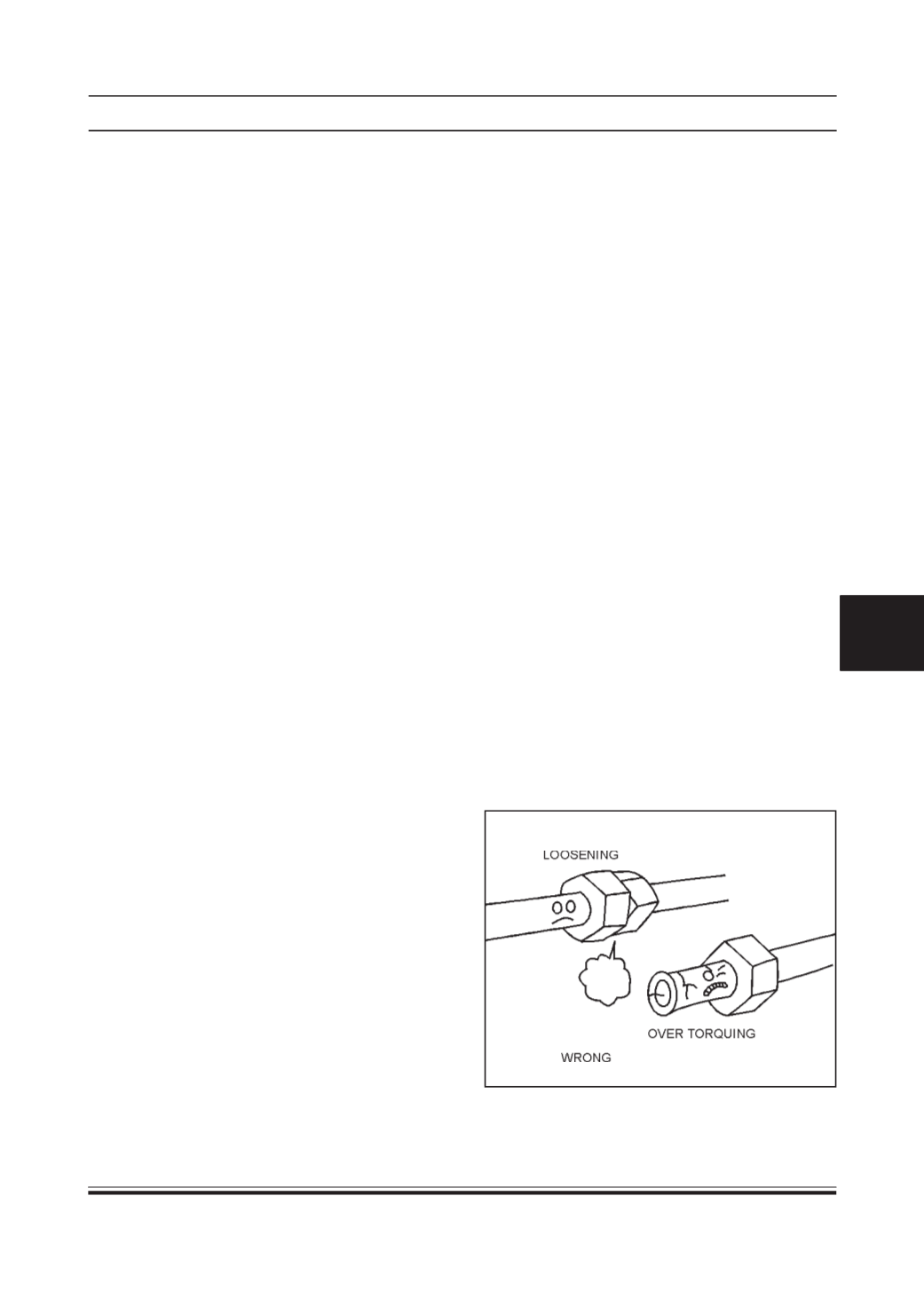
11. Always use two wrenches of the correct size,
one on each fitting when releasing and tightening
refrigeration unions.
12. Joints and ’O’ rings should be coated with
refrigeration oil to aid correct seating. Fittings
which are not lubricated with refrigerant oil are
almost certain to leak.
13. All lines must be free of kinks. The efficiency of
the system is reduced by a single kink or
restriction.
14. Completed assemblies must be checked for
refrigeration lines touching metal panels. Any
direct contact of lines and panels transmits noise
and must be eliminated.
Precautions while working on HVAC/AC Wirings
1. Disconnect battery negative terminal to prevent
any short circuits.
2. Connect wire connections securely.
3. Use a vinyl tape or original clamps to connect air
conditioning wire harness to main wiring harness.
4. If original harness is disconnected or removed for
any repair or diagnosis purpose, return it to a
proper position also during their installation be
careful not to pinch original clamps and AC wire
harness.
5. When adding lead wires to wiring harness by
soldering, use those lead wires which have the
same diameter with that of original one and
insulate each connections with tape.
6. Keep wiring harness away from the components
moving or subjected to high temperature.
7. Avoid any sharp edge contact with wire harness.
8. Retightening of pipe connections must be done
using two wrenches to avoid twisting of the
tubing.