



 481 / 1904

WHEELS AND TYRES
475
SUSPENSION
WHEEL RUNOUT
Wheel runout is because of poor bead seating on the
rim. Poor bead seating is usually the result of improper
mounting or the use of improperly made wheels.
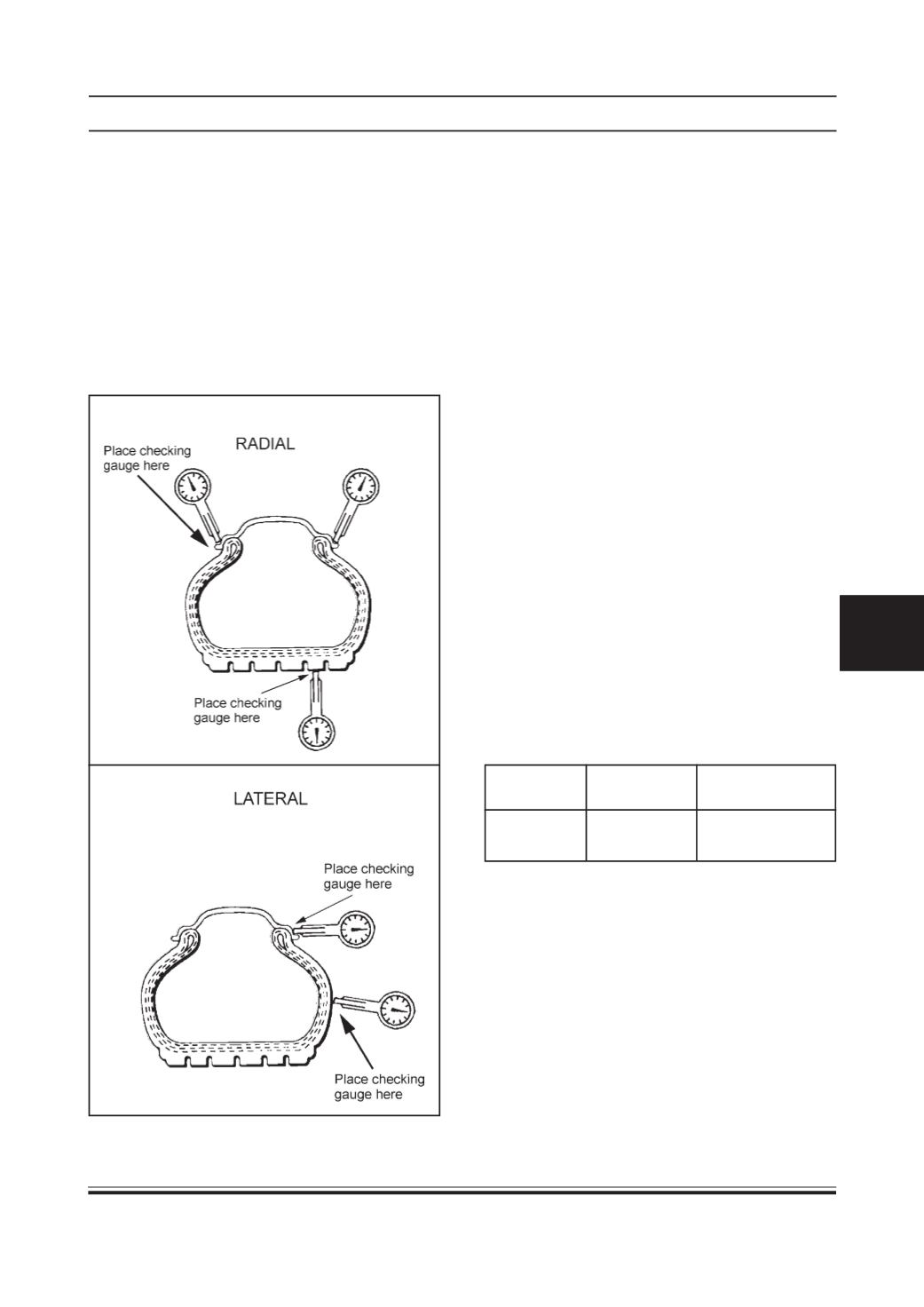
Basically there are two types of run-out :
(a) Radial runout:
An "out-of-round" situation where
vibrations are produced as thewheel spindlemoves
up and down.
(b) Lateral runout:
A side-to-side or wobbling
movement of the tyre and wheel.
Procedure to perform a wheel lateral and radial
run out check is as given below :
1. Remove wheel covers or wheel caps.
2. Mount the wheel on the vehicle or wheel balancer.
If on the vehicle, properly lift and support the vehicle
such that wheels can turn freely.
3. Position a dial indicator on a rigid fixture.
4. For lateral run out check, position the indicator
point horizontally against the side of the wheel
rim flange. For a radial runout check position the
indicator point vertically against the tyre mounting
surface of the wheel rim flange.
5. Slowly rotate the wheel one full revolution while
observing the dial indicator.
6. Rotate the wheel to the position where the lowest
dial indicator reading was obtained.
7. Zero out the dial indicator.
8. Slowly rotate the wheel one full revolution while
observing the dial indicator.
9. Record the highest dial indicator reading. Disregard
any indicator readings caused by welds, paint runs,
scratches etc.
10. Perform lateral and radial run out checks on both
inboard and outboard sides of the wheel.
11. Compare each reading with the specified values
(as given below) If the run out is greater than the
specification, the wheel must be replaced.
Run Out Checking Locations
Radial run Lateral run
out limit
out limit
Steel wheel / 1.14 mm 1.4 mm
Alloy wheel