



 482 / 1904

476
WHEELS AND TYRES
TYRE REPLACEMENT
Following precautions should be taken while
replacing tyres :
1. Whenever a tyre replacement is necessary, the
new tyre should be of original equipment type. It
should be of the same size, load range and
construction as those originally fitted on the
vehicle. Use of any other size or type may affect
ride, handling and vehicle ground clearance and
tyre clearance to the body chassis. Also be sure
that the wheel rim size and diameter are the right
ones for the tyre to be mounted.
NOTE :
It is recommended that new tyres be installed in pairs
on the same axle. In case of NANO as tyre sizes are
different, front tyres can not be installed in rear and
vice-versa.
2. Rim bead seats should be cleaned with a wire
brush or coarse steel wool to remove lubricants,
old rubber and light rust.
3. An inflated tyre, even with low air pressure, must
never be worked with a hammer while trying to
correct an improper position of the rings. In such
a case, the tyre must be deflated completely before
the necessary correction can be done.
4. Whenever a tyre is dismounted from wheel rim it
should be remounted such that the tyre and wheel
rim are matched. If the tyre’s paint dot cannot be
located, a line should be marked on the tyre and
wheel rim before dismounting to assure that it is
remounted in the same position.
Matched tyre and wheel rims :
Tyres and wheel rims are match mounted at the
assembly plant. This means that the radially stiffest
part of the tyre or “high spot” marked in YELLOW on
tyre, is matched to the smallest radius or “low spot”
of the wheel rim. This is done to provide the smoothest
possible ride.
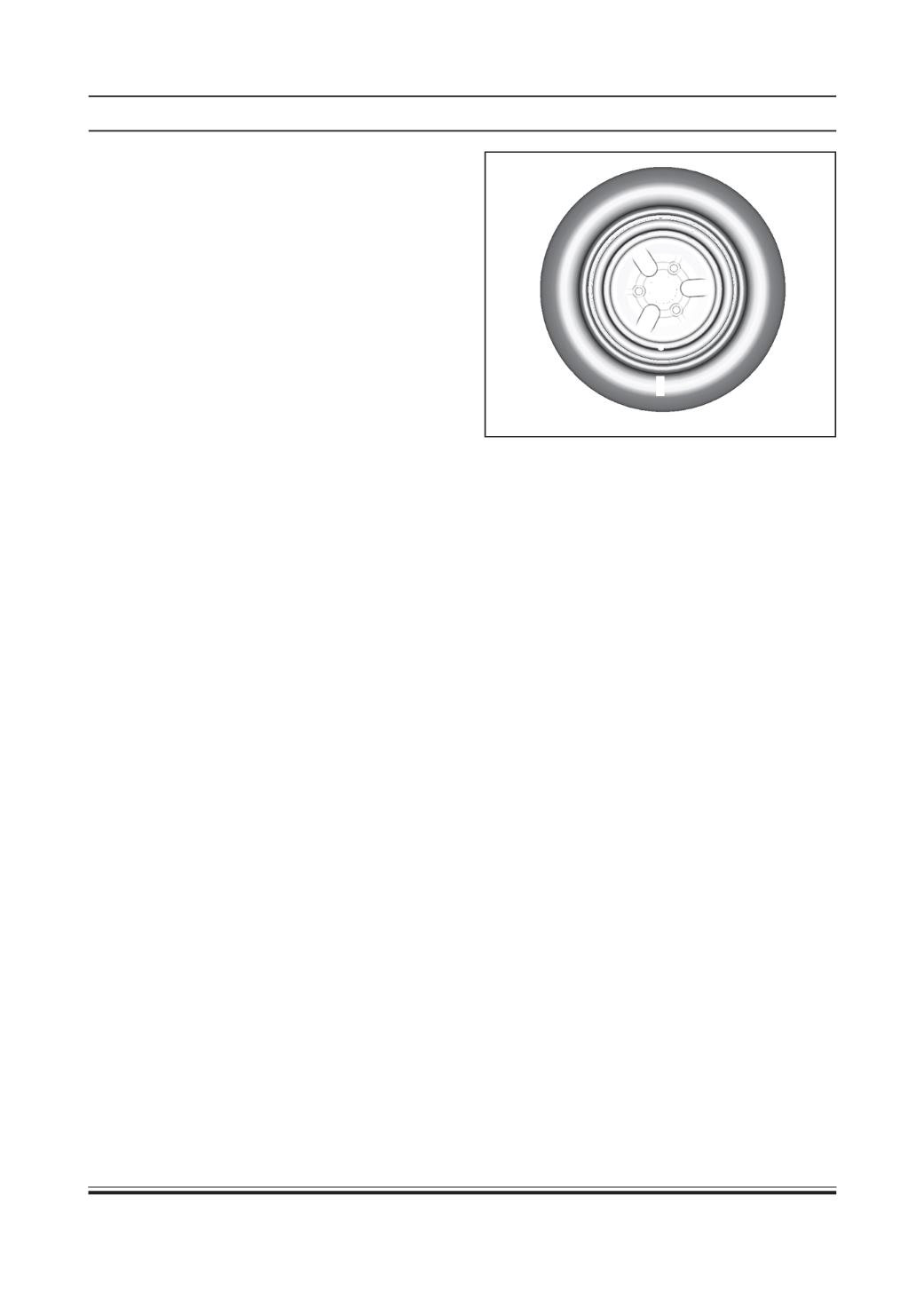
The colour spots on the tyres are originally marked
by paint dot on the out board sidewall.
The “low spot” is originally marked by paint dot on
the wheel rim-flange. If properly assembled, the wheel
rim’s paint dot should be aligned with the tyre’s paint
dot as shown in the figure.
Procedure for tyre replacement :
1. Always use a tyre changing machine to replace
tyres.
NOTE :
For replacing tyre, follow the manufacturer’s (of tyre
replacement machine) manual for installation
instructions, recommendations and any other
additional information.
2. Inspect the valve and replace the stem if necessary.
3. After replacing the tyre, inflate it to the specified
pressure so that beads are completely sealed.
4. Balance the wheel(s) (Refer wheel balancing
procedure)
WARNING :
(a) Do not use hand tools or tyre irons alone to change
tyres as they may damage tyre beads or wheel
rim.
(b) Do not exceed specified pressure when inflating.
(c) Do not stand near tyre when inflating. Bead may
break when bead snaps over rim’s safety hump
and cause serious personal injury.
(d) Do not mix different types of tyres on the same
vehicle such as radial, bias, and bias-belted tyres
except in emergencies, because handling may be
seriously affected and may result in loss of control.
(e) Do not fit an inner tube to a tubeless tyre to
overcome a problem of air leakage.