




 286 / 801

WHEELS AND TYRES
13
IV.
WHEEL RUN OUT
Wheel run - out is because of poor bead seating
on the rim. Poor bead seating is usually the result
of improper mounting or the use of improperly
made wheels.
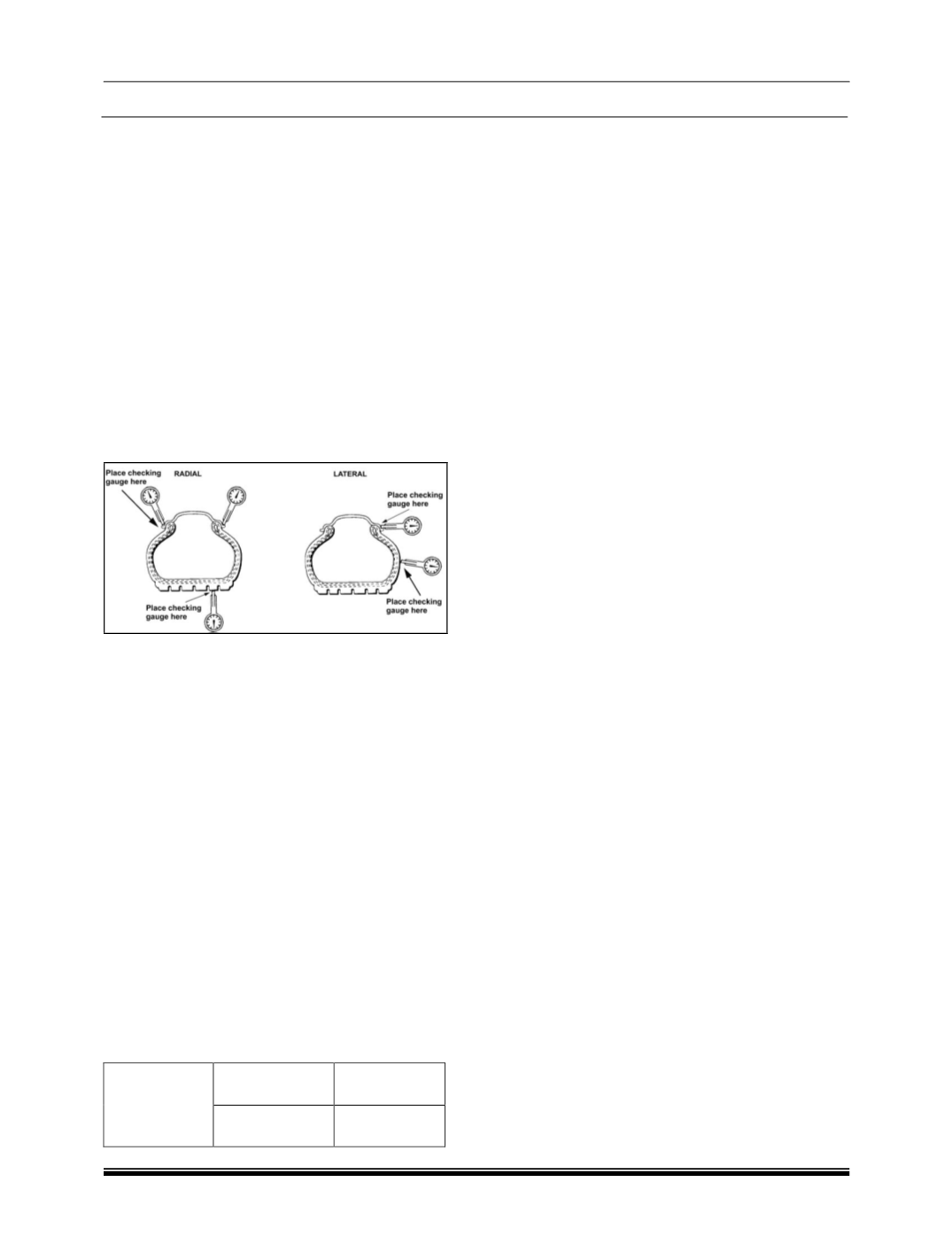
Basically there are two types of run-out:
a. Radial run-out:
An "out-of-round" situation
where vibrations are produced as the wheel
spindle moves up and down.
b. Lateral run-out:
A side-to-side or wobbling
movement of the tyre and wheel.
Procedure to perform a wheel lateral and radial
run out check is as given below:
1. Mount the wheel on the vehicle or wheel
balancer. If on the vehicle, properly lift and
support the vehicle such that wheels can turn
freely.
2. Position a dial indicator on a rigid fixture.
3. For lateral run out check, position the indicator
point horizontally against the side of the wheel
rim flange. For a radial run out check position
the indicator point vertically against the tyre
mounting surface of the wheel rim flange.
4. Slowly rotate the wheel one full revolution
while observing the dial indicator.
5. Rotate the wheel to the position where the
lowest dial indicator reading was obtained.
6. Zero out the dial indicator.
7. Slowly rotate the wheel one full revolution
while observing the dial indicator.
8. Record the highest dial indicator reading.
Disregard any indicator readings caused by
welds, paint runs, scratches etc.
9. Perform lateral and radial run out checks on
both inboard and outboard sides of the wheel.
10.Compare each reading with the specified
values
(as given below)
If the run out is greater
than the specification, the wheel must be
replaced.
Steel wheel /
Alloy wheel
Radial run-out
limit
Lateral run-
out limit
1.14 mm
(0.045 in)
1.4mm
(0.055 in.)
V.
DO'S AND DON’TS
•
For each vehicle, tyre of a particular size,
pattern and ply rating is recommended for
usage. Fit only recommended tyres.
•
The rim and wheel used must also be of the
recommended type and in a very good
condition.
•
Care must be taken while mounting the tyre on
the rim. Improper tools and careless handling
will not only damage the tyre but could result in
accidents causing serious injury.
•
It is recommended that with each new tyre, an
appropriate new tube and where applicable, a
new flap should be used.
•
The tyre has to be ensure with the right
inflation
as
recommended
by
the
manufacturer. Under-inflation and over-
inflation can seriously reduce the life of the tyre
and may even cause accidents due to
premature failures. The inflation pressure
should be checked at least once in a week
when the tyres are cold and have not run for
long.
•
The maximum load imposed on a tyre should
never exceed the maximum load carrying
capacity of the tyre.
•
Tyres rotation should be carried out as
recommended in the service schedule.
•
Driving on worn out tyres can be very
dangerous and can lead to serious accidents.