




 348 / 948

BRAKES
18
10. WHEEL SPEED SENSOR: (MONITORS
WHEEL SPEED)
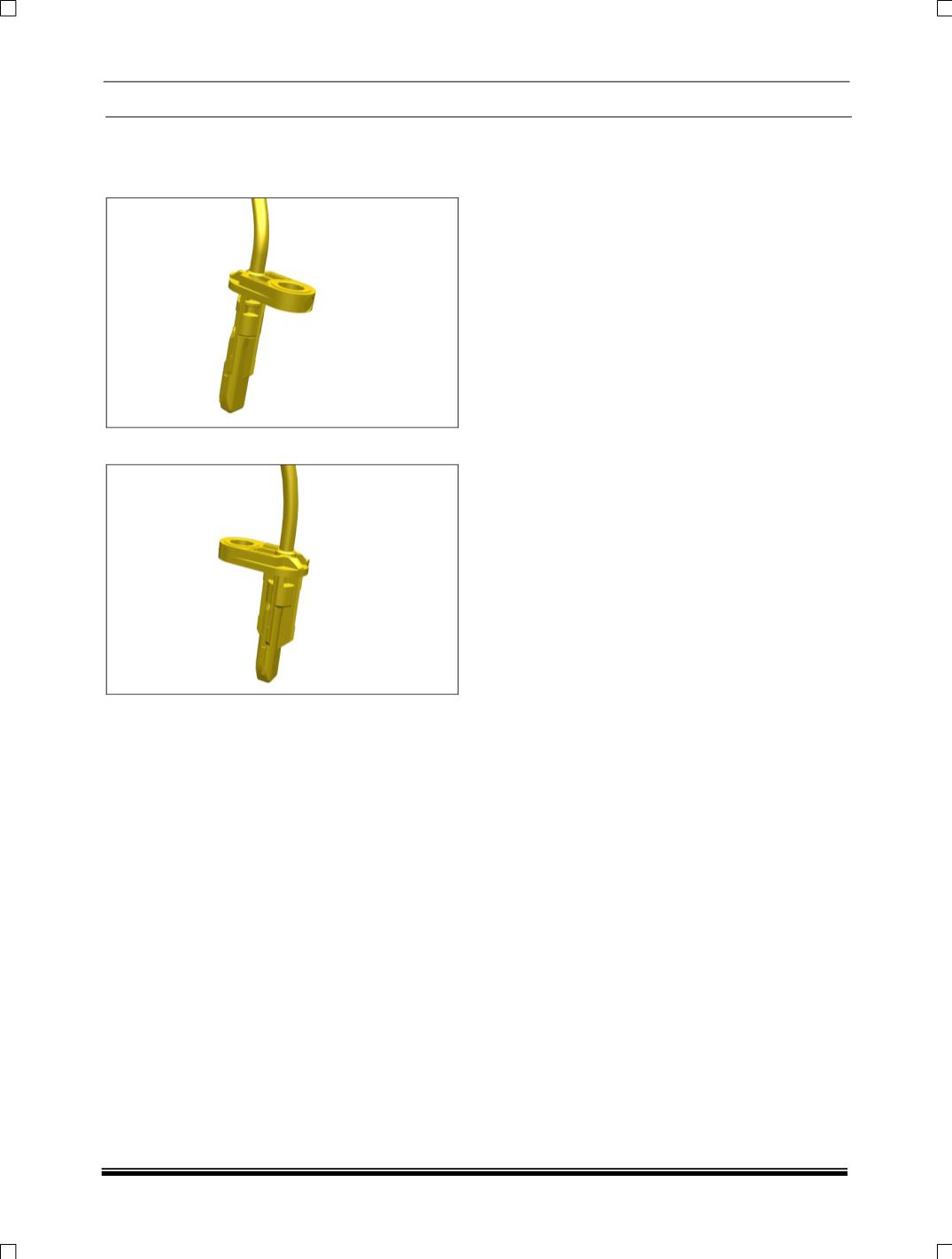
Front Wheel Speed Sensor
Rear Wheel Speed Sensor
Working principle:
It is an active wheel speed sensor, which means
that it must be connected to a voltage source for
operation. It supplies a signal with constant
amplitude pulses whose frequency varies with the
wheel speed. It uses Hall Effect principle, it has a
semiconductor chip with the electronic circuitry for
supply and signal processing integrated on it.
This chip is located within a completely insulated
magnetic circuit consisting of permanent mag- net
and pole elements. The wheel speed sensor is
mounted directly above the magnetized toner
wheel
WORKING PRINCIPLE:
It is an active wheel speed sensor, which means
that it must be connected to a voltage source for
operation. It supplies a signal with constant
amplitude pulses whose frequency varies with the
wheel speed. It uses Hall Effect principle, it has a
semiconductor chip with the electronic circuitry for
supply and signal processing integrated on it.
This chip is located within a completely insulated
magnetic circuit consisting of permanent mag- net
and pole elements. The wheel speed sensor is
mounted directly above the magnetized toner
wheel.
The magnetized toner wheel is a ring with teeth on
it. The toner wheel is fitted on to the wheel hub.
The alternating teeth and gap that accompanies
the wheel rotation induces differential magnetic
flux density, thus leading to the variation in the
voltage induced in the semiconductor chip. The
signal conditioning circuit converts this voltage
variation into constant amplitude current pulses.
The frequency of these pulses de- pends up on
the wheel speed. This measurement principle
permits zero speed measurement.
Precise alignment and gap (1 mm) between the
stator pole and the Toner wheel is vital. To obtain
correct signal, the specified gap between the end
of sensor & the toner ring must be maintained.
Front:
0.5 mm to 1.5 mm
Rear:
0.5 mm to 1.5 mm
Precautions while handling wheel speed
sensor
1. Storage temperature (- 40°C to + 115°C) should
not be exceeded
2. Avoid free fall of the sensor
3. The sensor tip should not be scratched.
4. Sensor should not be exposed to strong
magnetic field.