




 32 / 948

KRYOTEC ENGINE
23
CYLINDER LEAKAGE TEST
The cylinder leakage test provides an accurate
means for determining engine condition. Cylinder
leakage testing will detect:
• Exhaust and intake valve leaks (improper
seating).
• Leaks between adjacent cylinders or into water
jacket.
1. Check the coolant level and fill as required.
DO NOT install the radiator cap.
2. Start and operate the engine until it attains
normal operating temperature.
3. Turn the engine OFF.
4. Remove the fuel injector.
5. Set the piston of the cylinder to be tested at
TDC on the compression stroke.
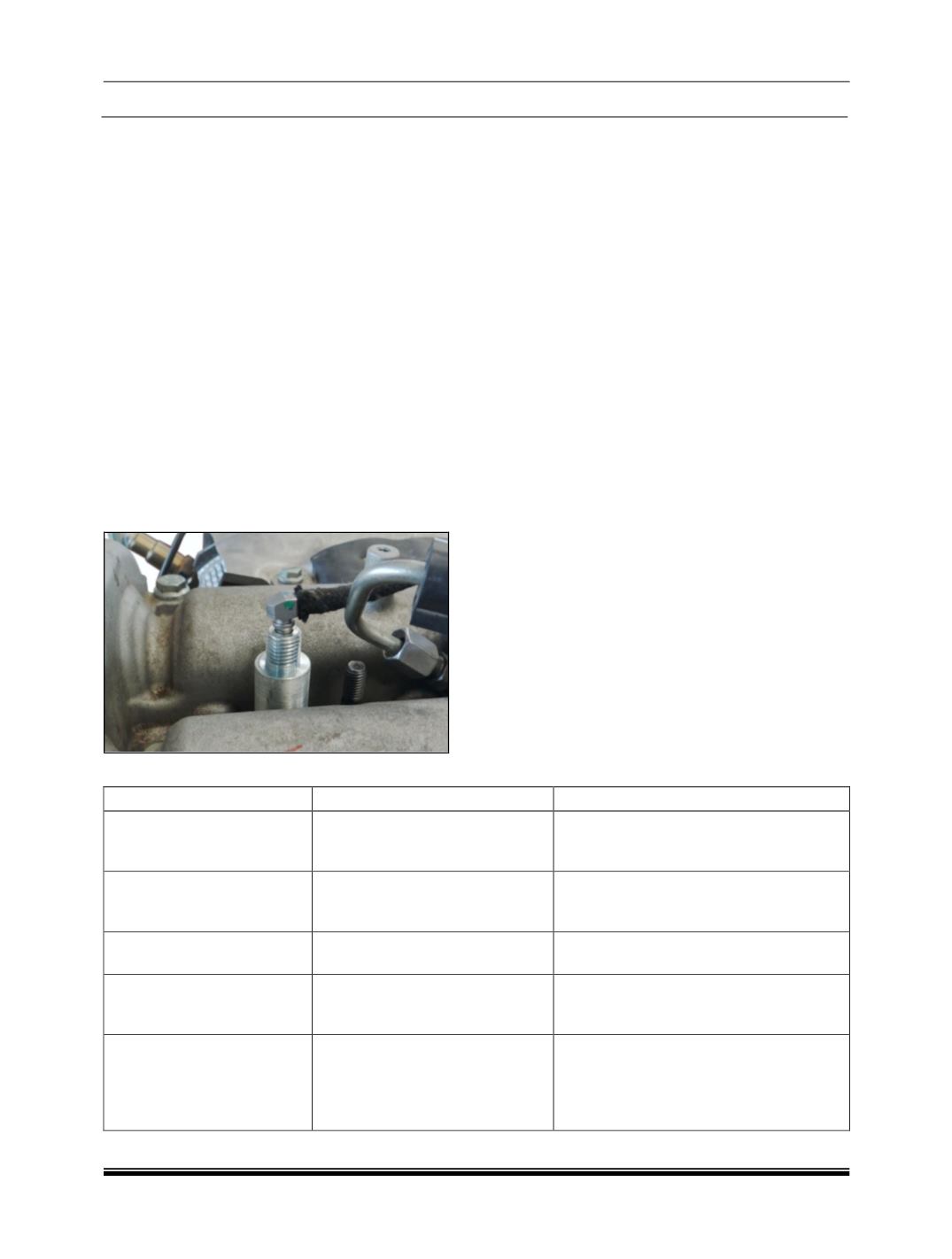
6. Install the 5412 5890 0702 dummy injector
complete with the fitting into fuel injector hole of
cylinder to be tested.
7. Install the clamp and tighten the nut 25 Nm (18
ft. lbs.).
8. Calibrate the tester according to the
manufacturer's instructions. The shop air source
for testing should maintain a regulated air
pressure at 552 kPa (80 psi).
9. Connect the leakage tester and perform the
leakage test procedure on each cylinder
according
to
the
tester manufacturer's
instructions.
10. As each cylinder is pressurized, listen for the
air escaping through the EGR air flow control
valve, tailpipe, and the oil filler cap opening.
Check for bubbles in the pressurized coolant
bottle.
11. All gauge pressure indications should be
equal, with no more than 25% leakage. Refer to
CYLINDER LEAKAGE DIAGNOSIS CHART
below.
CYLINDER LEAKAGE DIAGNOSIS CHART
CONDITION
POSSIBLE CAUSE
CORRECTION
AIR ESCAPES THROUGH
THROTTLE BODY
Intake valve bent, burnt, or not
seated properly.
Inspect valve and valve seat. Reface Or
replace, as necessary. Inspect valve
springs. Replace as necessary.
AIR ESCAPES THROUGH
TAILPIPE
Exhaust valve bent, burnt, or not
seated properly.
Inspect valve and valve seat. Reface or
replace, as necessary Inspect valve
springs. Replace as necessary.
AIR ESCAPES THROUGH
RADIATOR
Head gasket leaking or cracked
cylinder head or block.
Remove cylinder head and inspect.
Replace the defective part.
MORE THAN LEAKAGE
FROM ADJACENT
CYLINDERS
Head gasket leaking or crack in
cylinder head or block between
adjacent cylinders.
Remove cylinder head and inspect.
Replace gasket, head, or block as
necessary.
MORE THAN 25%
LEAKAGE AND AIR
ESCAPES THROUGH OIL
FILLER CAP OPENING
ONLY
Stuck or broken piston rings;
cracked piston; worn rings
and/or cylinder wall.
Inspect for broken rings or piston.
Measure ring gap and cylinder diameter,
taper and out-of-round. Replace
defective part as necessary.