




 96 / 1265

1.2L REVOTRON ENGINE
58
vii. Turbocharger
Check for Tuning
1. Check intactness of actuator rod end.
2. Collapsed or restricted air pipe before turbo
3. Check for crank bend or actuator rod bend or
hose pinch.
4. Restricted or damaged cross over pipes turbo
to inlet manifold.
5. Foreign object between air cleaner and turbo.
6. Compressor turbine wheel damage due to
Foreign object entry.
7. Turbine bolts, Compressor bolts, actuator
bracket bolts, or Clamps loose.
8. Check Air filter for any blockage
9. Check for excessive back pressure.
The Paint seal should not be broken.
If not OK the turbo charger must be replaced.
Check Turbocharger compressor wheel
damage
1. Disconnect Compressor Air inlet pipe.
2. Inspect compressor wheel blade.
3. There should be no visible damage.
If damaged, the turbo charger must be
replaced.
The entire air circuit must be cleaned or
changed to avoid new failure in case of
foreign object.
The foreign object can be found in the heat
exchanger.
Check Turbocharger rotor movement
1. Check rotor movement, it should spin freely.
2. There should be no trace of contact with
housing.
If not OK the turbo charger must be replaced
Check Turbocharger Turbine wheel damage
1. Disassemble Turbocharger or exhaust gas
connection.
2. Inspect turbine wheel rotor damage, you need
to look behind the blades, damages are often
located in tip area. If damaged, the turbo charger
must be replaced. The foreign object can be
found in the catalyst or in the particulate filter
Back to back swap test with a new
turbocharger
After all the diagnostic, and if nothing wrong is
found, it may be recommended to test with a new
turbocharger and decide on turbo replacement.
B. ENGINE TESTS
I. ENGINE COMPRESSION TEST
DESCRIPTION
The engine compression test provides the
technician with information regarding the
condition of the engine piston rings/block,
cylinder head gasket, and the valves. Before
performing the engine compression test, make
certain the loss of power or overheating cannot
be attributed to something simple such as
improper fuel, obstructed air filter, low oil or
coolant level, or dragging brakes.
TEST PROCEDURE
1. If possible, bring the engine up to operating
temperature (approximately 80° - 90° C) by
starting and driving the vehicle for several
minutes.
2. Make sure the vehicle battery is fully
charged.
3. Remove the air filter.
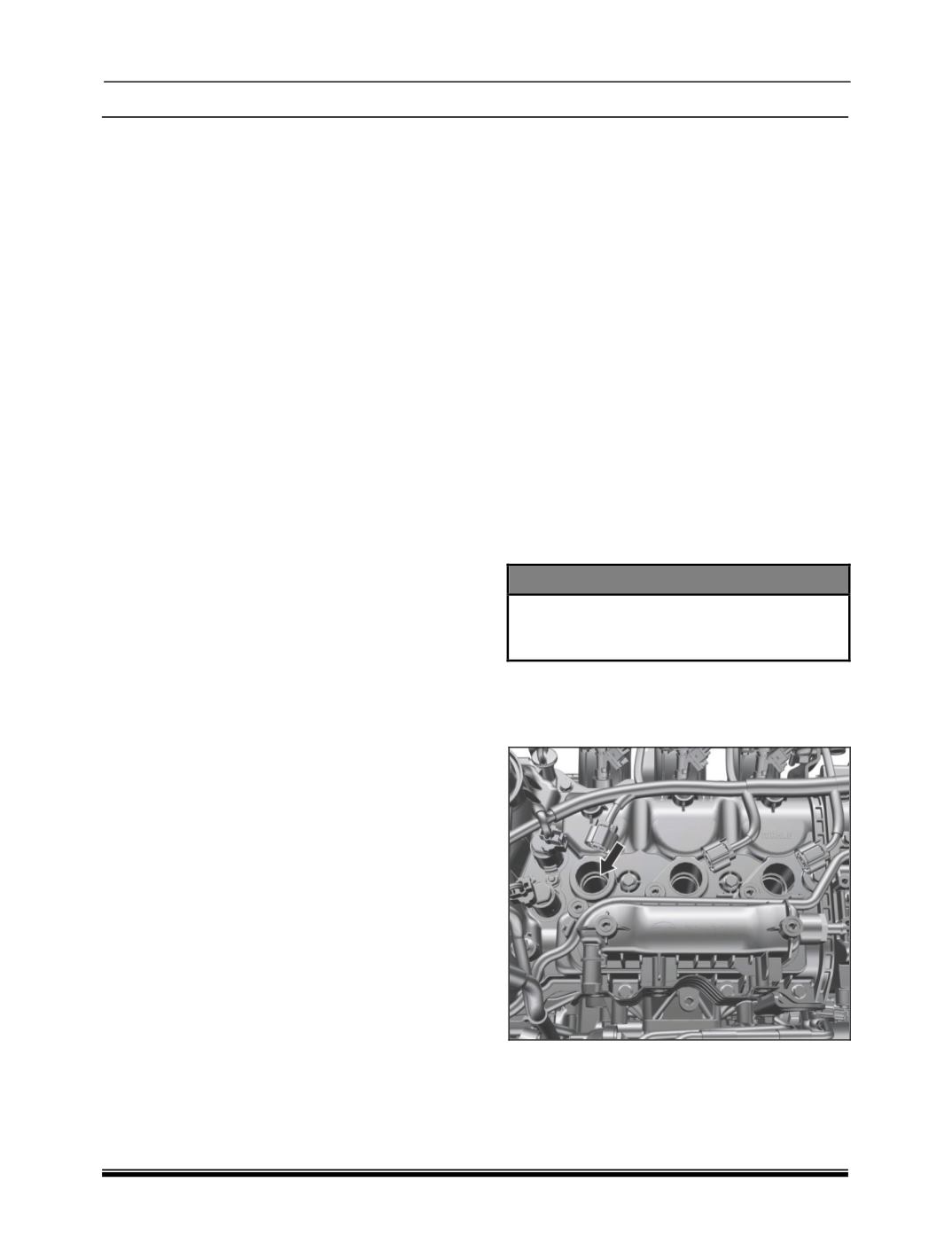
4. Label the spark plug coils and remove all
spark plugs from the engine.
CAUTION
Use care not to damage the threads in the
spark plug port when installing the
compression test gauge adapter.
5. Install an engine compression test gauge (0
to 25 bar) into the number one engine
cylinder spark plug port. . (Remove fuel
injector connections to avoid fuel injection).
6. Depress the clutch and accelerator pedal
fully and crank the engine
7. Have an assistant read and record the
highest pressure obtained on the gauge.
8. Follow steps 5 through 7 for the three
remaining cylinders, recording the pressure