




 98 / 1133

1.2L REVOTRON ENGINE
60
11. Drive the vehicle for approximately 200 or
300 km. A minimum of 30 - 40 km should be
on a highway or other road where a speed of
60 km/h can be maintained. Record the
distance travelled (D).
12. Return the vehicle to the exact location the
oil was previously drained from the engine.
13. Wait for few minutes to cool down the oil.
14. Drain the oil from the engine into the
container used to originally weigh the oil.
Allow the oil to drain completely and use
care not to spill any oil, as this will adversely
affects the test results.
15. Weigh and record the weight of the oil (W2).
16. Calculate and compare oil consumption.
a. Determine the amount of oil consumed
(W3) by subtracting the weight of oil after
the drive from the original oil weight (W1-
W2).
b. Divide the oil consumed by the specific
gravity of oil to determine the volume of
oil consumed, in milliliters (W3 / 0.88 =
C
a
ml)
c. Divide the volume of oil consumed by the
distance traveled to determine the volume
of oil consumed per kilometer (C ml by
D).
d. Multiply by 1000 to determine the amount
of oil consumed every 1000 km.
e. Compare the actual oil consumed with
the standard oil consumption.
Calculation
W1 - W2 = W3
Divide W3 by 0.88 gm/cm
3
= C
a
ml
Divide C
a
ml by D
Multiply by 1000
Solution
Milliliters consumed per 1000 km
III. ENGINE OIL PRESSURE TEST
DESCRIPTION
If suspecting the oil pressure of being
inadequate or a faulty oil pressure transducer,
the pressure can be checked by removing the oil
pressure transducer and connecting a gauge
directly to the engine head.
PROCEDURE
1. Park the vehicle on a flat surface and
engage the parking brake.
2. Check that the oil level is at the 'MAX' mark
on the engine oil dipstick. Add oil as
necessary.
3. Verify that the right grade weight of oil is
used.
4. Inspect the engine thoroughly for signs of
external leaks through the cylinder head
cover seal, crankshaft main seals, camshaft
seal, oil sump gasket, oil pump sealant, oil
sump drain plug, etc. Repair any external
leaks.
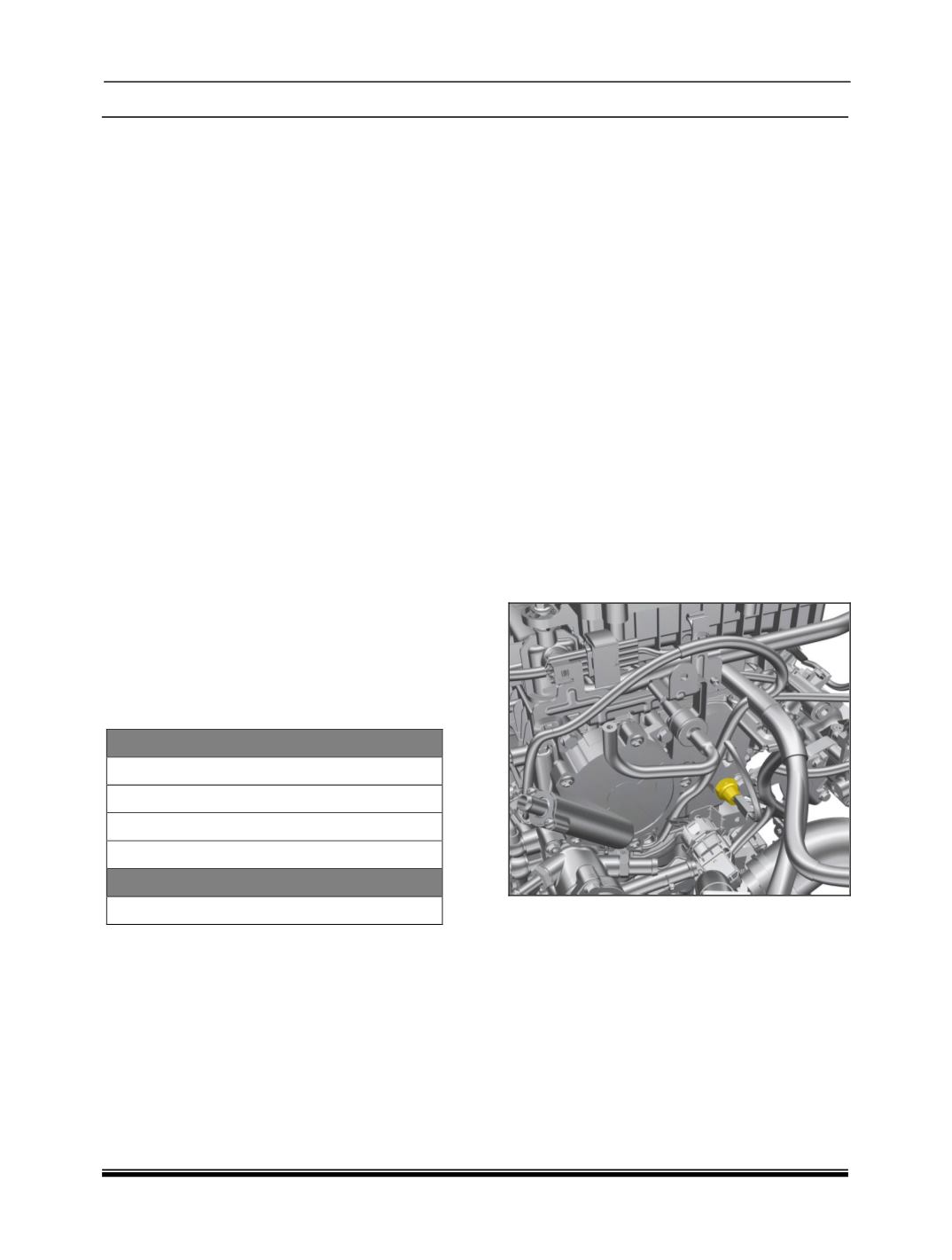
5. Disconnect the oil pressure transducer,
electrical connection. Remove the oil
pressure transducer from the engine.
6. Install a pressure gauge in the oil pressure
transducer port.
7. Place the vehicle in neutral and start the
engine. Allow the engine to warm up to
normal
operating
temperature
(approx.80°C).