




 13 / 1906

GENERAL
6
7. If correct service tool is not available, use a suita-
ble drift approximately 0.4 mm
(0.015 in)
smaller
than outside diameter of seal. Use a hammer
VERY GENTLY on drift if a press is not suitable.
8. Press or drift seal in to depth of housing if housing
is shouldered or flush with face of housing where
no shoulder is provided. Ensure that the seal
does not enter the housing in a tilted position.
NOTE
Most cases of failure or leakage of oil seals are due
to careless fitting, and resulting damage to both
seals and sealing surfaces. Care in fitting is essential
if good results are to be obtained.
Never use a seal
which has been improperly stored or handled,
such as hung on a hook or nail.
BEARINGS
BALL AND ROLLER BEARINGS
! CAUTION
Never refit a ball or roller bearing without first ensur-
ing that it is in good condition.
1. Remove all traces of lubricant from bearing un-
der inspection by washing in a suitable
degreaser; maintain absolute cleanliness
throughout operations.
2. Inspect visually for markings of any form on roll-
ing elements, raceways, outer surface of outer
rings or inner surface of inner rings. Reject any
bearings found to be marked, since any marking
in these areas indicates onset of wear.
3. Holding inner race between finger and thumb of
one hand, spin outer race and check that it re-
volves absolutely smoothly. Repeat, holding
outer race and spinning inner race.
4. Rotate outer ring gently with a reciprocating mo-
tion, while holding inner ring; feel for any check
or obstruction to rotation, and reject bearing if
action is not perfectly smooth.
5. Lubricate bearing generously with lubricant ap-
propriate to installation.
6.
Inspect shaft and bearing housing for discolora-
tion or other marking suggesting that movement
has taken place between bearing and seating.
(This is particularly to be expected if related
markings were found in point 2).
7. Ensure that shaft and housing are clean and free
from burrs before fitting bearing.
8. If one bearing assembly of a pair shows an im-
perfection it is generally advisable to replace
both with new bearings; an exception could be
made if the faulty bearing had covered a low
mileage, and it could be established that dam-
age was confined to it only.
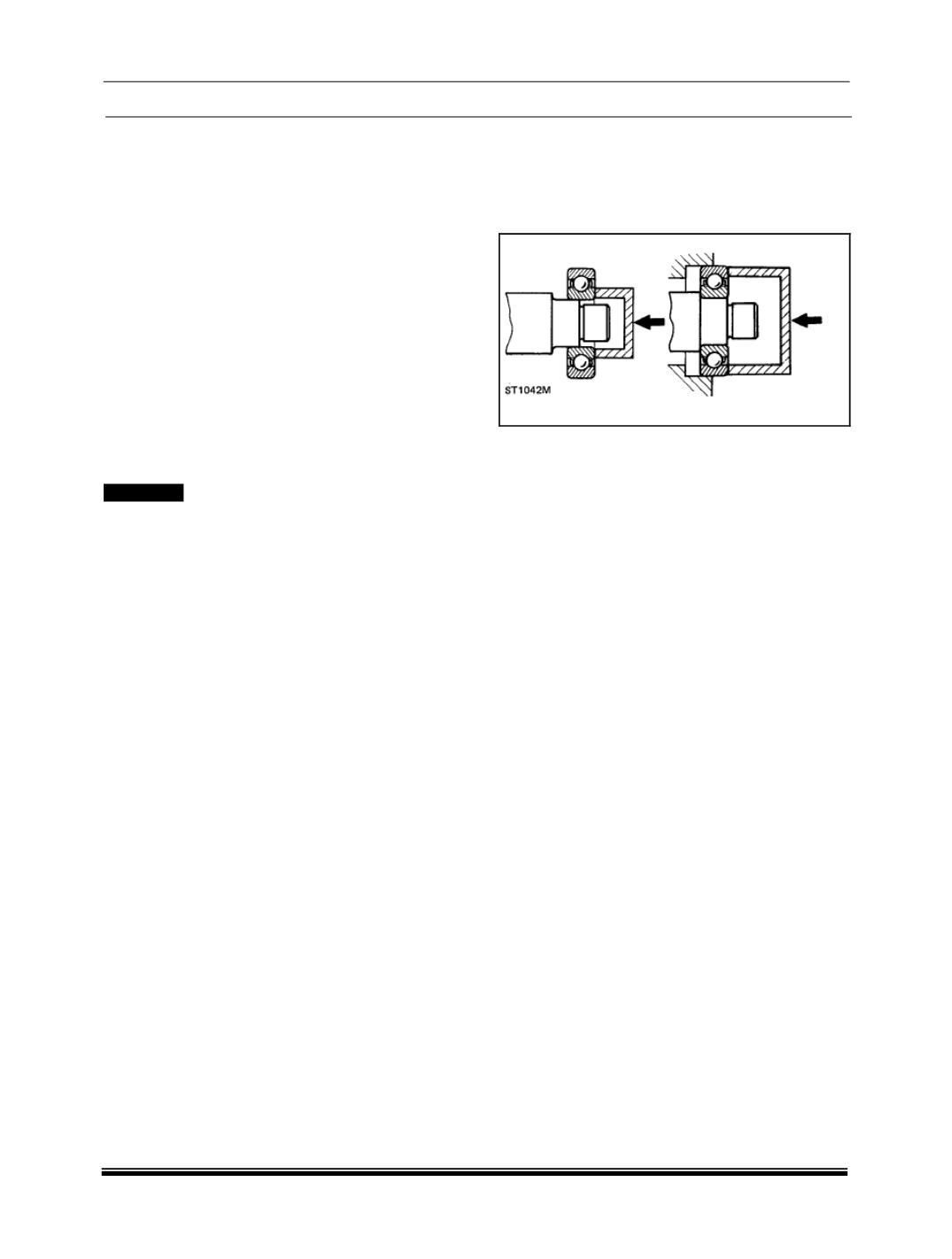
9. When fitting bearing to shaft, apply force only to
inner ring of bearing, and only to outer ring when
fitting into housing, as shown above.
10.Inthe case of grease lubricated bearings (
e.g.
hub bearings)
fill space between bearing and
outer seal with recommended grade of grease
before fitting seal.
11
.
Always mark components of separable bearings
(e.g. taper roller bearings)
in dismantling, to en-
sure correct reassembly. Never fit new rollers in a
used outer ring, always fit a complete new bear-
ing assembly.