




 429 / 1232

ENGINE 1.3L QUADRAJET (90PS)
92
Operation at low rotation speeds:
When the engine runs at a low rotation speed, the
exhaust gases possess little kinetic energy; in these
conditions a traditional turbine would turn slowly,
providing limited supercharging pressure.
In the variable geometry turbine (1) on the other hand,
the moving vanes (2) are in the maximum closed
position and the small sections between the vanes
increase the speed (C) of the exhaust gases
TURBOCHARGER – VGT TYPE
It is the variable geometry turbine (VGT) type and is
connected to the exhaust manifold. It is designed to
increase the volumetric efficiency of the engine.
Variable geometry type turbochargers are composed
of:
Q
a centrifugal compressor
Q
a turbine
Q
a series of moving vanes
Q
a pneumatic actuator controlling the moving vanes.
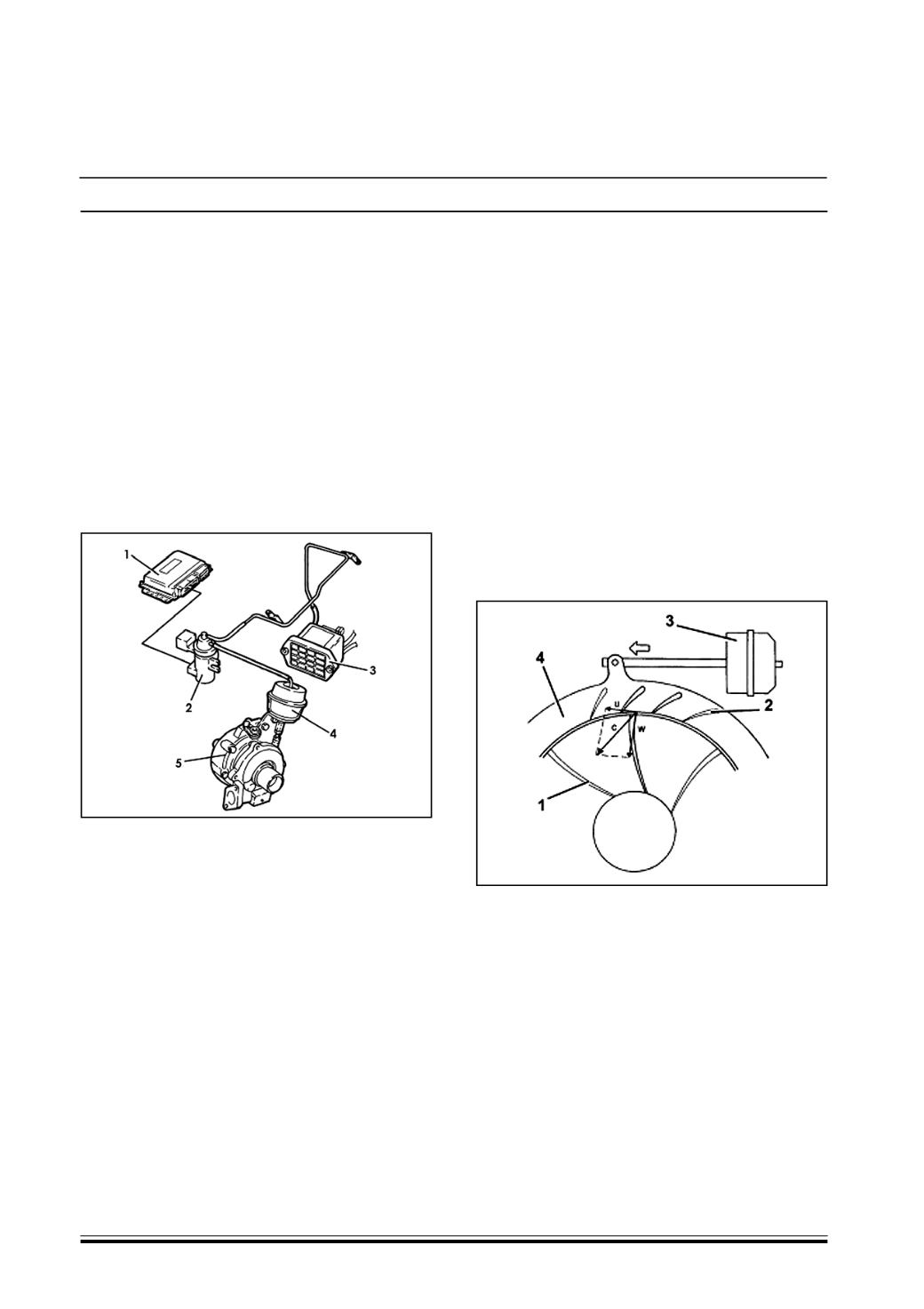
The management of the operation of the turbocharger
variable geometry is controlled by the control unit
through the operation of the VGT solenoid valve.
1. Engine management control unit
2. VGT solenoid valve
3. Vacuum reservoir
4. Moving vane control actuator
5. Turbocharger
The variable geometry turbocharger makes it
possible to:
(a) Increase the speed of the exhaust gases in the
turbine at low engine speeds
(b) Slow down the speed of the exhaust gases in the
turbine at high speeds.
Controlling the speed (kinetic energy) of the
exhaust gases allows for:
(a) Increased engine torque at low speeds
(b) Increased maximum power at high speeds.
Operation at high rotation speeds:
As the rotation speed of the engine increases, there
is a gradual increase in the kinetic energy of the
exhaust gases.
As a result, the speed of the turbine (1) and,
consequently the supercharging pressure, which also
acts on the actuator (3), increases.
The actuator (3), controlled by the solenoid valve, opens
the moving vanes (2) by means of a rod, until the
maximum opening position is reached.
The increase in the section produces a slowing down
of the flow of the exhaust gases passing through the
turbine (1) at speeds which are the same as or less
than the low speed condition.
The speed of the turbine (1) decreases and settles
down at a suitable level for the correct operation of the
engine at high speeds.
1. Turbine
2. Moving vanes
3. Pneumatic actuator
4. Rotary seal