



 135 / 1526

96
4 DLT ENGINE
TURBOCHARGER
Working Principle of Turbocharger
T
he power output from an internal combustion engine
depends on the mass of the air and fuel quantity that
are available for combustion. To increase the engine
horse power, more air for combustion and more fuel
have to be delivered. In case of a naturally aspirated
engine, the power increase is obtained by increasing
the swept volume or by raising the speed. Increasing
the swept volume, however, in general leads to larger
and heavier engines that are expensive.While a speed
increase involves considerable technical problems and
obvious disadvantages, like low mechanical
efficiency, increased wear and tear and increase in
noise etc.
Power increase with unchanged swept volume at the
same engine speed can be obtained by what is known
as supercharging of the engine.
S
uper charger delivers precompressed air to the
engine cylinders i.e. engine intake pressure is higher
than atmospheric whereas in naturally aspirated
engines it is slightly below atmospheric.
T
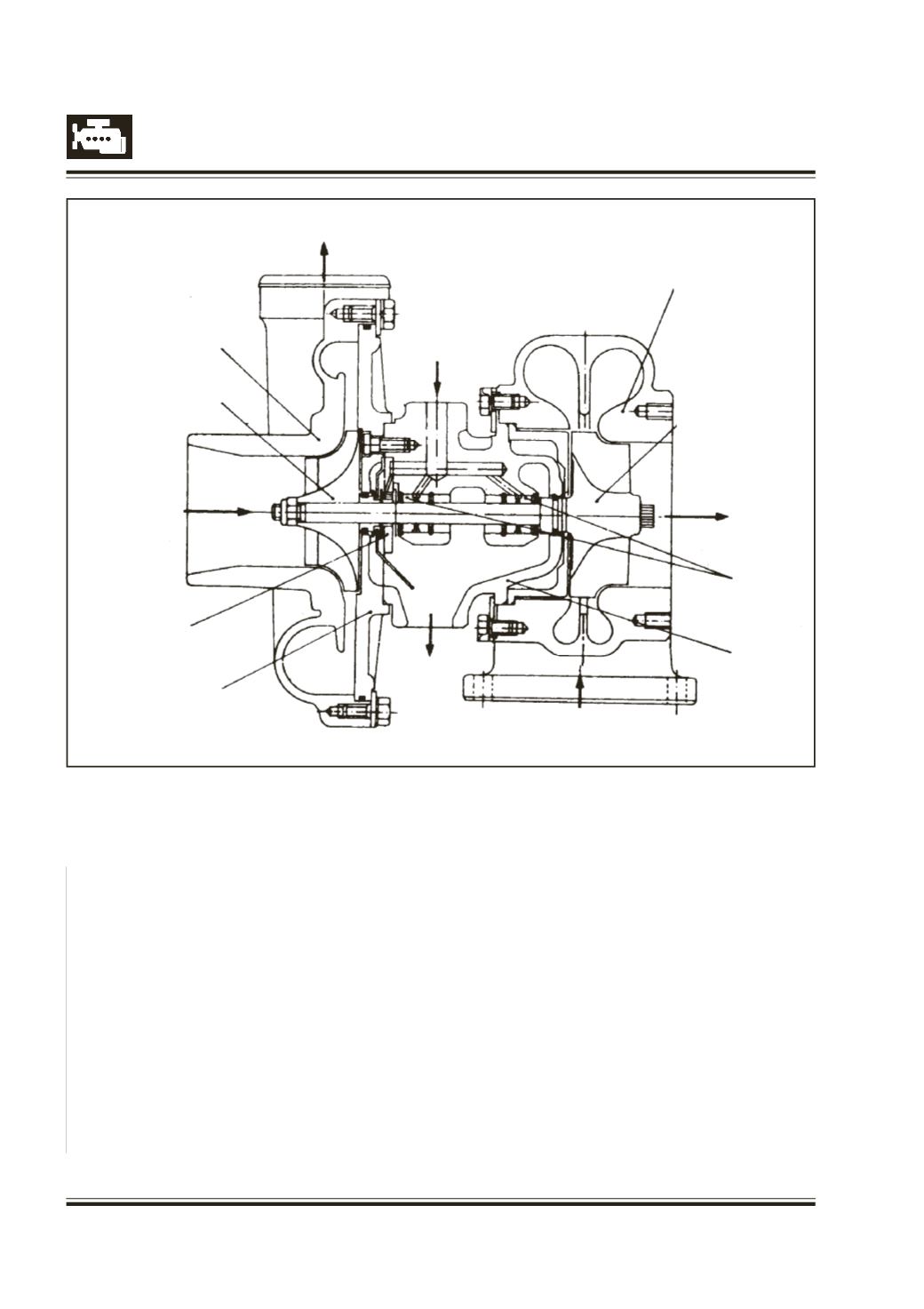
he turbocharger is one of the common super charging
devices used in an engine. It makes use of thermal
energy of engine exhaust gases to run a turbine which
in turn drives a compressor to pressurize the inlet air.
AIR TO
INDUCTIONMANIFOLD
COMPRESSOR
HOUSING
COMPRESSOR
WHEEL
AIR
FROM
FILTER
TURBINE
HOUSING
SHAFT &
TURBINE
WHEEL
ASSEMBLY
GASES TO
EXHAUST
PIPE
BEARING
BEARING
HOUSING
THRUST
BEARING
COMPRESSOR
BACKPLATE
GASES FROM
EXHAUST MANIFOLD
Fig. 185
OIL OUTLET
OIL INLET