




 1400 / 1525

18
4 PL FUEL SYSTEM
Assembly :
1.
Vapour hoses connections varies for each type of
joint.Necessarycare tobe takentoconnect andclamp
each hose correctly. Use suitable tool for fitment of
clamp.
2.
Donot kink/pinchor twisthosewhentheyare routed.
This will reduce the effectiveness of the emission
control systemandmay damage to fuel tank etc.
3.
Tank pressure valve must be fitted right way round.
Theport bearing theword“Tank”(tank end)must be
positioned towards the tank. The port bearing the
word“CAN”(canisterend)mustbepositionedtowards
the canister.The vacuum port to be connected to T
connector which is connected to intake manifold.
(Refer schematic circuit diagramFig. 22)
NOTE :
Unless replacement is necessary,it shouldnot be removed
from the circuit. Do not apply an excessive force to the
tank pressure valve nipple. This may result in bend /
damage.
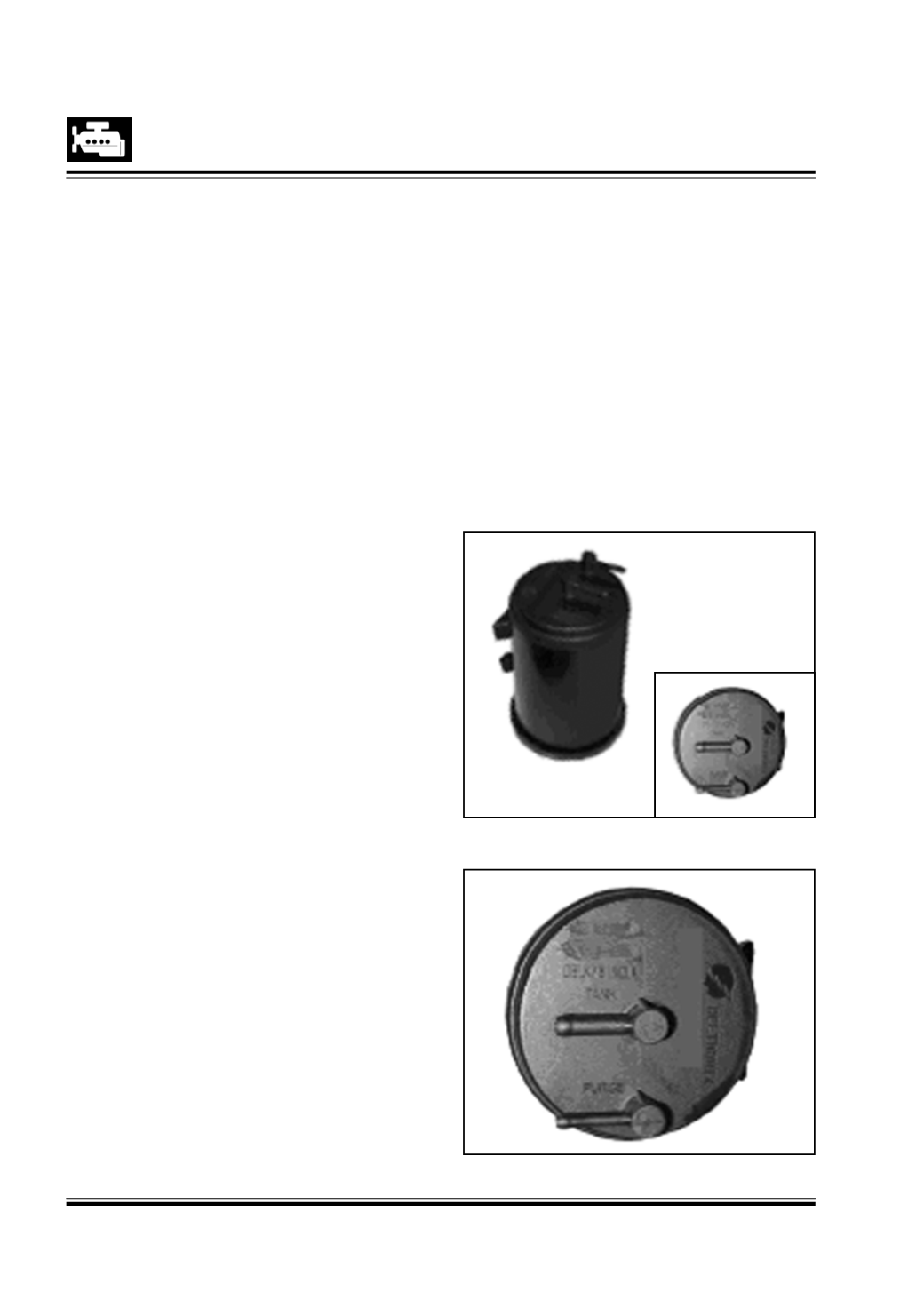
d) Carbon canister : Fig. 23 & 24
A canister made of high grade Nylon 66/PA66,
containing special dust free activated carbon is used
to adsorb fuel vapours.The lower endof the canister
is open to atmosphere for ventilation.The end is not
really open but there is foam filter. The purpose of
the bottom filter is to protect the canister fromdust
and dirt during operation. When the engine is
inoperative (i.e.whileparked) fuel vapoursgenerated
inside the fuel tankdue to fuel volatility are absorbed
andstored inthecanister throughtankpressurevalve.
When the engine is running, the fuel vapours
absorbed in the canister are purged into intake
manifold through canister purge valve operated by
ECU.Thepurgingtakesplaceduetoairdrawnthrough
the canister sbecause of pressure differential
betweenmanifold vacuumand atmosphere.
Removal:
1.
Disconnect hose ( from canister to purge valve).
2.
When the air is blown intoTank port,there shouldbe
no restriction of flow through Purge port and Air
port(i.e. canister bottomport).
3.
If the operation differs from the above description,
canister must be replaced.
4.
Connect hoses to canister.
5.
Ensure that hoses are clamped securely.
Warning :
Donot suck air through canister port. Fuel vapours inside
canister is harmful.
Fig. 24
Fig. 23