



 57 / 1235

ENGINE
.
25
ENGINE
so on lower side and equal, it may be due to
blown cylinder head gasket.
D. Fuel System
Check the Fuel system for fuel flow. If the flow is re-
stricted change the filter. Check for any kink or
blockage in the fuel lines. Check “Water in fuel indi-
cator” in the instrument cluster, if illuminated drain
the water from the sedimentor.
E. Clutch Slippage
•
Clutch slipping can be confirmed by any of the
following two methods:
•
Drive the vehicle with normal load in 3rd gear on
level ground and let the speed drop down to ap-
proximately 15 kmph. Now press accelerator
pedal fully. With slipping clutch abnormal engine
speed increase will be seen and vehicle speed
will not pick up. Also clutch burning smell will be
noticed. If this does not occur and vehicle picks
up speed normally, it indicates that clutch does
not slip.
F. Brake Binding
•
During driving apply brakes number of times and
then shift gear to neutral position and check free
rolling of vehicle. Check brake drums/brake
discs for overheating and if necessary jack up
the vehicle and check wheels for free rotation.
2. EXCESSIVE ENGINE OIL CONSUMPTION
High engine oil consumption may also lead to over-
hauling of the engine but before proceeding to
overhauling, check following points:
•
Make sure that there is absolutely no external oil
leakage i.e. from the camshaft oil seal, crank-
shaft oil seal, oil sump gasket, oil pump gasket,
and cylinder head cover gasket, turbocharger oil
feeder and return lines etc.
•
Ensure that the oil separator in the cylinder head
cover is properly mounted.
•
Check that no excessive oil found in the inter-
cooler piping and OMS is functioning properly.
•
If no external leakage is found, determine the
exact engine oil consumption, as per following
procedure.
DETERMINING EXACT ENGINE OIL CONSUMP-
TION
! CAUTION
Do not make a rough estimate of engine oil con-
sumption by noting the kilometers covered by the
vehicle at any random stage and finding oil con-
sumed from the topped up position taking into con-
sideration dipstick level and oil sump capacity.
PROCEDURE:
1. Once it is doubted that engine oil consumption is
higher, place the vehicle on a level ground.
2. Top up oil sump to its capacity of 7.5 liters.
3. Warm up the engine so that oil temperature is
75º- 80º C.
4. Take a clean vessel; place it below the drain
plug of oil sump.
5. Drain the hot oil into the clean vessel. Drain it
fully.
6. Screw in oil sump drain plug and tighten it.
7. Weigh the vessel along with oil. Let this weight
be ‘w1’ gms.
8. Refill the weighed oil into the oil sump. Do not
spill any oil. The vessel used for draining should
not be used for any other purposes.
9. Drive the vehicle approx. 200 - 300 km. This
drive should include at least 30 - 40 kms. Of
highway or similar road, vehicle running at about
60 kmph.
10. Let this drive distance be ‘D’ kms.
11. Immediately after the test drive, place the vehicle
at the same spot from where it started.
12. Place the same previously used vessel below
the Oil sump.
13. Unscrew the drain plug and drain off oil into the
vessel. Drain the sump fully.
14. Weigh the vessel along with oil, now for the se-
cond time. Let this weight be ‘w2’ Gms.
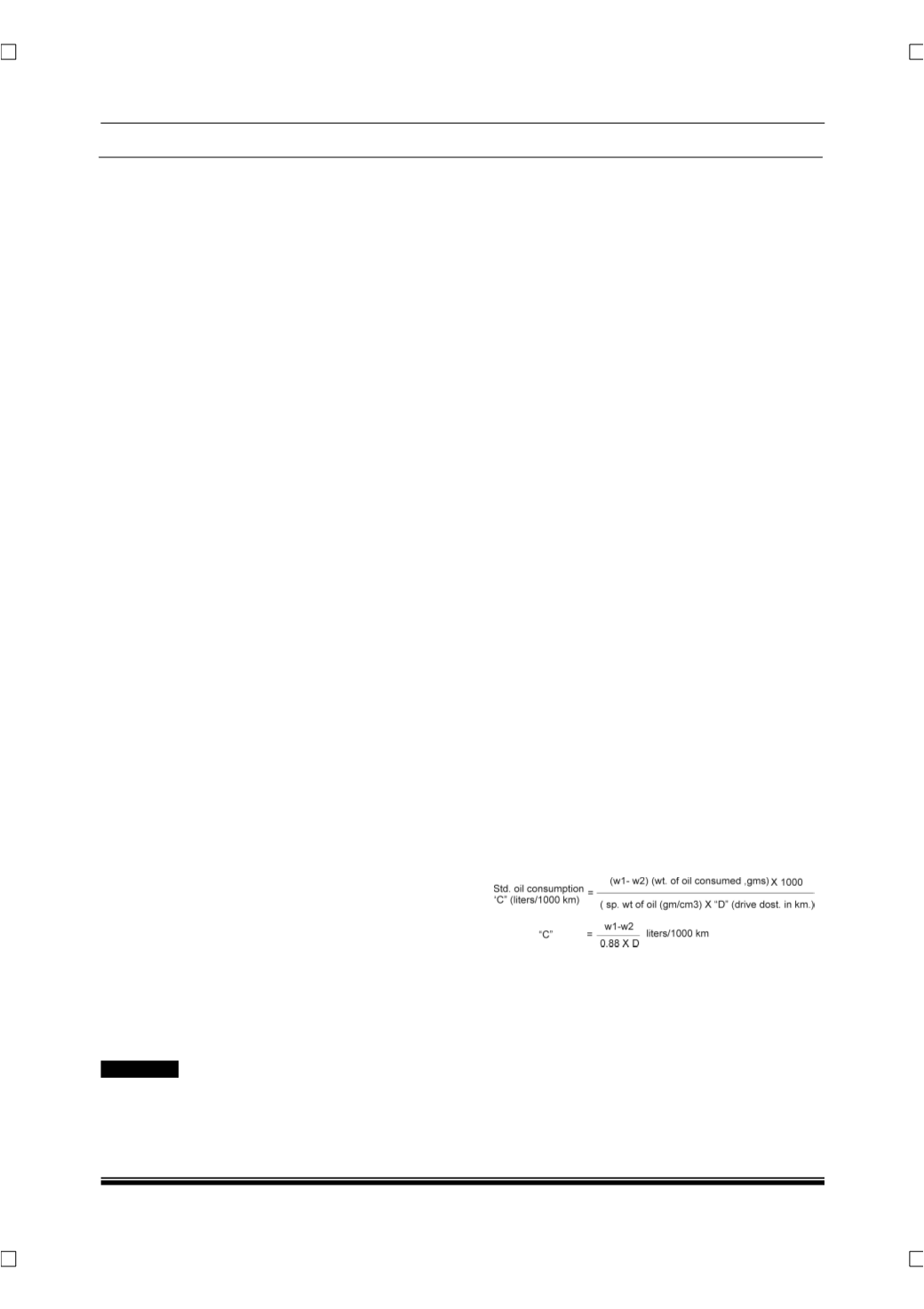
Find out standard oil consumption as follows:
If the engine oil consumption is more than 0.2 liter
per 1000 kilometers then it can be treated as high
engine oil consumption and the engine can be tak-
en for further investigation.
3. EXTREMELY LOW ENGINE OIL PRESSURE
Check the following:
•
External leakages.
•
Oil level in sump up to maximum mark on dip-
stick / Check oil level.