




 87 / 896

ENGINE 273 MPFI
83
ENGINE
COMPRESSION PRESSURE CHECKING
PROCEDURE
•
Warm up engine preferably by road drive to attend
a temperature of about 75 °C to 85 °C.
•
Remove fuel connection to fuel rail (after relieving
fuel pressure as indicated in fuel section) & suitably
prevent fuel from spilling from open connection.
•
Remove one of the spark plug whose compression
is to be check. (Refer Engine group for spark plug
removal procedure)
•
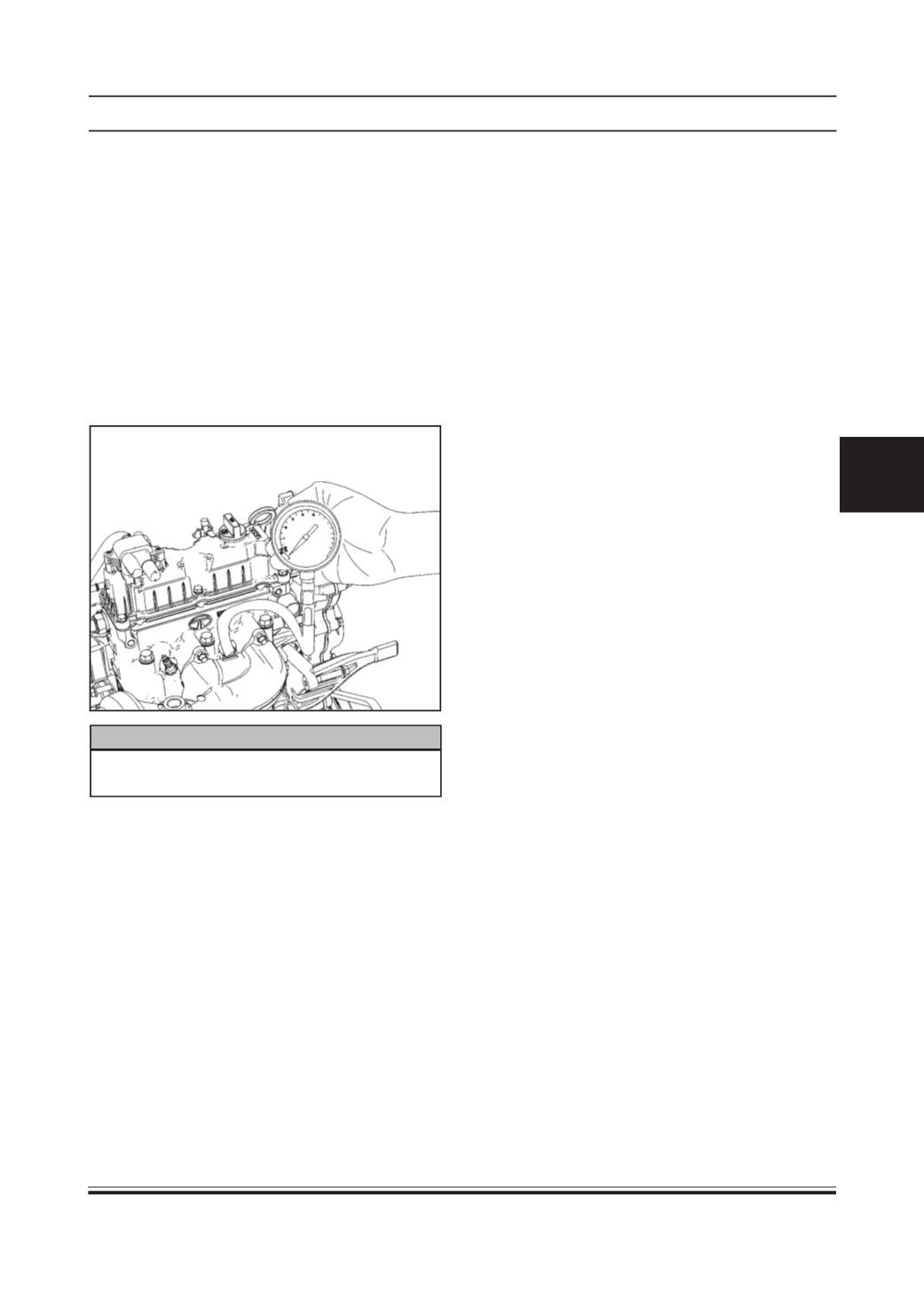
Install Compression gauge (Range about 0 to 25
kg/cm
2
) into one of the spark plug hole.
NOTE
Use adaptor if required which is commercially
available to suit the size of the spark plug threads
.
•
Press the clutch pedal to disengage clutch (to
reduce starting load on engine) and depress
accelerator pedal all the way to make throttle valve
open fully.
•
Disconnect ECU.
•
Crank engine with fully charged battery, and read
the highest pressure on compression gauge.
•
Carry out above steps on remaining cylinder to
obtain compression pressures. The specified
compression pressure is 12 to 13 bar minimum.
•
Variation in compression pressure between
cylinders should not be more than 1 bar.
•
Low compression pressure may be due to leakage
past valves / piston rings/blown cylinder head
gasket. To ascertain the point of leakage, spray
small quantity of clean engine oil in to the cylinder
showing low pressure and recheck compression
pressure. If it improves, wear in piston rings/cylinder
bore is indicated. If it does not, leakage past the
valves is indicated. If compression pressure of
adjacent cylinder is also on lower side, it may be
due to blown cylinder head gasket.