



 512 / 1904

500
BRAKE SYSTEM
General:
TATA NANO is equipped with a mechanical vacuum
booster to assist driver’s pedal effort. This is achieved
by using vacuum from engine inlet manifold. A
diaphragm is provided between the two shells of the
booster, the difference of pressure on two sides of
diaphragm (one side vacuum and another side
atmospheric pressure) gives mechanical advantage.
This amplifies the driver’s pedal effort while braking.
The unit is connected to the brake pedal and the master
cylinder. The vacuum booster input push rod is
connected to brake pedal while the output push rod
operates the master cylinder. If failure of vacuum
occurs, the two push rods act as a single rod and the
brakes will work in the conventional manner, but more
pedal effort will be required and the fatigue of the driver
will increase.
The booster assembly and TMC assembly are coupled
with the help of fasteners. The meting dimensions of
booster and TMC are factory set
Hence:
1. Do not alter the height of the output rod of the
vacuum booster unit at any stage and ensure
booster out put rod is correctly aligned to the
primary piston bore during assembly of TMC
to the booster.
2. Once the booster assembly is removed from
vehicle, at the time of refitting on vehicle, the
gasket at the mounting face of the booster
should be replaced with a new one.
3. Booster assembly is a non serviceable unit and
it should never be tampered with.
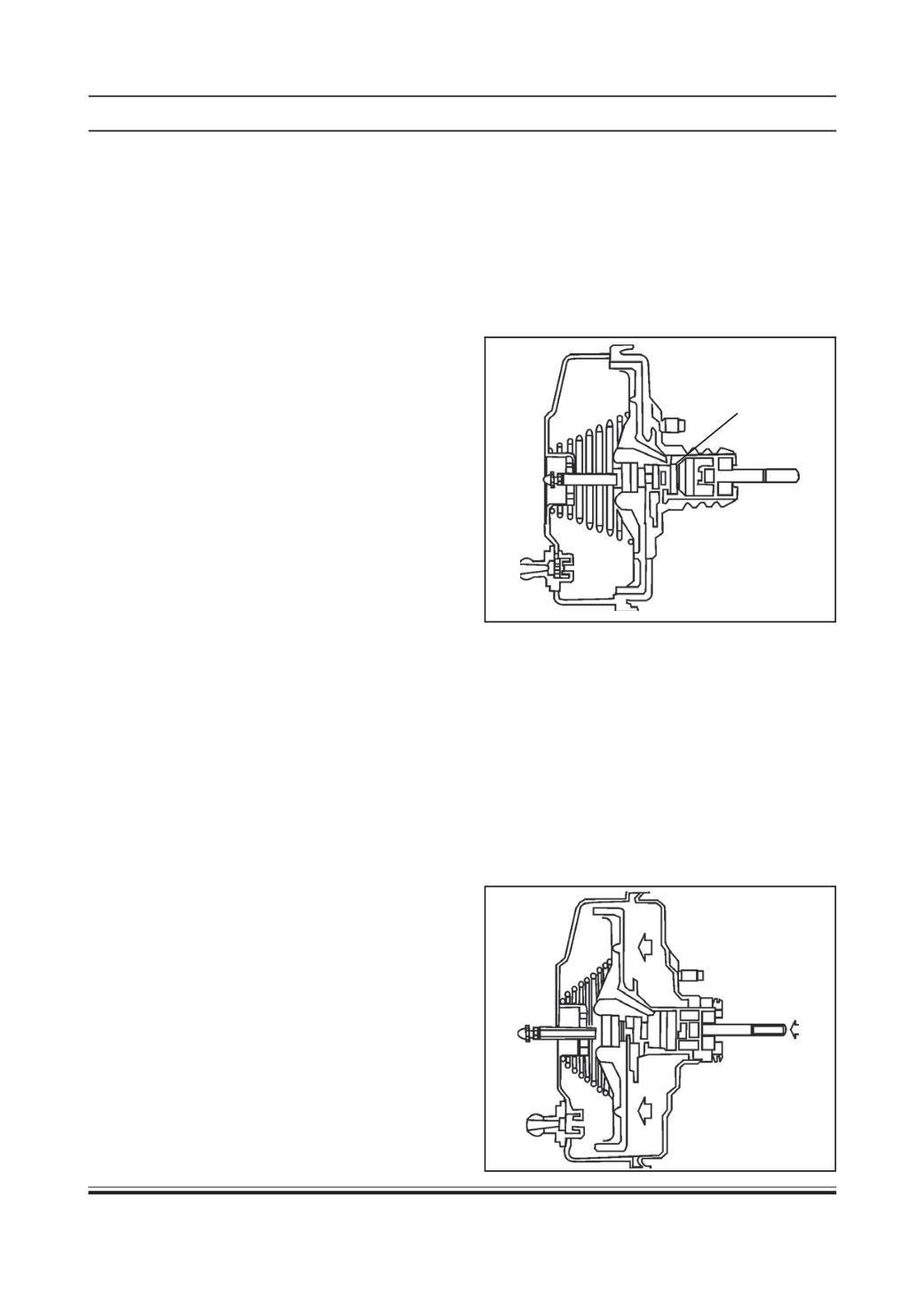
2. Brakes Applied
When the brake pedal is depressed, the input rod
assembly moves forward inside the diaphragm plate
until the control valve closes the vacuum port; at this
stage vacuum is still present on both the sides of the
diaphragm. As the input rod continues to move
forward, the control plunger moves away from the
control valve, opening the atmospheric port, which is
formed between these two parts. Air enters the rear
shell behind the diaphragm and the effect of
atmospheric pressure assisted by the valve rod helps
in pushing the diaphragm plate forward and thus the
output rod actuates the TMC plunger.
Vaccum port
WORKING PRINCIPLE OF VACUUM
BOOSTER
1. Brakes OFF
The diaphragm is fully retracted and is held against
the rear shell by the diaphragm return spring. The input
rod assembly is also fully retracted by the brake pedal
return spring. With the input rod in this position, the
vacuum port is open and the vacuum is applied on
both the sides of the diaphragm.