




 555 / 745

FATC
46
d) LEAK DETECTION
a. Visual Detection:
Look out for oil leaking from
joints, as compressor oil is mixed with refrigerant it
also circulates along with it, hence it might also leak
at the joints. If leakage is found rectify, if not proceed
with any of the test mentioned below to confirm leak-
age.
b. Ultra fluorescent Leak Detector:
The compres-
sor oil used is pre-mixed with a fluorescent dye.
Using a specially designed UV lamp inspect the
components. If there is a leakage the colored dye
glows bright. This test can pin point small leakages.
c. Electronic Leak Detector:
This test is done using
an electronic leak detector
1. Place the vehicle in a well ventilated area, free
from wind, as leakage can be dissipated without
detection in a windy area.
2. Follow the instructions issued by the manufactur-
er of the particular leak detector being used.
3. Commence searching for leaks by passing the
detector probe around all joints and components.
NOTE
Refrigerant gas is heavier than air.
4. Insert the probe into an air outlet of the evapora-
tor or into the evaporator drain tube.
5. Switch the air conditioning blower on and off at
intervals of ten seconds. Any leaking refrigerant
will be gathered in by the blower and detected.
6. Insert the probe between the magnetic clutch and
compressor to check the shaft seal for leaks.
7. Check all service valve connections.
8. Check the condenser for leaks at the pipe unions.
9. If any leaks are found, the system must be dis-
charged before rectification.
10.Rectify any leaks and recheck for leaks during
evacuation prior to charging.
(c) Using Soap Solution/ Leak detector spray:
A
leak detector spray or soap solution can be used to
detect the leak by spraying it at the joints. If there is
a leak bubbles are formed.
B. REGULAR MAINTENANCE
a) REFRIGERANT RECOVERY, RECYCLING
AND RECHARGING
WARNING
Air conditioning system is charged with a high
pressure, potentially toxic refrigerant. Repairs or
servicing must only be carried out by an operator
familiar with both the vehicle system and the
charging and testing equipment.
All operations must be carried out in a well- venti-
lated area away from open flame and heat
sources.
Always wear safety goggles and gloves when
opening refrigerant connections. Wear eye and
hand safety protection. Open connections slowly
and carefully when liquid or pressure is present,
allowing it to bleed off slowly.
CAUTION
Overcharging air conditioning system will cause ex-
cessive head pressure.
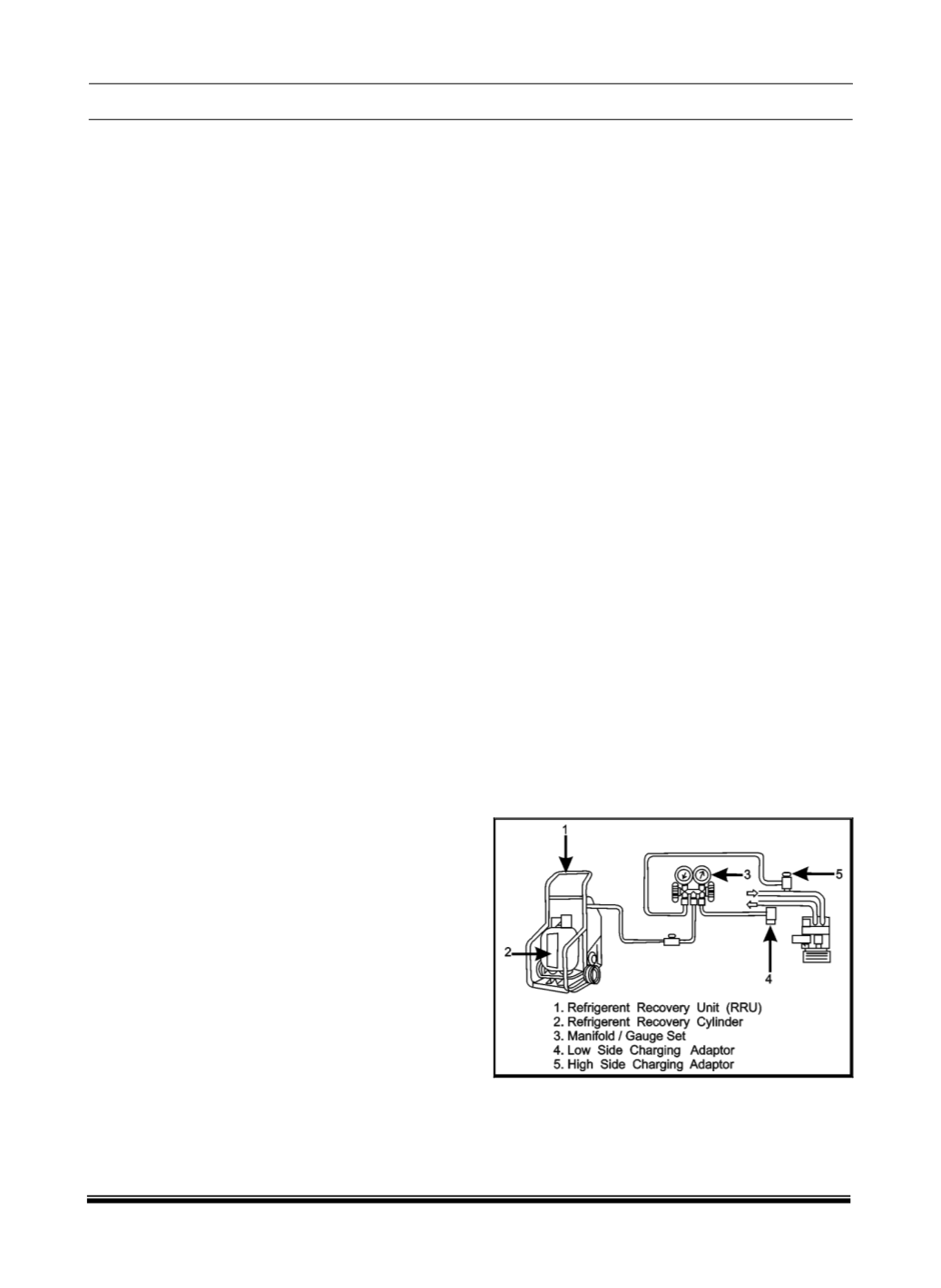
An air conditioning portable Refrigerant Recovery
Recycling Recharging Station or Refrigerant Recov-
ery Unit (RRU) for use with R134a refrigerant
incorporates all the features necessary to recover
refrigerant R134a from the air conditioning system,
to filter and remove moisture, to evacuate and re-
charge with the reclaimed refrigerant. The unit can
also be used for performance testing and air condi-
tioning system analysis.
The operator must adhere to the equipment manu-
facturers’ instructions.
The RRU set up is as shown in following figure: