




 414 / 745

BRAKES
11
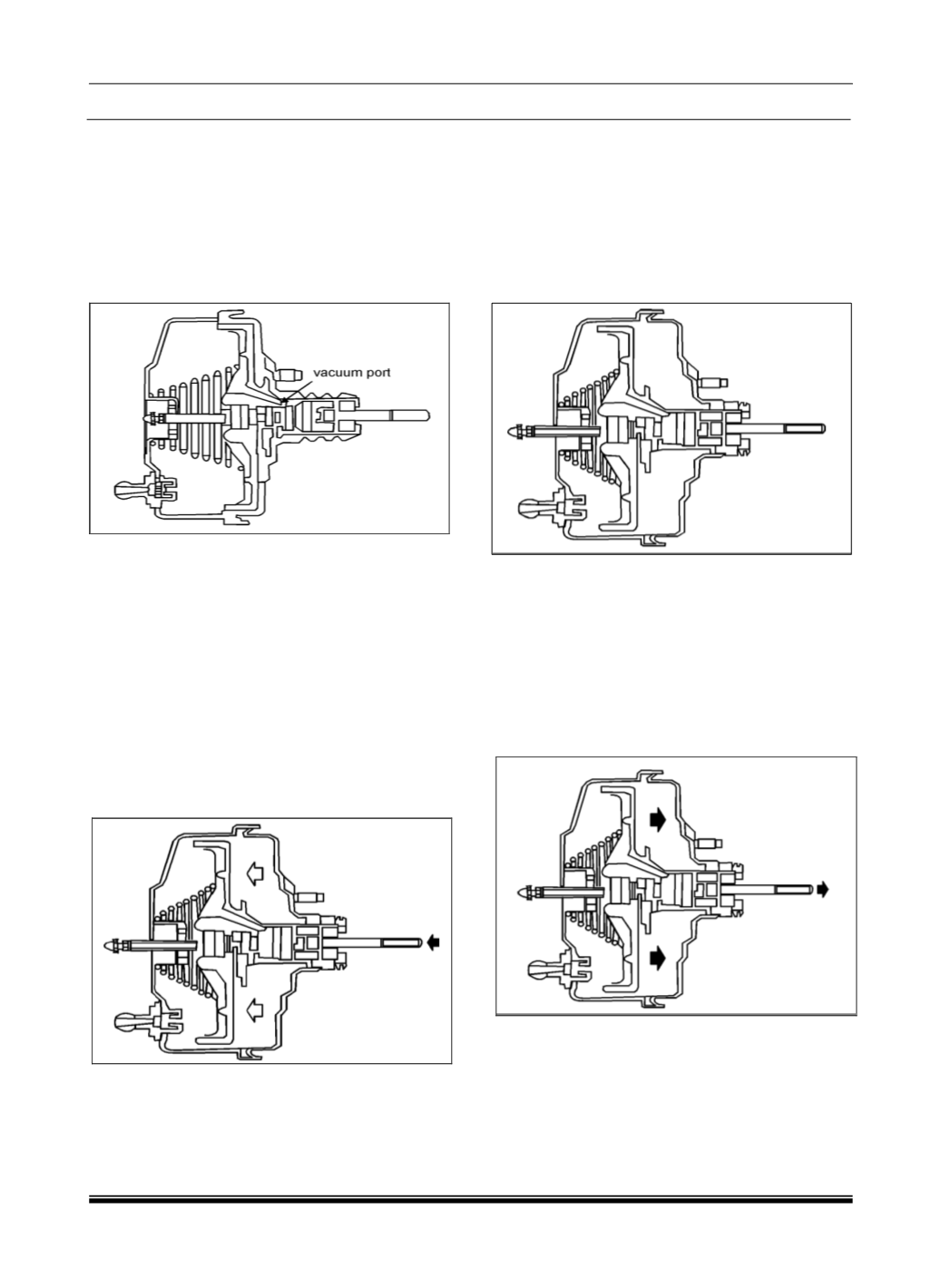
WORKING PRINCIPLE OF VACUUM BOOSTER:
1. Brakes OFF
The diaphragm is fully retracted and is held against
the rear shell by the diaphragm return spring. The
in- put rod assembly is also fully retracted by the
brake pedal return spring. With the input rod in this
position, the vacuum port is open and the vacuum
is applied on both the sides of the diaphragm
2. Brakes Applied
When the brake pedal is depressed, the input rod
assembly moves forward inside the diaphragm
plate until the control valve closes the vacuum
port; at this stage vacuum is still present on both
the sides of the diaphragm. As the input rod
continues to move forward, the control plunger
moves away from the control valve, opening the
atmospheric port, which is formed between these
two parts. Air enters the rear shell behind the
diaphragm and the effect of atmospheric pressure
assisted by the valve rod helps in pushing the
diaphragm plate forward and thus the out- put rod
actuates the TMC plunger.
3. Brakes Held ON
When the brake pedal is held on, the diaphragm
will momentarily continue to move forward and
thus compresses the outer edges of the reaction
disc. This movement causes the center of the disc
to extrude, pressing back the input rod and thus
closing the atmospheric port. Thus the output force
is balanced against that of the input force. Further
movement of the brake pedal either opens the
vacuum port or the atmospheric port depending on
whether the brake pedal is released or depressed.
4. Brakes Released
Immediately after the brake pedal is released, the
vacuum port is opened and the atmospheric
pressure in the rear chamber is extracted into the
front chamber and from there to the inlet manifold
via the non- return valve. The atmospheric port
remains closed whilst the input rod assembly
returns to its original position as shown in figure.
The diaphragm is then again ‘suspended’ in
vacuum until the brake pedal is depressed.