




 986 / 1119

HVAC
13
7. HVAC UNIT COMPONENTS
The front HVAC unit in vehicle comprises of the fol-
lowing parts:
A. BLOWER.
B. EVAPORATOR COIL AND TXV
(THERMAL
EXPANSION VALVE)
C. HEATER COIL
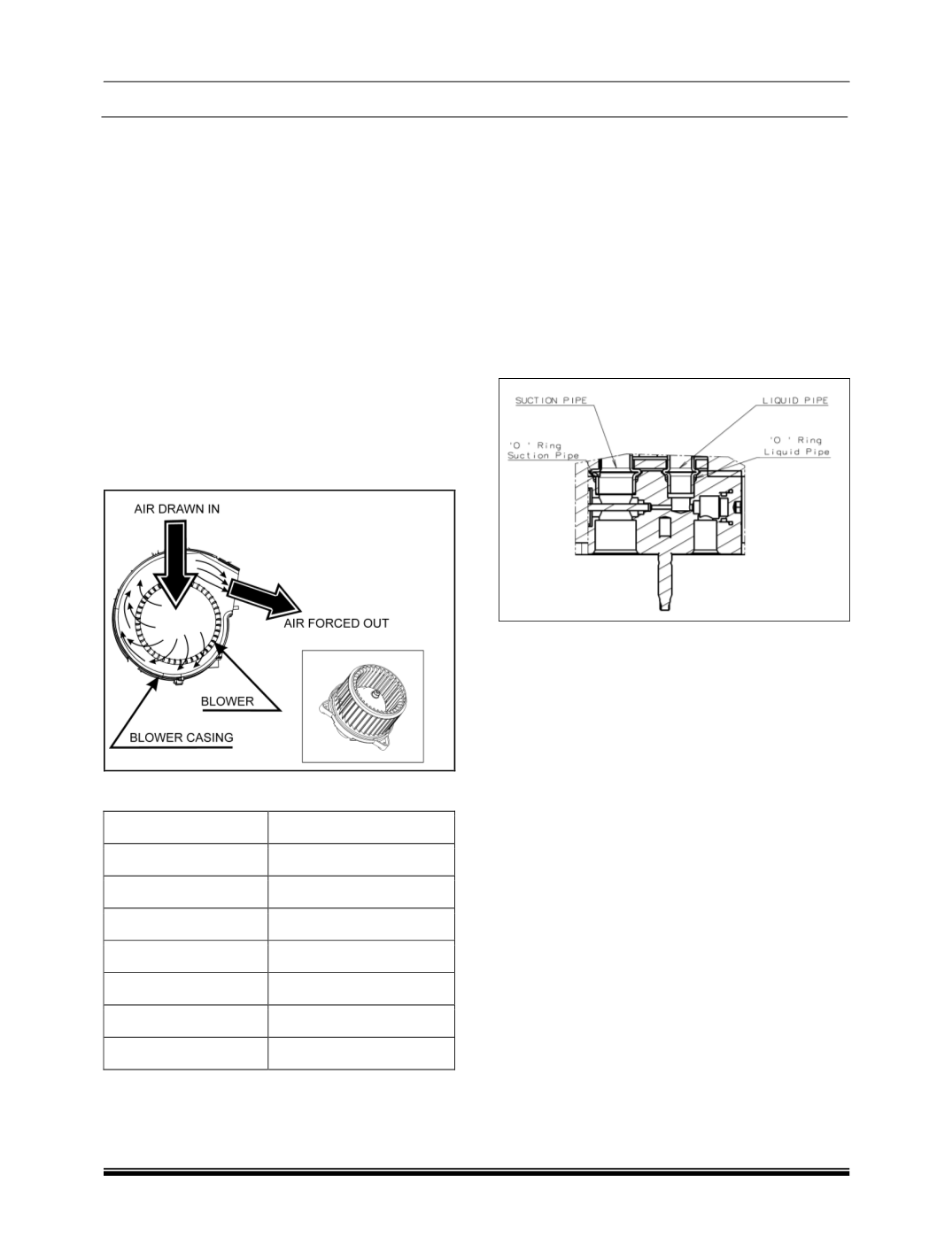
A. BLOWER:-
The Blower is located at the top on the backside of
HVAC unit when viewed from inside the vehicle. It
acts as a centrifugal pump drawing in air from the
center and pushing it out diagonally. The air flows
through the evaporator and the heater coil and then
to the cabin.
The Blower speed is controlled using a blower con-
trol module.
Blower Motor Specification
MAKE
GBM S SERIES
VOLTAGE
DC 12.5 V
CURRENT
21.6 A MAX
RATING TORQUE 0.45 Nm
RATING SPEED
3300 ± 200 rpm
RATING OUTPUT -
AIR FLOW
416 M3/HR
CLAMPING TORQUE TBD Nm
B. EVAPORATOR COIL AND TXV
(THERMAL
EXPANSION VALVE)
EVAPORATOR COIL
It is a heat exchanger cum dehumidifier which ab-
sorbs heat and moisture of the air passing through it
to give cold dehumidified air. As the refrigerant ab-
sorbs the heat it changes its state from liquid to
vapors. A thermistor (
temperature sensor)
is used to
measure the temperature of the air passing over the
evaporator in order to avoid freezing.
TXV (THERMAL EXPANSION VALVE)
The TXV used is block type valve. It consists of a
two passages one for refrigerant flowing into the
evaporator and the other for refrigerant coming out of
evaporator and into the compressor. A temperature
sensing element is placed in the outlet passage. This
sensing element is filled with a fluid which expands
and contracts when there is rise or fall in the temper-
ature. When the temperature of the refrigerant
flowing out of the evaporator rises it causes the ex-
pansion of the refrigerant in the sensing element
which in turn pushes the pin, such that the ball valve
blocking the orifice opens to allow more refrigerant
into the evaporator. The pressure spring provided
below the ball tends to close the ball valve and
hence this pressure has to be overcome in order to
open the valve.
There is a passage in the block valve where refriger-
ant flowing out can build pressure under a
diaphragm on which the sensing element is mounted
causing the diaphragm to move up; this provides the
needed pressure correction while regulating the re-
frigerant into the evaporator.
C. HEATER COIL
A heater coil is a radiator-like device used in heating
the cabin of a vehicle. Hot coolant
from
the vehicle's