




 852 / 924

FATC
24
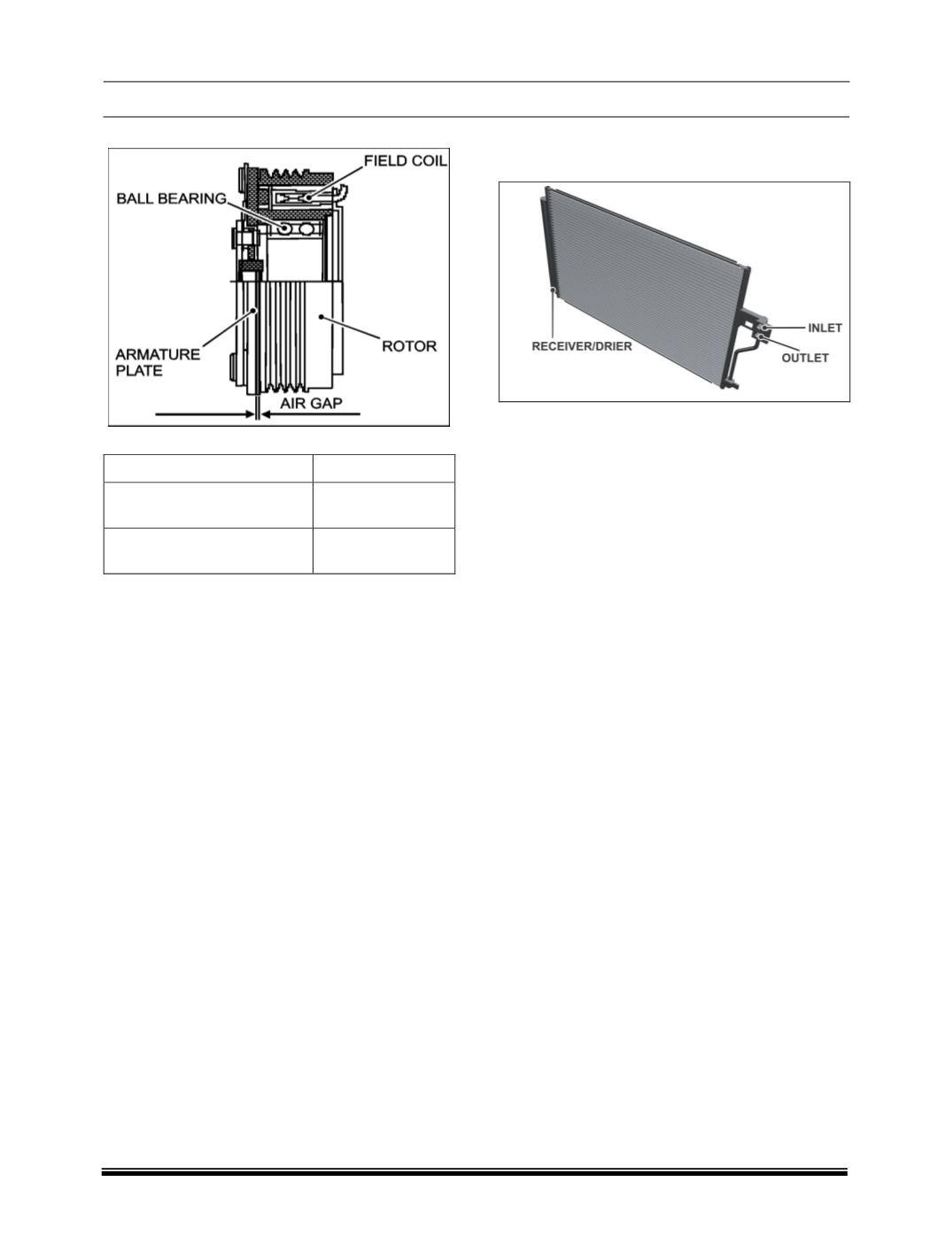
MAGNETIC CLUTCH
SPECIFICATION
NOMINAL VOLTAGE
DC12V
AIR GAP AT AMBIENT
TEMP 20º
0.4 to 0.8 mm
DIRECTIONOF ROTATION
(CLUTCH SIDE VIEW)
Clockwise
A magnetic clutch is used to connect and disconnect
the compressor from the engine.
Main components are stator, rotor, and pressure
plate.
PRINCIPLE
When the current is fed to the coil magnetic force is
generated in iron, which attracts any other iron.
CONSTRUCTION
A magnetic clutch consists of a stator, rotor with
pulley, and pressure plate to engage the drive pulley
and compressor magnetically. The stator is fixed on
the compressor housing, and the pressure plate is
attached to the compressor shaft. Two ball bearings
are used between the inner surface of the rotor and
the front housing of the compressor.
OPERATION
Whenever the engine is operating, the pulley is
rotating since it is connected to the crankshaft by a
belt, but the compressor does not operate until the
clutch is energized. When the air conditioning
system is switched ON, the ECU generates a signal
for energizing the compressor. The electromagnet
attracts the pressure plate and pulls the plate against
the friction facings on the pulley. The friction
between the facing and plate causes the clutch
assembly to rotate as a unit, and drive the
compressor.
12. CONDENSER AND RECEIVER DRIER
CONDENSER
CONDENSER
The condenser is a heat exchanger used to cool the
hot vapourised refrigerant. Also the refrigerant
changes its state from vapour to liquid. The
condenser is placed in front of the radiator behind
the radiator is the fan used to draw in ambient air.
CONDENSER SEALING DUCTS
Sealings are used to guide the flow of the air to the
condenser and also to avoid the hot air recirculating
from the engine compartment to the condenser.
RECEIVER DRIER (R.D)
The receiver drier is integrated into the Condenser
and has three main functions.
i) It absorbs the moisture in the refrigerant.
ii) It allows only liquid (
high pressure liquid)
to pass
through to the TXV.
It keeps a reserve of refrigerant to accommodate
fluctuating refrigerant requirements.