




 474 / 948

HVAC
39
d) REPLENISHING COMPRESSOR OIL
(a) While re-installing the Original Compressor
1. Drain and measure the refrigerant oil contained in
the compressor.
2. Charge oil through the discharge port of the com-
pressor with the same amount of new refrigerant
oil.
NOTE
If the amount of oil in the original compressor was
not checked, then approximately 70±10 ml. of new
oil should be added to the compressor being in-
stalled. (This is assuming the compressor being
installed has first been drained).
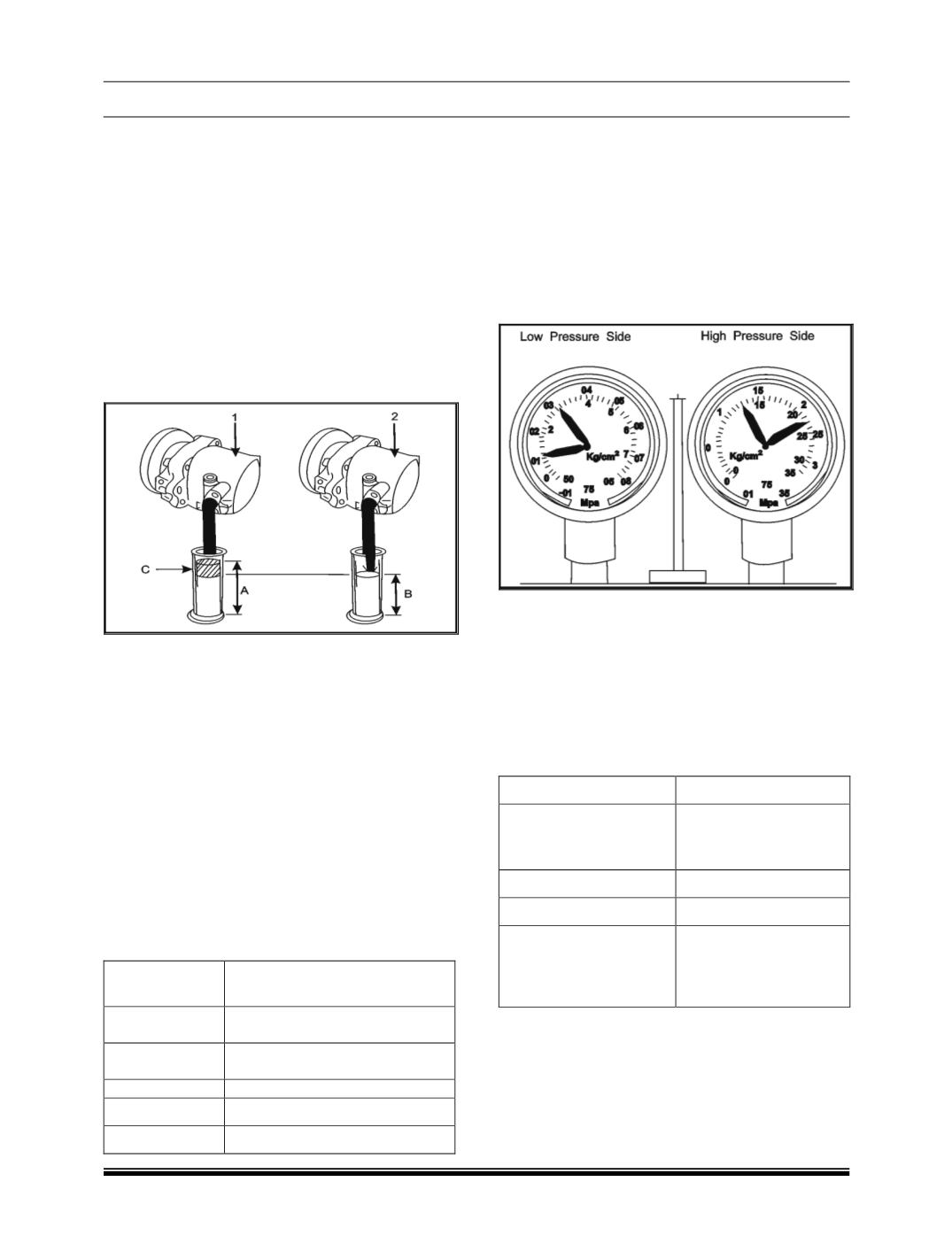
(b) While installing a New Compressor
A new compressor (1) comes with a certain amount
of oil (A) sealed in it. When replacing the old com-
pressor (2) with a new one; an amount of oil (C) as
calculated below should be drained from the new
compressor.
“C” = “A” -“B”
“C” = Amount of oil to be drained
“A” = Amount of oil sealed in a new compressor (1)
“B” = Amount of oil remaining in old compressor (2)
NOTE
As it is necessary to replenish oil by approximately
the same amount which is remaining in old compres-
sor, draining of additional oil from the New
Compressor becomes necessary.
Following table illustrates the amount of oil to
be replenished for respective HVAC/AC com-
ponents
Replaced part Amount of compressor oil to
be replenished (in CC)
Evaporator
(front)
25
Evaporator
(Rear)
20
Condenser
40
Hoses
10
Pipes
10
NOTE
When only charging refrigerant without replacing any
component, replenish the same amount of measured
oil when recovering refrigerant, if not measured, re-
plenish 30cc oil.
CAUTION:
Specify SP10 oil for compressor Top-Up.
e) PRESSURE TEST
USING
MANIFOLD
GAUGES
This is a method where trouble is detected and re-
paired by using manifold gauge. The manifold gauge
indicates the refrigeration cycle high and low pres-
sure side pressures on the respective gauge.
NOTE
Make sure following conditions are fulfilled before
getting the correct gauge readings (after engine has
warmed –up
)
Engine speed
1500rpm
A/C inlet temperature
(Ambient Temperature)
30° - 35° C (86° - 95°
F)
Blower speed
High
Temperature Control
Full cold
Reference value be-
fore AC operation at
both high and low
pressure sides
5-8 kg/ cm
2
(0.5 - 0.8
MPa)